No Group Can Occupy Demonstration Grounds Indefinitely: Supreme Court Rules Designated Sites Require Strict Time Limits
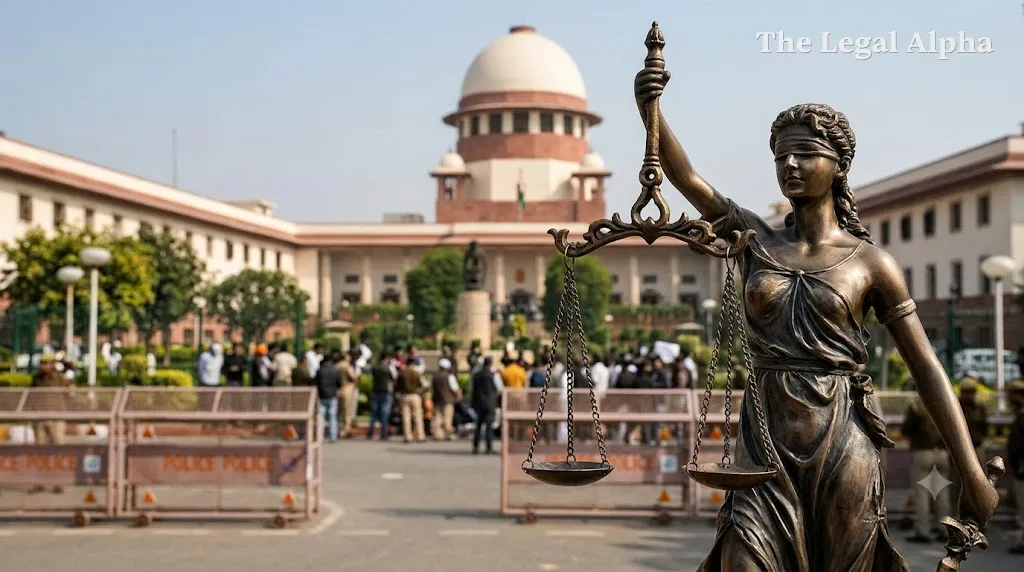
The Supreme Court of India observed that public demonstration grounds cannot be monopolised indefinitely by any single group, emphasising that even designated protest venues must operate under definite time boundaries.
A bench presided over by Chief Justice of India Surya Kant addressed the issue during proceedings arising out of prolonged demonstrations in Delhi. Local traders and commercial establishments approached the apex court complaining of severe economic disruption, roadblocks, and livelihood losses caused by extended sit-ins.
The Court pointed out that democratic rights belong equally to all citizens—including other prospective demonstrators such as farmers, trade unions, and professionals—meaning perpetual occupation by one faction deprives others of their constitutionally protected avenues of expression.
Legal Topic
Area of Law: Constitutional Law
Sub-topic: Fundamental Freedoms / Regulation of Assembly and Public Order
Core Legal Issue
The principal issue before the Court centres on whether the fundamental right to peaceful assembly includes the prerogative to continuously occupy designated demonstration venues, and how regulatory authorities must balance freedom of speech with the competing rights of the public to free movement and unhindered commerce.
Specifically, the Court examined whether public administrations possess the authority and duty to impose strict, time-bound permissions on protest grounds so that public spaces do not become permanent encampments.
What Did the Court / Authority Decide?
The Supreme Court issued notice on the traders' petition and directed the petitioners to implead the specific protest organizers as parties to the case.
The bench verbally observed that protest venues cannot be monopolised indefinitely and indicated that authorities must frame designated time allocations for demonstrations. The Court stressed that while peaceful agitation is a fundamental right, it cannot override the economic rights of local residents, daily wage earners, and business owners.
The proceedings remain pending, with the Court seeking formal responses from the Union Government and related administrative bodies before issuing final regulatory guidelines.
Key Legal Points
-
Public demonstration venues cannot be occupied on a perpetual basis; administrative clearances must stipulate definite, enforceable time durations.
-
The right to assemble peacefully under Article 19(1)(b) must coexist with the general public’s Article 19(1)(d) right to free movement and Article 21 livelihood protections for daily earners and traders.
-
Monopolising an agitation venue breaches the principle of equal access, effectively blocking other civic and professional groups from exercising their own democratic right to dissent.
-
Organisers calling public demonstrations bear direct accountability for adherence to permit durations and subsequent disruption to civil administration.
Relevant Law
-
Constitution of India, 1950:
-
Article 19(1)(a) – Freedom of speech and expression.
-
Article 19(1)(b) – Right to assemble peaceably and without arms.
-
Article 19(2) & 19(3) – Reasonable restrictions in the interests of public order and sovereignty.
-
Article 19(1)(d) & 19(1)(g) – Right to move freely throughout the territory of India and practice any profession, trade, or business.
-
Article 21 – Right to life and livelihood.
-
-
Judicial Precedent:
-
Amit Sahni v. Commissioner of Police (Shaheen Bagh Case, 2020) – Established that public roads and spaces cannot be blocked or occupied indefinitely for protests, and that dissent must take place only in designated areas.
-
Arguments of the Parties
Petitioners (Traders and Commercial Associations):
Counsel for the trading community argued that prolonged sit-ins completely throttle local commercial ecosystems. They contended that uninterrupted blockades undermine the fundamental right to livelihood of traders, street vendors, and daily wage labourers, turning designated public grounds into commercial no-go zones.
The Union Government:
Solicitor General Tushar Mehta submitted that permits are frequently granted for single-day gatherings, yet organizers routinely prolong sit-ins beyond authorized hours and attempt unauthorized marches toward high-security zones such as Parliament. The State maintained that organizers must face direct legal responsibility for deliberate overstays and ensuing civic disturbances.
Why Does It Matter?
This development clarifies the outer limits of permissible dissent under Indian constitutional jurisprudence. While previous apex court rulings prohibited blocking public thoroughfares, this matter turns attention directly to designated protest zones themselves.
If the Supreme Court formalises rules mandating time limits and organizer liability, municipal commissioners and police departments across India will gain clearer operational frameworks to revoke permissions, clear venues after allotted hours, and hold leadership committees financially and legally answerable for overstays. For businesses and local residents, it provides a judicial basis to resist prolonged public disruptions.
Legal Takeaway
The right to protest is an essential democratic guarantee, but it does not convey an entitlement to squat permanently at any public site. Agitations must be subject to clear temporal boundaries to protect the livelihoods of the surrounding community and preserve equal protest access for all citizens.
Sources
-
Primary Source: Supreme Court of India, Proceedings before the bench headed by Chief Justice of India Surya Kant (Hearing dated November 3, 2026).
-
Additional Sources: Bar & Bench; LiveLaw; Press Trust of India / National Law Reports.