Supreme Court Demands Answers Over Demonstrations on Court Premises and Bar Involvement
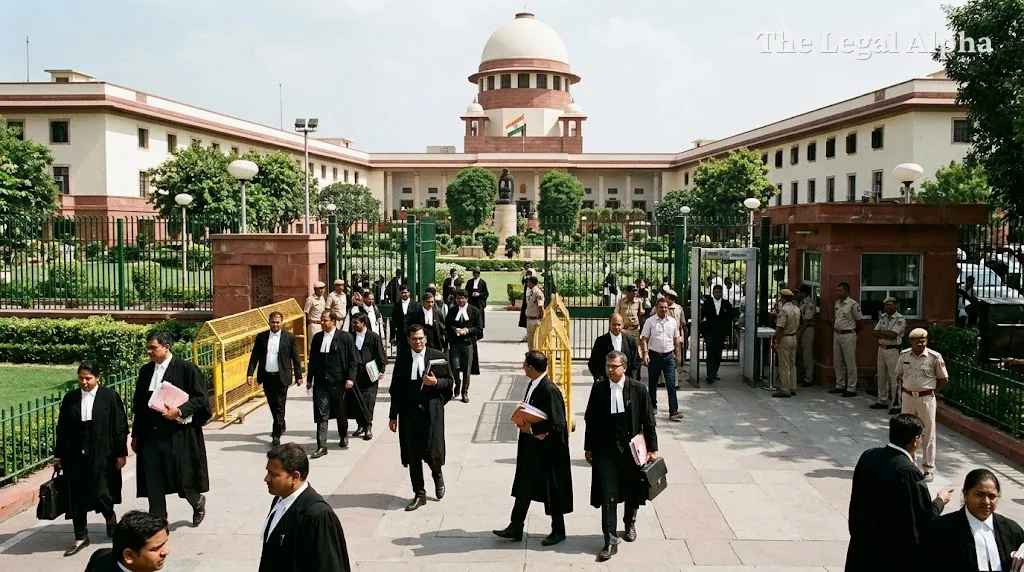
The Supreme Court of India raised serious concerns over demonstrations taking place directly within judicial precincts, taking note of allegations that members of the legal profession actively participated in the unrest. While presiding over a batch of petitions connected to widespread political rallies against Chief Election Commissioner Gyanesh Kumar and the Election Commission’s Special Intensive Revision (SIR) of electoral rolls, a three-judge bench expressed strong displeasure over the breach of institutional decorum. The development follows an October 12 political march towards the apex court that culminated in tense standoffs at nearby police barricades and unauthorized agitational activity inside the judicial complex.
Legal Topic
Area of Law: Constitutional Law & Professional Ethics
Sub-topic: Court Administration, Contempt Jurisdiction, and Regulation of Public Assemblies
Core Legal Issue
The controversy centres on the constitutional boundary between the fundamental right to peaceful protest and the institutional necessity of maintaining the sanctity, security, and administrative order of constitutional court premises.
The primary questions confronting the bench are whether political demonstrations can lawfully be extended into the immediate precincts of courtrooms, what regulatory frameworks must govern political gatherings around judicial hubs, and whether practising advocates violate their statutory duties as officers of the court by participating in demonstrations within the court complex.
What Did the Court / Authority Decide?
A three-judge bench led by Chief Justice of India Surya Kant determined that formal responses must be placed on record, observing that court facilities cannot be treated as arenas for agitational politics. The bench indicated it would issue notices to relevant respondents, including Union authorities, the Delhi Police, and political leaders named in the petitions.
While the court did not hand down a final ruling on the merits, it previously ordered law enforcement authorities to preserve digital evidence and CCTV footage from the protest sites. The bench is also actively entertaining procedural mechanisms—such as the potential formation of an all-women or predominantly female committee—to independently review allegations of sexual violence and harassment lodged by media personnel caught in the clampdown. The underlying petitions remain pending for substantive adjudication.
Key Legal Points
-
Advocates occupy a fiduciary role as officers of the court, raising serious disciplinary questions when members of the Bar participate in disruptive demonstrations on institutional premises.
-
The right to assemble peaceably under Article 19(1)(b) of the Constitution remains subject to reasonable restrictions under Article 19(3) regarding public order, security, and the unobstructed functioning of constitutional organs.
-
Comprehensive judicial guidelines may be framed to regulate assemblies in and around court complexes to safeguard institutional autonomy and litigant access.
-
State authorities are legally obligated to respect journalistic protections under the freedom of the press, with the judiciary supervising administrative compliance through evidentiary safeguards such as mandatory CCTV retention.
Relevant Law
-
Article 19(1)(a) and Article 19(1)(b) of the Constitution of India (Freedom of speech, expression, and peaceful assembly).
-
Article 19(2) and Article 19(3) of the Constitution of India (Reasonable restrictions in the interest of public order and institutional propriety).
-
Article 129 and Article 142 of the Constitution of India (Inherent powers of the Supreme Court as a court of record to regulate its own proceedings and ensure complete justice).
-
The Advocates Act, 1961 (Standards of professional conduct, decorum, and etiquette prescribed for Bar members).
-
Bar Council of India Rules, Part VI, Chapter II (Duties of an advocate toward the court).
Arguments of the Parties
Petitioners (Practising Advocates and Media Bodies)
The advocate-petitioners argued that unchecked political protests inside and directly around the Supreme Court disrupt institutional functioning, intimidate judicial visitors, and set an alarming precedent for legal administration. They sought enforceable regulatory directions and judicial scrutiny of the conduct of high-profile political figures. Concurrently, journalistic groups such as the Network of Women in Media, India, submitted that law enforcement officers subjected reporting staff—particularly women journalists—to excessive force, unlawful detention, physical intimidation, and assault, requiring strict judicial safeguards.
Respondents (Union Government and Law Enforcement)
Solicitor General Tushar Mehta submitted that the central government was finalizing its formal position and would place its detailed counter-affidavit on record. The authorities maintained that crowd-control measures, barricades, and transit restrictions near the court were deployed out of security necessity to manage large-scale marches, avert public disorder, and safeguard high-security zones from unauthorized mass entry.
Why Does It Matter?
This development highlights a critical institutional flashpoint regarding the limits of political agitation in judicial spaces. If the Supreme Court institutes binding guidelines for court perimeters, it will redefine how protests are handled near high-security public institutions nationwide. Moreover, by confronting the involvement of advocates, the court signals that bar membership cannot be used as a shield to bypass venue-specific security protocols or disrupt regular court functioning. At the same time, the parallel inquiry into police action offers an important opportunity to clarify operational protections for journalists covering public demonstrations.
Legal Takeaway
Public demonstrations and political protests cannot be conducted inside court premises, nor can judicial corridors be used as stages for agitational politics. Lawyers participating in disruptive protests within court facilities face potential disciplinary scrutiny under statutory bar regulations and judicial decorum standards.
Sources
Primary Source:
Supreme Court of India Proceedings, Three-Judge Bench presided over by Chief Justice of India Surya Kant (Hearing dated November 3, 2026).
Additional Sources:
Public interest litigation filed by the Network of Women in Media, India, and advocate petitions regarding courtroom security regulation; Official representations before the Supreme Court of India.