Right to Protest Under Scrutiny: Delhi High Court Moved Against Police Order Ending Jantar Mantar as Agitation Site
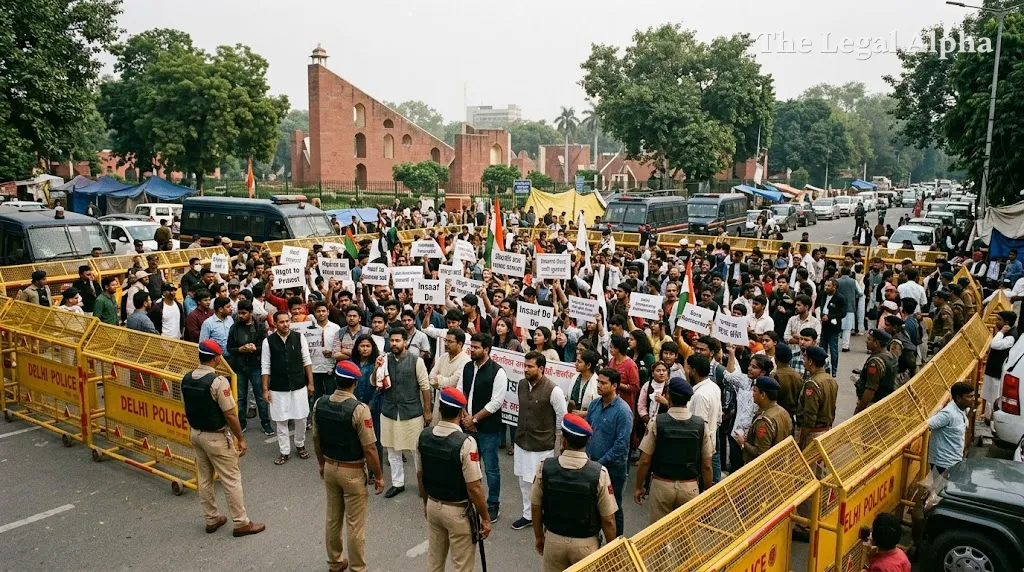
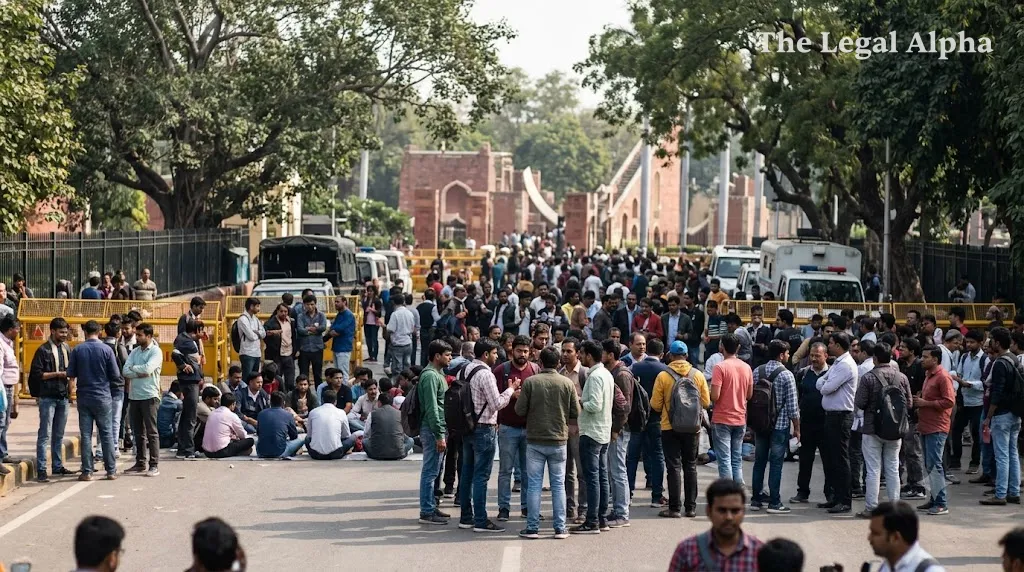
The Indian Youth Congress (IYC), through its national president Uday Bhanu Chib, approached the Delhi High Court to challenge the Delhi Police's decision to strip Jantar Mantar of its decades-old status as an official protest venue.
The move comes via a fresh interlocutory application within an ongoing writ petition originally filed by Chib. The petitioner had initially approached the High Court to challenge the police's refusal to grant permission for a peaceful demonstration at Jantar Mantar. However, following the Delhi Police Commissioner's standing order dated October 11, which formally denotified Jantar Mantar and relocated designated demonstrations to alternative venues—such as Ramlila Ground, Burari Ground, and the CBD Ground in East Delhi—the petitioner expanded the challenge to target the blanket denotification order itself.
Legal Topic
Area of Law: Constitutional Law / Administrative Law
Sub-topic: Fundamental Freedoms / Regulation of Public Assembly and Dissent
Core Legal Issue
The core legal question centers on whether an administrative authority can invoke its regulatory powers over public order and traffic management to execute a blanket exclusion of historical, centrally located public venues for peaceful assembly. Specifically, the High Court is asked to examine whether shifting civic protests away from the democratic core of the capital to peripheral or alternative venues imposes an unreasonable restriction on citizens' constitutional freedoms under Article 19(1)(a) and Article 19(1)(b) of the Constitution of India.
What Did the Court / Authority Decide?
The matter remains pending adjudication.
During recent hearings arising from the dispute over protest denial, the Delhi High Court issued notice on the petitioner’s plea contesting the arbitrary rejection of permissions. While police authorities maintained that the core petition had become infructuous following the formal denotification of the venue on October 11, the court declined to dismiss the challenge outright, keeping the proceedings alive and listing the matter for substantive hearing in mid-November.
The new application directly challenging the validity of the October 11 denotification standing order will now be considered alongside the broader challenge to Delhi Police’s protest regulatory framework.
Key Legal Points
-
Scope of Regulatory Discretion: The court must evaluate whether the executive power to regulate the time, place, and manner of assemblies can legally stretch into an effective complete prohibition at historic public demonstration hubs.
-
Doctrine of Proportionality: Administrative curbs on assembly must demonstrate that the least restrictive measure was chosen to address public order or security concerns, rather than resorting to an outright venue ban.
-
Meaningful Assembly: The challenge revives legal scrutiny over whether geographic accessibility to government centers is an essential component of the constitutional right to express dissent and hold authorities accountable.
Relevant Law
-
Constitution of India:
-
Article 19(1)(a) (Freedom of speech and expression)
-
Article 19(1)(b) (Right to assemble peaceably and without arms)
-
Article 19(2) and Article 19(3) (Permissible grounds for reasonable restrictions on fundamental freedoms)
-
Article 14 (Protection against arbitrary and discriminatory administrative action)
-
-
Delhi Police Act, 1978: Provisions empowering the Commissioner of Police to regulate public assemblies, processions, and maintain public order.
-
Judicial Precedents: Mazdoor Kisan Shakti Sangathan (MKSS) v. Union of India (2018), where the Supreme Court directed authorities to frame balanced guidelines facilitating peaceful protests at Jantar Mantar while addressing local residents' environmental and noise concerns.
Arguments of the Parties
Petitioner
The petitioner argued that the administration’s power to regulate peaceful demonstrations cannot be weaponized to effectively extinguish them. Counsel submitted that relocating protests away from Jantar Mantar to peripheral locations undermines the very essence of public demonstrations, which rely on visibility to government institutions to convey grievances. It was further contended that the blanket order lacked an individualized and proportionate assessment and arbitrarily infringed upon fundamental rights guaranteed under Articles 14, 19(1)(a), and 19(1)(b).
Respondent / State
The Delhi Police contended that the measure was introduced in alignment with judicial directions and sound administrative governance concerning law and order, security, and traffic management in the high-security Central Vista zone. The authorities submitted that peaceful assembly has not been prohibited, as adequate alternative designated sites—such as Ramlila Ground, Burari Ground, and East Delhi’s CBD Ground—have been made available to facilitate public gatherings without disrupting essential civic movement.
Why Does It Matter?
This legal battle carries broad ramifications for democratic civic space across India. For over three decades, Jantar Mantar served as the de facto epicenter of citizen activism, civil society demonstrations, and political opposition rallies due to its proximity to Parliament and central ministries.
If upheld, the relocation of designated protest zones to distant urban fringes could establish an administrative precedent for municipal and police authorities across other states to banish public demonstrations from city centers. Conversely, a judicial intervention could reinforce the principle that the right to protest encompasses not merely the freedom to gather, but the right to do so within sight and sound of the authorities being addressed.
Legal Takeaway
The dispute underscores that the constitutional right to peaceful assembly cannot be rendered nominal by moving demonstrations out of sight. Any administrative measure regulating protest venues must withstand the test of proportionality, ensuring that public order concerns do not overshadow the constitutional guarantee to express public dissent effectively.
Sources
Primary Sources:
-
High Court of Delhi: Uday Bhanu Chib v. Union of India & Ors. (Writ Petition & Interlocutory Application)
-
Delhi Police Standing Order / Notification dated October 11, denotifying Jantar Mantar as a protest site
Additional Sources:
-
Official reporting and proceedings coverage via Press Trust of India (PTI) and Asian News International (ANI)
-
Case tracking and legal updates reported by LawBeat and The Print