Pricing Transparency Under Judicial Lens: Supreme Court Scrutinises Private Healthcare Billing and Statutory Non-Compliance
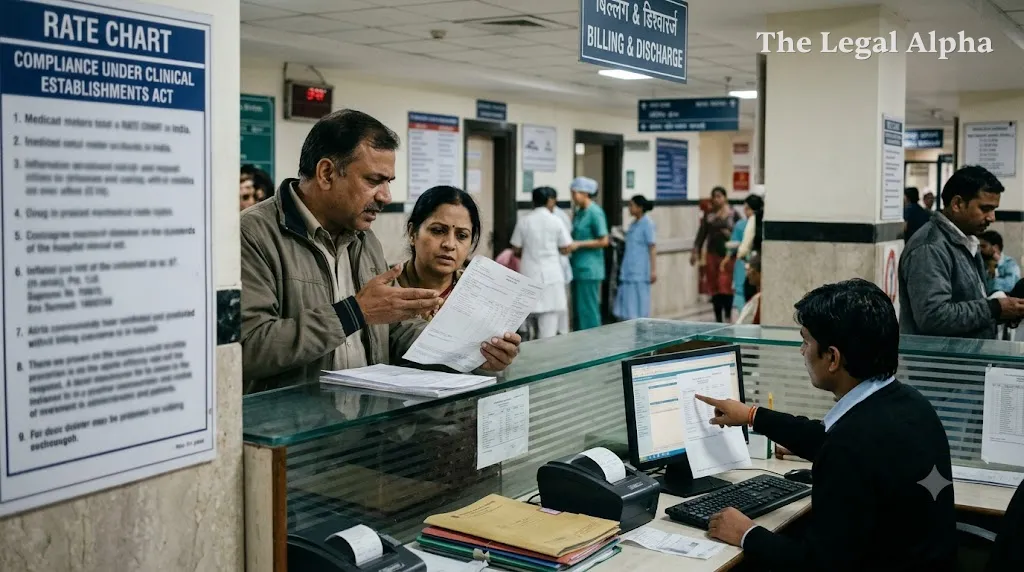
The Supreme Court of India has intensified its scrutiny over private clinical establishments charging excessive, opaque, and highly inflated medical fees to inpatient consumers. Responding to ongoing public interest litigation highlighting predatory pricing practices, the Union Government—through the Ministry of Health and Family Welfare—issued strict compliance directives ordering all private and public healthcare facilities to prominently display comprehensive rate charts across premises in English and regional languages.
The action follows judicial observations highlighting significant markups on unregulated consumables, procedural tariffs, and non-scheduled medicines. During proceedings, the Union Government conceded that systemic enforcement loopholes persist in managing private medical charges and pledged immediate corrective administrative measures.
Legal Topic
-
Area of Law: Healthcare Law / Administrative & Consumer Law
-
Sub-topic: Regulation of Clinical Establishments, Price Transparency, and Fundamental Rights under Public Health
Core Legal Issue
The primary legal issue is whether the Union and State governments have failed to enforce their statutory mandate under the Clinical Establishments (Registration and Regulation) Act, 2010—specifically Rule 9 of the Clinical Establishments (Central Government) Rules, 2012—which requires clinical establishments to charge rates within a determined range and prominently display treatment costs.
A secondary constitutional question is whether commercial pricing exploitation and a lack of tariff transparency in life-saving private care violate a citizen's fundamental Right to Health and Life under Article 21 of the Constitution of India.
What Did the Court / Authority Decide?
While the substantive petition remains pending final adjudication, the apex court issued decisive interim directives:
-
The Supreme Court cautioned the executive that if the Central and State governments failed to coordinate and notify standardized treatment tariffs, the Court would consider applying Central Government Health Scheme (CGHS) rates uniformly across private facilities as an interim benchmark.
-
In response to the Court's stance, the Union Ministry of Health and Family Welfare directed State Chief Secretaries to mandate that all clinical establishments immediately publish conspicuous rate schedules covering room tariffs, consultation fees, diagnostic investigations, and surgical packages.
-
The National Pharmaceutical Pricing Authority (NPPA) and the Department of Pharmaceuticals were tasked with reviewing enforcement mechanisms concerning consumables and formulations to curb artificial billing inflations.
-
The broader mechanism for fixing standardized cost ranges across diverse geographic zones remains pending further consultation between the Centre and the States.
Key Legal Points
-
Statutory Obligation of Tariff Display: Rule 9 of the Clinical Establishments (Central Government) Rules, 2012 obligates registered establishments to conspicuously display treatment rates and provide advance cost estimations to patients or attendants.
-
Enforceability of Constitutional Guarantees: Private healthcare operations are held accountable under the expansive interpretation of Article 21, establishing that access to fair and non-exploitative medical treatment forms an integral facet of the Right to Life.
-
Federal Regulatory Friction: Public health falls under Entry 6 of the State List in the Seventh Schedule, meaning Central legislation such as the Clinical Establishments Act requires state-level adoption and implementation to achieve uniform enforcement.
-
Regulatory Gap on Consumables: While scheduled formulations are strictly capped under the Drugs (Prices Control) Order (DPCO), medical consumables, disposables, and non-scheduled devices lack comparable price controls, allowing captive hospital pharmacies to bill upcharges ranging upwards of 40%.
Relevant Law
-
Article 21 of the Constitution of India: Right to Life and Personal Liberty, expanded to guarantee access to healthcare and non-exploitative medical services.
-
Clinical Establishments (Registration and Regulation) Act, 2010: Section 11, Section 12, and Section 49 concerning registration conditions, standard-setting, and administrative powers to issue directions.
-
Clinical Establishments (Central Government) Rules, 2012 (Rule 9): Prescribes conditions for charging rates within determined ranges and displaying price charts prominently.
-
Drugs (Prices Control) Order, 2013 (DPCO): Issued under Section 3 of the Essential Commodities Act, 1955, governing ceiling prices for National List of Essential Medicines (NLEM) formulations.
-
Paschim Banga Khet Majoor Samity v. State of West Bengal (1996) 4 SCC 37: Foundational precedent affirming that preserving human life is an absolute constitutional obligation of a welfare state.
Arguments of the Parties
Petitioner / Public Interest Litigants
The petitioners submitted that private hospitals routinely levy unchecked, arbitrary markups on consumables, basic diagnostic tests, and tiered bed categories, effectively weaponising emergencies against vulnerable families. They argued that the Union Government’s prolonged failure to notify standardized rate brackets under the Clinical Establishments Act leaves consumers without statutory safeguards, rendering the constitutional guarantee under Article 21 illusory.
Union of India and Regulatory Authorities
The Union Government contended that public health is constitutionally a State subject, requiring individual State legislatures to adopt and enforce regulatory frameworks locally. While acknowledging existing pricing loopholes and the disproportionate markup on consumables, the Solicitor General submitted that the executive is actively coordinating with State administrations to enforce mandatory price disclosures without crippling private sector viability or clinical discretion.
Why Does It Matter?
This development marks a decisive shift from self-regulation in private clinical operations to judicial and administrative price governance. For ordinary citizens and health insurance policyholders, upfront price disclosure strips away the opacity surrounding captive pharmacy charges, procedural packages, and unexpected ancillary add-ons.
For the healthcare sector, it signals increased compliance risks. Hospitals that rely on substantial trade margins on unlisted consumables to subsidise operations face mounting regulatory audits and potential sanctions. More broadly, it tests the limits of cooperative federalism, probing whether the Centre can compel uniform healthcare billing standards across States that possess primary legislative competence over medical institutions.
Legal Takeaway
Private healthcare providers do not operate outside constitutional boundaries, and statutory mandates requiring clear rate displays are enforceable legal obligations. The apex court's intervention establishes that healthcare commercialisation cannot override consumer transparency, making transparent pricing and standardized tariff adherence a critical compliance priority for medical establishments nationwide.
Sources
Primary Source:
-
Veterans Forum for Transparency in Public Interest v. Union of India, Writ Petition (Civil) No. 648/2020 (Supreme Court of India).
-
Union Ministry of Health and Family Welfare Directive on Clinical Establishments Rate Display Compliance (October 2026).
-
The Clinical Establishments (Registration and Regulation) Act, 2010 (Act No. 23 of 2010) and Central Rules, 2012.
Additional Sources:
-
Financial Express Report: Inflated hospital bills: SC scrutiny & state audits expose huge upcharges (October 2026).
-
Parliamentary Standing Committee on Health and Family Welfare (176th Report on Healthcare Costs and Private Establishments).