Press Freedom vs Data Privacy: Supreme Court Seeks Centre's Response on Media Challenge to DPDP Act
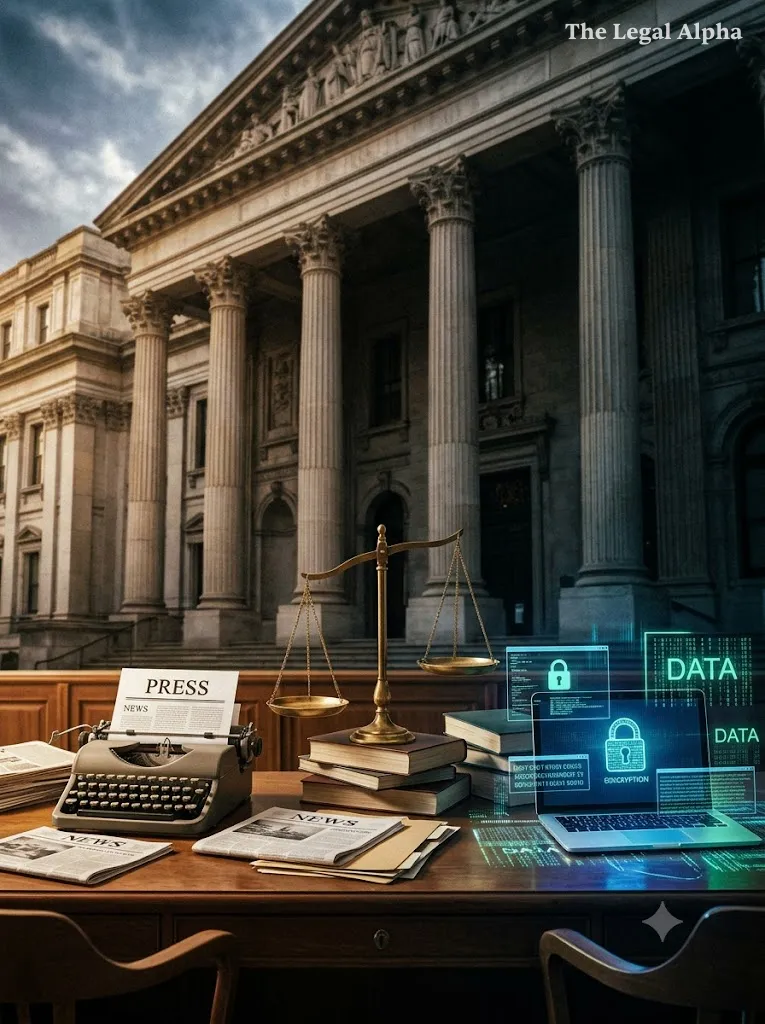
The Supreme Court of India issued formal notice to the Central Government on a constitutional writ petition filed by the Digital News Publishers Association (DNPA). The association, representing prominent print and digital media houses across the country, has challenged core provisions of the Digital Personal Data Protection Act, 2023 (DPDP Act) and the DPDP Rules, 2025.
The publishers contend that subjecting journalism to rigid statutory consent frameworks, data erasure mandates, and heavy financial penalties without a clear journalistic exemption threatens day-to-day newsroom operations and infringes on the constitutional guarantee of press freedom.
Legal Topic
-
Area of Law: Constitutional Law / Information Technology Law
-
Sub-topic: Press Freedom, Digital Privacy, and Intermediary Regulation
Core Legal Issue
The constitutional petition requires the Court to evaluate whether the DPDP Act and its delegated rules impose an unconstitutional chilling effect on freedom of the press under Article 19(1)(a) of the Constitution.
Specifically, the Court must decide whether treating investigative and conventional news publishers as standard "Data Fiduciaries"—obligated to provide notice, secure data principal consent, and erase published or archived news items upon request—amounts to an unreasonable restriction that cannot be justified under the narrow exceptions of Article 19(2).
What Did the Court Decide?
A bench headed by Chief Justice of India Surya Kant issued notice on the main petition as well as on the application for interim stay.
The bench declined to grant an immediate, ex parte interim stay on the operation of the statutory provisions, maintaining that the Union of India must be heard before any coercive or staying orders are passed. Chief Justice Kant observed that a constitutional balance must be drawn between an individual’s privacy rights and the press's ability to report freely. The Court also inquired how digital news organisations propose to self-regulate while handling sensitive individual data. The matter is scheduled for further hearing on November 17.
Key Legal Points
-
Absence of Statutory Journalistic Shield: Unlike data privacy frameworks in foreign jurisdictions and earlier statutory drafts, the DPDP Act, 2023 omits an explicit primary statutory exemption for journalistic, literary, and academic processing.
-
No Ex Parte Interim Relief Against Primary Legislation: The Supreme Court reaffirmed the established legal doctrine that parliamentary enactments carry a presumption of constitutionality, refusing to stay statutory provisions without first examining the government's counter-affidavit.
-
Balancing Competing Fundamental Rights: The proceedings place Article 19(1)(a) (freedom of speech and press) in direct friction with Article 21 (right to privacy as established in Puttaswamy), requiring the judiciary to calibrate proportionate boundaries between both fundamental rights.
-
Scrutiny of Self-Regulation Mechanisms: The bench placed an onus on digital publishers to substantiate how newsrooms safeguard non-consensual personal data and avoid privacy violations through internal oversight bodies.
Relevant Law
-
Constitution of India:
-
Article 19(1)(a) (Freedom of speech and expression, encompassing press freedom)
-
Article 19(2) (Permissible reasonable restrictions)
-
Article 21 (Protection of life and personal liberty, including informational privacy)
-
-
Statutory Provisions:
-
Digital Personal Data Protection Act, 2023 (provisions governing consent, notice, data erasure, and fiduciaries)
-
Section 17, DPDP Act (Exemptions framework left to executive notification)
-
Digital Personal Data Protection Rules, 2025
-
-
Judicial Precedents:
-
Justice K.S. Puttaswamy (Retd.) v. Union of India (2017) (establishing the fundamental right to privacy and the four-fold proportionality test)
-
Bennett Coleman & Co. v. Union of India (1972) (safeguarding press freedom against indirect legislative curbs)
-
Arguments of the Parties
Petitioner (Digital News Publishers Association)
-
The association argued that requiring journalists to obtain prior consent from individuals before publishing news, investigative reports, or historical facts fundamentally subverts the very nature of news gathering.
-
Counsel submitted that without a statutory journalistic exemption, provisions permitting individuals to seek the erasure of published archives create an indirect censorship regime and expose media houses to massive compliance penalties.
-
The petitioners maintained that leaving news exemptions entirely to executive discretion under delegated legislation undermines the independence of the fourth estate.
Respondent (Union of India)
-
While formal replies are pending, the statutory scheme of the DPDP Act rests on the mandate to protect the informational privacy of data principals and prevent unauthorized processing of personal records.
-
The statutory framework empowers the Central Government under Section 17 to notify specific classes of data fiduciaries or purposes for exemption, arguing that privacy protections must remain comprehensive rather than creating blanket unregulated exclusions.
Why Does It Matter?
This litigation marks the first major constitutional challenge brought by the media against India's data protection regime. If newsrooms are subjected to strict consent and erasure obligations, investigative reporting—such as exposés on corruption, financial misconduct, and public accountability—could become legally unviable, as subjects could withhold consent or demand retroactive deletion of public records.
The Supreme Court’s eventual ruling will define the legal boundary where personal data rights end and the public’s right to know begins, setting precedent for digital archives, journalistic privilege, and the autonomy of independent media in the digital age.
Legal Takeaway
The Supreme Court has formally initiated judicial review of the DPDP Act's impact on journalism, refusing immediate interim stays while seeking the Centre's response on whether digital media can function under statutory data processing mandates. For legal and corporate observers, the case will determine whether journalistic activities require an express statutory carve-out to survive constitutional scrutiny under Article 19(1)(a).
Sources
-
Primary Source: Supreme Court of India, Proceedings in Digital News Publishers Association v. Union of India (Hearing dated October 27, 2026, Bench led by Chief Justice Surya Kant).
-
Additional Sources: The Digital Personal Data Protection Act, 2023; DPDP Rules, 2025; Reference reports by The Statesman and LawChakra.