Precedent Cannot Substitute for Admitted Evidence: Florida Appellate Bench Strikes Down Spousal Support Award Following 249-Day Marriage
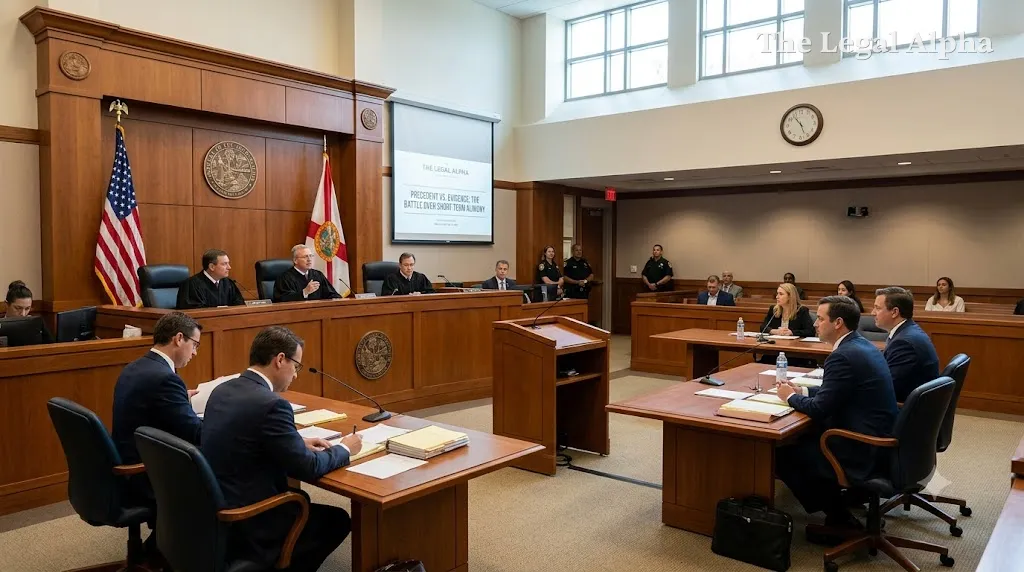
Florida’s Fifth District Court of Appeal vacated a spousal maintenance directive ordering a former husband to disburse $2,675.87 per month following the dissolution of a 249-day marriage. The dispute originated in the Circuit Court for Marion County, where the trial judge dissolved the brief, child-free union between Syed Imran Ali and Saba Shoukat.
Alongside entering the divorce decree, the lower bench granted Shoukat nine months of "bridge-the-gap" alimony. Because the former wife presented minimal evidence at trial regarding the duration of her financial need—testifying only that she required funds for several months—the trial court relied on historical case law to calculate a nine-month payment window. Ali appealed the maintenance award, equitable distribution, and attorney fees. The appellate panel ruled that legal precedent cannot fill factual voids in an evidentiary record, reversing the financial support mandate in its entirety.
Legal Topic
-
Area of Law: Family Law
-
Sub-topic: Bridge-the-Gap Alimony / Evidentiary Burden of Proof
Core Legal Issue
The central inquiry before the appellate court was whether a trial court may determine the duration and necessity of bridge-the-gap alimony by analogizing to prior judicial precedents when the party seeking support fails to introduce concrete factual evidence detailing specific, quantifiable short-term needs and a definite timeline.
Under Florida statutory standards, spousal assistance designed for transitional periods requires identifiable financial requirements. The court examined whether judicial discretion allows a judge to craft a support timeframe by looking at outcomes in past decisions rather than proof entered directly onto the record during trial.
What Did the Court Decide?
The Fifth District Court of Appeal reversed the portion of the final judgment granting bridge-the-gap alimony and remanded the matter to the Marion County Circuit Court with direct instructions to vacate the financial award.
The court held that Shoukat failed to sustain her statutory burden of establishing both the precise nature and duration of her transitional needs. While the circuit judge turned to historical appellate decisions to justify a nine-month payout period, the appellate panel held that judicial precedent cannot serve as a proxy for admitted testimony or tangible financial documentation. The panel affirmed the trial court’s remaining rulings regarding property division and attorney fees without additional comment.
Key Legal Points
-
Evidentiary Threshold: The party petitioning for spousal maintenance bears the foundational burden under Florida law to affirmatively establish actual financial need as well as the opposing party's ability to satisfy those demands.
-
Statutory Nature of Bridge-the-Gap Support: Bridge-the-gap awards are strictly limited to assisting an individual during the concrete transition from married to single life and mandate identifiable, non-speculative short-term requirements.
-
Limits of Judicial Precedent: Prior case law assists courts in understanding statutory interpretation, but trial judges cannot import factual timelines from historical rulings to cure an evidentiary deficit at trial.
-
Insufficiency of Vague Testimony: Generalized assertions regarding a desire for financial help over an indefinite period of "several months" do not supply an adequate record to justify structured maintenance orders.
Relevant Law
-
Florida Statutes § 61.08(2)(a): Establishes the burden on the moving party to demonstrate individual financial need and the payor's financial ability.
-
Florida Statutes § 61.08(6): Governs bridge-the-gap alimony, limiting support to legitimate, identifiable short-term needs for a duration not exceeding two years.
-
Murray v. Murray, 374 So. 2d 623 (Fla. 4th DCA 1979): A historical ruling involving a short-term marriage where maintenance was altered on review; distinguished by the appellate bench as inapplicable to supply missing trial evidence.
-
Saario v. Tiller, 333 So. 3d 315 (Fla. 5th DCA 2022): Sets out the abuse of discretion standard and required statutory evaluations for spousal support awards.
Arguments of the Parties
Appellant (Syed Imran Ali) Represented by appellate counsel, Ali argued that the circuit court committed reversible error by awarding bridge-the-gap maintenance in the absence of competent, substantial evidence showing identifiable short-term needs. He contended that the trial court abused its discretion by looking outside the trial record and relying on distinct, decades-old case law to establish the duration of the financial support obligation.
Appellee (Saba Shoukat) Shoukat did not enter an appearance, retain appellate representation, or submit an answer brief before the Fifth District Court of Appeal. At the trial bench, she had testified generally that she would lack independent financial support for several months following the separation and requested a lump-sum transitional contribution.
Why Does It Matter?
This ruling reinforces the rigorous evidentiary standards governing post-dissolution financial obligations. With Florida's modern spousal support framework placing greater emphasis on formulaic caps, defined terms, and the elimination of open-ended remedies, this decision makes it clear that short-duration marriages carry strict scrutiny.
Trial courts frequently seek equitable solutions when parties experience sudden economic shifts, but this decision restricts lower benches from bridging gaps in testimony through comparative analogies to external case law. For family law litigators and litigants, the holding underlines that asserting broad economic insecurity is insufficient; every request for bridge-the-gap support must be accompanied by an itemized accounting of transitional costs and a proven, specific timeline.
Legal Takeaway
A party petitioning for bridge-the-gap alimony must provide direct, competent evidence demonstrating the exact nature and expected timeline of their transitional financial needs. Trial judges cannot look to historical case law to establish how long payments should last when the evidentiary record itself fails to prove that timeline.
Sources
Primary Source:
-
Syed Imran Ali v. Saba Shoukat, Case No. 5D2025-1410 (Fla. 5th DCA Oct. 16, 2026) (Opinion by Soud, J.; Boatwright and Kilbane, JJ., concurring).
Additional Sources:
-
Florida Statutes § 61.08 (Spousal Support and Maintenance Framework).
-
Murray v. Murray, 374 So. 2d 623 (Fla. 4th DCA 1979).