Polish Presidency Has No Power to Veto Constitutional Tribunal Judges, Legal Lawmakers Assert
A severe constitutional impasse escalated in Warsaw following declarations by European Parliament lawmaker and rule of law attorney Michał Wawrykiewicz, who publicly emphasized that the President of Poland possesses no constitutional competence to appoint or reject judges of the Constitutional Tribunal.
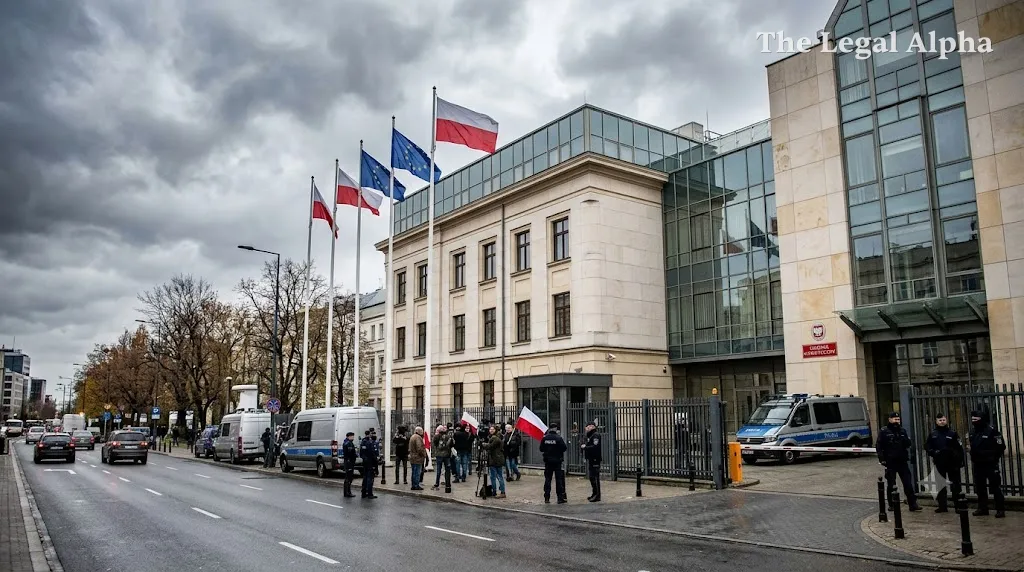
The statement follows a dramatic confrontation at Poland’s apex constitutional court. On October 30, 2026, Constitutional Tribunal judge Anna Korwin-Piotrowska issued an extraordinary order declaring the suspension of the court’s president, Bogdan Święczkowski, and vice-president, Bartłomiej Sochański. The suspension followed months of deadlock after the lower house of parliament (the Sejm) elected new judges to vacant seats on the 15-member tribunal, only for President Karol Nawrocki to refuse to administer the required oaths to the majority of them. When tribunal leadership prevented the parliament-elected judges from taking up their adjudicative duties, Korwin-Piotrowska assumed acting leadership under emergency necessity, prompting protests, police deployment around the court headquarters, and allegations of unconstitutional overreach from the presidential palace.
Legal Topic
Area of Law: Constitutional Law
Sub-topic: Separation of Powers / Prerogatives of the Head of State and Constitutional Appointments
Core Legal Issue
The primary constitutional question centers on whether the President of Poland possesses any substantive or discretionary authority to veto, refuse, or delay the swearing-in of judges elected by the Sejm to the Constitutional Tribunal, or whether the presidential function is strictly ministerial.
Under Polish constitutional doctrine, there is a fundamental distinction between the appointment of ordinary court judges and the selection of Constitutional Tribunal judges. The legal controversy asks whether a head of state can unilaterally block the lawful composition of the constitutional court by refusing to administer oaths, and conversely, whether internal members of the court can invoke statutory mechanisms from ordinary courts to suspend leadership that refuses to seat parliamentary appointees.
What Did the Court / Authority Decide?
While the broader institutional clash remains unresolved and politically contested, recent legal determinations have crystallized the operational dispute:
-
Acting Leadership Order: Judge Anna Korwin-Piotrowska declared the temporary removal from duties of President Bogdan Święczkowski and Vice-President Bartłomiej Sochański, convening an emergency General Assembly of the Constitutional Tribunal to address administrative operations and the tribunal's budget.
-
Prosecutorial Action: Poland’s Minister of Justice and Prosecutor General moved to formally request the waiver of immunity for the contested tribunal leadership in connection with the obstruction of constitutional bodies.
-
European Court Interventions: The European Court of Human Rights had previously issued interim measures and binding judgments directing Polish authorities to eliminate all institutional obstacles preventing legitimately elected Sejm nominees from exercising their judicial duties.
-
Pending Status: President Karol Nawrocki has declined to recognize the validity of the leadership suspension, denouncing the police cordon and acting administration as unlawful. The legal status of the internal orders and the eventual seating of the disputed judges remain pending amid intense political division.
Key Legal Points
-
Exclusive Parliamentary Prerogative: Unlike ordinary judges who are appointed by the President upon nomination by the National Council of the Judiciary, judges of the Constitutional Tribunal are elected exclusively and individually by the Sejm under Article 194(1) of the Polish Constitution.
-
Nature of Presidential Oath-Taking: Polish jurisprudence and leading constitutional scholars have established that administering the oath of office to a Constitutional Tribunal judge is a mandatory constitutional duty of the President, not a discretionary prerogative.
-
Dispute Over Extraordinary Powers: The invocation of Article 130 of the Law on the System of Ordinary Courts to suspend Constitutional Tribunal leaders remains legally controversial, as statutory powers designed for regular courts do not automatically map onto an independent constitutional organ.
-
Institutional Continuity vs. Legality: The standoff illustrates the deep tension between preserving the procedural continuity of state organs and dismantling appointments made under disputed legislative frameworks.
Relevant Law
-
Article 194(1) of the Constitution of the Republic of Poland: Mandates that the Constitutional Tribunal consists of 15 judges chosen individually by the Sejm for a nine-year term from among persons distinguished by legal knowledge.
-
Article 179 of the Constitution of the Republic of Poland: Governs the appointment of ordinary and administrative judges by the President, contrasting sharply with the tribunal’s election mechanism.
-
Article 130 of the Act of 27 July 2001 – Law on the System of Ordinary Courts: Provides emergency suspension mechanisms for court leaders, invoked analogously during the current tribunal impasse.
-
Act of 30 November 2016 on the Organization and Proceedings Before the Constitutional Tribunal: Sets out the statutory governance and internal rules of procedure for the apex constitutional body.
-
Article 6 of the European Convention on Human Rights (Right to a Fair Trial): Establishes that tribunals must be established by law, an issue central to international rulings on Poland's judicial restructuring.
Arguments of the Parties
Proponents of Judicial Restoration and Parliamentary Authority
Lawmakers backing parliamentary supremacy, including MEP Michał Wawrykiewicz, argue that the Polish Constitution confers no appointment power on the President regarding the Constitutional Tribunal. They maintain that:
-
The Sejm is the sole constitutional body vested with selecting tribunal judges.
-
Once the Sejm votes to elect a candidate, the President is constitutionally obligated to receive the oath without delay or substantive review.
-
The refusal of the presidential palace and outgoing tribunal leadership to seat validly elected judges constitutes unlawful obstruction of a constitutional organ, justifying emergency measures to restore normal functioning.
Presidential Chancellery and Contested Tribunal Leadership
President Karol Nawrocki, supported by opposition conservatives and displaced tribunal leadership, contends that:
-
The actions taken to lock out tribunal leadership and convene unauthorized assemblies constitute an unprecedented assault on judicial independence and the separation of powers.
-
No statutory or constitutional mechanism grants an individual judge or a justice minister the competence to remove the sitting President of the Constitutional Tribunal.
-
The invocation of ordinary court rules to manage the internal leadership of an apex constitutional organ is legally void, creating a dangerous precedent that undermines the rule of law.
Why Does It Matter?
The dispute goes to the core of democratic governance and the separation of powers in European constitutional democracies. When the constitutional court itself becomes non-functional or fractured into competing factions, the state loses its ultimate arbiter for resolving statutory disputes, electoral challenges, and constitutional rights.
This crisis demonstrates the severe risks of political weaponization of appointment procedures. If a head of state can effectively veto constitutional court judges by withholding oaths, the executive gains an unwritten veto over the legislature's supreme constitutional appointments. Conversely, using novel or tenuous statutory workarounds to neutralize entrenched judicial leadership risks creating long-term instability and retaliatory cycles whenever parliamentary majorities shift.
Legal Takeaway
Under the Polish Constitution, the election of Constitutional Tribunal judges is the exclusive prerogative of parliament, and the President has no constitutional competence to select, approve, or veto those choices. A head of state's refusal to perform the ministerial duty of administering judicial oaths creates an institutional breakdown that cannot be easily cured without strict adherence to constitutional procedure.
Sources
Primary Source:
-
The Constitution of the Republic of Poland (1997): Articles 179, 194, and 195 (Provisions governing the election and status of Constitutional Tribunal judges and the presidential prerogative).
-
Law of 30 November 2016 on the Status of Judges of the Constitutional Tribunal: Statutory procedures governing assumption of judicial duties and oath administration.
Additional Sources:
-
Official Statements and Broadcasts: Euronews News Division, Interview and Legal Analysis by MEP Michał Wawrykiewicz on the Polish Constitutional Tribunal Crisis (November 2026).
-
European Court of Human Rights Jurisprudence: Interim orders and foundational rulings regarding judicial appointments and tribunal legitimacy in Poland.