Constitutional Vigilance: Critical Inquiry and Public Reasoning Are Vital Defences Against Authoritarian Rule
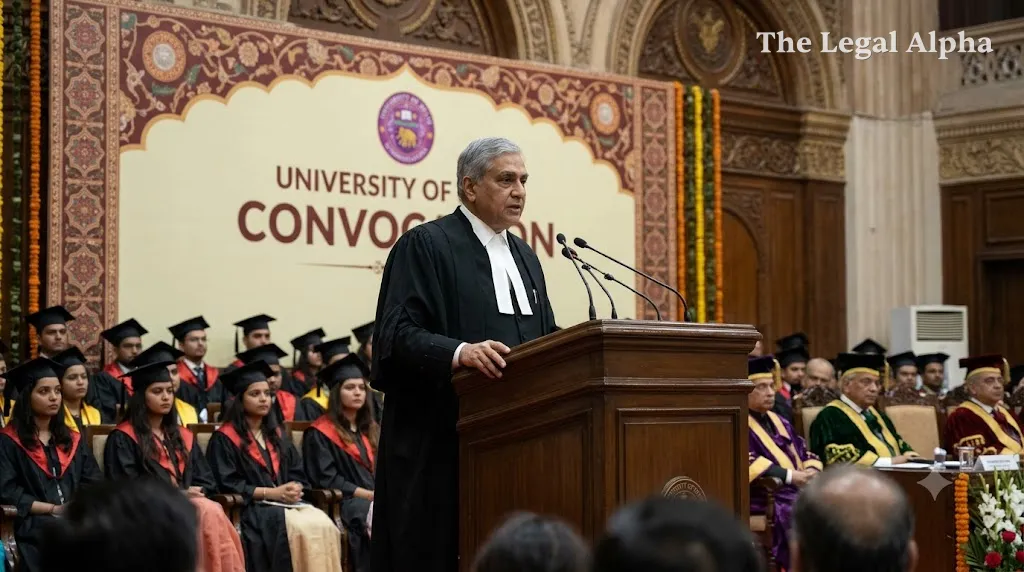
Supreme Court of India judge Justice Ujjal Bhuyan addressed the graduating students at the 12th convocation ceremony of the University of Science and Technology, Meghalaya. During his address, Justice Bhuyan delivered remarks on the essential relationship between democratic resilience, constitutional ethics, and public inquiry.
He cautioned that a populace that grows hesitant or fearful of questioning authority unwittingly lays the groundwork for authoritarian governance. Emphasizing the need for an informed citizenry, he outlined how active public reasoning, transparency, and the protection of pluralistic identities form the true operating core of India’s constitutional democracy.
Legal Topic
Area of Law: Constitutional Law & Jurisprudence
Sub-topic: Democratic Accountability, Fundamental Freedoms, and Constitutional Morality
Core Legal Issue
The substantive issue addressed in the discourse is how democratic societies preserve the rule of law against creeping executive dominance and institutional decay. Specifically, the address explored the constitutional imperative of scientific temper, free speech, and accessible information as systemic safeguards against arbitrary state power.
The speech examined whether democracy should be understood merely as an institutional apparatus—such as holding periodic elections—or as a substantive, functional system that survives only when citizens retain the space to examine entrenched orthodoxies, challenge authority, and maintain public scrutiny without fear.
What Did the Authority State?
While speaking in an extrajudicial capacity at an academic forum, the sitting apex court judge articulated several observations on constitutional values and civil liberties:
-
Risk of Authoritarian Drift: Justice Bhuyan observed that authoritarian power thrives when citizens surrender the instinct to critically inquire, noting that arbitrary rule feeds directly on unexamined beliefs, ignorance, and societal fear.
-
Functional versus Institutional Democracy: Drawing on Amartya Sen’s jurisprudential work The Idea of Justice, he distinguished between purely formal electoral mechanics and genuine functional democracy, the latter of which relies entirely on sustained public reasoning.
-
Access to Information as a Prerequisite: He noted that effective public debate cannot exist in a vacuum; an informed citizenry requires unhindered access to public information as a structural necessity.
-
Plurality and the Constitutional "We": Addressing the social fabric of the republic, he criticized divisive "us versus them" polarities, highlighting that the Preamble's opening words, "We, the People of India," establish a shared constitutional unity that protects and celebrates cultural and individual diversity rather than compelling forced uniformity.
Key Legal Points
-
Scientific temperament, as embodied in the Constitution, serves as a direct legal and intellectual bulwark against arbitrary governance.
-
Public reasoning and institutional transparency are non-negotiable structural elements required for a functioning participatory democracy.
-
Democratic accountability cannot be reduced to periodic balloting; it requires continuous civic engagement, debate, and the ability to challenge public institutions.
-
Constitutional unity under the Indian framework is inherently pluralistic, meaning cultural and regional distinctiveness enhances rather than diminishes the republic's sovereignty.
Relevant Law
-
Constitution of India, Preamble: Establishes the sovereign, socialist, secular, democratic republic rooted in fraternity and the foundational mandate of "We, the People."
-
Constitution of India, Article 19(1)(a): Protects freedom of speech and expression, which courts have long recognized as including the right to receive information and engage in public dissent.
-
Constitution of India, Article 51A(h): Identifies the development of the scientific temper, humanism, and the spirit of inquiry and reform as fundamental duties.
-
Judicial Precedents: Jurisprudential doctrines surrounding the rule of law and transparency, notably reflected in decisions such as State of U.P. v. Raj Narain (1975) regarding citizens' right to know, and S.P. Gupta v. Union of India (1981) on open governance.
Context and Competing Perspectives
While judicial addresses do not constitute formal litigation between an applicant and a respondent, discussions around critical speech and public order typically reflect competing constitutional philosophies:
-
The Civil Libertarian and Democratic Perspective: Proponents of this view emphasize that active dissent, freedom of expression, and independent scrutiny of state actions are indispensable to avoiding an overreach of executive authority and preserving the basic structure of the Constitution.
-
The Majoritarian and Executive Perspective: Conversely, administrative viewpoints frequently prioritize social cohesion, administrative ease, and national uniformity, occasionally viewing intense public contestation or dissenting inquiries as impediments to decisive administration or internal cohesion.
Why Does It Matter?
Extrajudicial remarks by sitting Supreme Court justices carry considerable moral and jurisprudential weight. They offer clarity on how members of the higher judiciary interpret the health of the constitutional order and democratic institutions.
In practical terms, these remarks reinforce the legal profession's role in safeguarding civic spaces against arbitrary administrative actions, civil liberties curbs, and regulatory overreach. For citizens, academia, and the press, the emphasis on access to information and free inquiry underscores that dissent and questioning are not merely tolerated actions, but affirmative duties embedded within the constitutional structure.
Legal Takeaway
Democratic survival depends on a vigilant citizenry exercising its right to question authority and engage in reasoned public debate. When unexamined tradition or fear suppresses public scrutiny, the legal safeguards protecting citizens from arbitrary power inevitably erode.
Sources
Primary Source: Address delivered by Justice Ujjal Bhuyan at the 12th Convocation of the University of Science and Technology, Meghalaya.
Additional Sources:
-
Amartya Sen, The Idea of Justice (Harvard University Press).
-
The Constitution of India (Articles 19, 51A, and the Preamble).
-
Contemporary legal reports on judicial proceedings and public addresses (November 2026).