Party Worker Cannot File Defamation for Remarks Against Political Leadership: Sultanpur Court Acquits Rahul Gandhi for Lack of Locus Standi
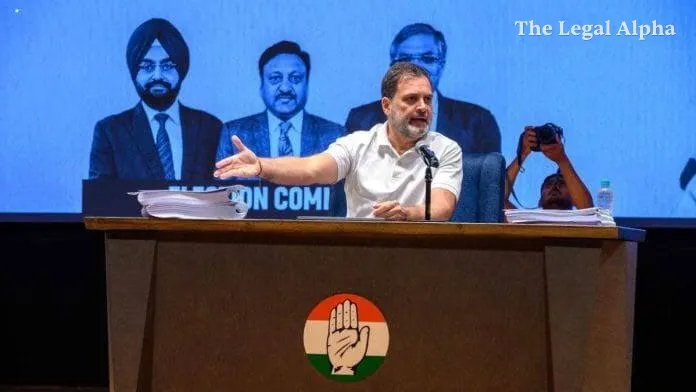
A special MP/MLA court in Sultanpur, Uttar Pradesh, acquitted Leader of the Opposition Rahul Gandhi in a six-year-old criminal defamation case initiated by a local Bharatiya Janata Party (BJP) functionary.
The complaint stemmed from remarks made during a press conference in Bengaluru in May 2018 amidst the Karnataka Assembly election campaign, where Gandhi commented on Union Home Minister Amit Shah (then BJP National President). Following the statement, local BJP worker Vijay Mishra filed a private criminal complaint in August 2018, asserting that the remark caused him personal distress and brought disrepute to his party and leadership.
Concluding trial proceedings on 26 October 2026, the court held that the complainant was not an "aggrieved person" capable of maintaining the prosecution and cleared Gandhi of all charges.
Legal Topic
Area of Law: Criminal Law / Procedural Law
Sub-topic: Criminal Defamation / Locus Standi & Maintainability of Complaints
Core Legal Issue
The fundamental legal question before the magistrate was whether an individual party member or political worker has the legal standing (locus standi) to institute a criminal defamation complaint under Section 499 and Section 500 of the Indian Penal Code for alleged imputations directed against a party leader or the political organization as a whole.
A connected question was whether the complainant fulfilled the mandatory statutory requirement under Section 199 of the Code of Criminal Procedure, 1973, which restricts courts from taking cognizance of criminal defamation except upon a complaint made by the person specifically aggrieved by the offence.
What Did the Court Decide?
Additional Chief Judicial Magistrate Shubham Verma of the Special MP/MLA Court acquitted Rahul Gandhi, ordering the dismissal of the proceedings.
The court held that:
-
The complainant, Vijay Mishra, failed to establish that the impugned remarks referred to him personally or caused direct, cognizable injury to his own reputation.
-
The speech was directed primarily at Amit Shah individually and, at most, at the political party in an abstract sense, leaving a third-party political worker without standing to maintain a private prosecution.
-
The prosecution's evidence lacked credibility, as witness depositions revealed material contradictions and inconsistencies regarding how, when, and where the video recording of the press conference was procured and viewed.
With the judgment concluding the trial, the charges against Gandhi stand dismissed, subject only to any potential statutory appeal the complainant may prefer before a higher appellate court.
Key Legal Points
-
Strict Construction of "Person Aggrieved": Section 199(1) of the CrPC creates a statutory bar against proxy or surrogate litigation in criminal defamation cases; only the individual directly targeted by an imputation holds the standing to prosecute.
-
Absence of Personal Imputation: Imputations directed against an identified person cannot automatically be adopted by associates, party workers, or admirers to claim personal defamation.
-
Evidentiary Gaps in Electronic Proof: Contradictory statements regarding the source, retrieval, and viewing of digital media recordings undermine the foundation required to prove publication and malice under criminal standard of proof.
-
Protection of Political Discourse: Broad political criticisms exchanged during electoral campaigns cannot be converted into actionable criminal wrongs by third parties without demonstrating direct, individual harm.
Relevant Law
-
Section 499, Indian Penal Code, 1860 (IPC): Defines the substantive offence of criminal defamation, detailing exceptions and requirements for defamatory imputations.
-
Section 500, Indian Penal Code, 1860 (IPC): Prescribes the punishment for criminal defamation.
-
Section 199, Code of Criminal Procedure, 1973 (CrPC): Sets out the jurisdictional condition precedent, mandating that no court shall take cognizance of an offence punishable under Chapter XXI of the IPC except upon a complaint made by some person aggrieved by the offence.
-
Applicable Judicial Precedents: Subramanian Swamy v. Union of India (2016), which upheld the constitutional validity of Sections 499 and 500 of the IPC while emphasizing that the qualification under Section 199 CrPC operates as a vital filter to prevent vexatious and surrogate criminal proceedings.
Arguments of the Parties
Complainant
-
The complainant argued that as a devoted worker and local office-bearer of the BJP, allegations made against the party's national president injured the collective image of the party and caused deep anguish and reputational harm to him in the public eye.
-
It was submitted that defamatory assertions made on a national platform during an election campaign intentionally demeaned the entire political organization and its leadership, thereby giving members a valid grievance to pursue legal action.
Accused / Defence
-
Counsel for the accused submitted that the complaint was non-maintainable ab initio because the complainant was not an "aggrieved person" within the explicit meaning of Section 199 CrPC.
-
It was contended that the statements were political criticisms made in a press conference in another state, aimed neither at the complainant nor at an identifiable, finite class of individuals capable of being collectively defamed.
-
The defence further challenged the evidentiary basis of the complaint, highlighting substantial discrepancies in witness testimonies concerning the circulation and viewing of the alleged clip.
Why Does It Matter?
This ruling underscores a fundamental safeguard in Indian criminal jurisprudence against the weaponization of criminal defamation through surrogate litigation. In highly polarized political contests, speeches and press statements frequently contain sharp critiques of rival leaders. If third-party supporters, cadre, or party office-bearers were permitted to file defamation complaints in various jurisdictions on behalf of their leaders, it would lead to a flood of vexatious prosecutions across the country.
By enforcing the requirement of locus standi under Section 199 of the CrPC, the Sultanpur court reaffirmed that criminal defamation is an individual grievance rather than a representative cause of action. For political actors, commentators, and media organizations, the decision reiterates that while personal defamation remains punishable, the law does not allow unrelated third parties to act as legal proxies to punish political speech.
Legal Takeaway
Criminal defamation under Section 499/500 IPC cannot be prosecuted by proxy. Unless an imputation specifically refers to the complainant or targets a small, determinate class of persons to which they belong, third-party supporters and political workers lack the legal standing to maintain a criminal prosecution under Section 199 CrPC.
Sources
Primary Source:
-
Judgment/Order dated 26 October 2026 passed by Additional Chief Judicial Magistrate Shubham Verma, Special MP/MLA Court, Sultanpur, Uttar Pradesh in Vijay Mishra v. Rahul Gandhi.
Additional Sources:
-
Indian Penal Code, 1860 (Sections 499 & 500).
-
Code of Criminal Procedure, 1973 (Section 199).
-
Supreme Court of India ruling in Subramanian Swamy v. Union of India (2016) 7 SCC 221.