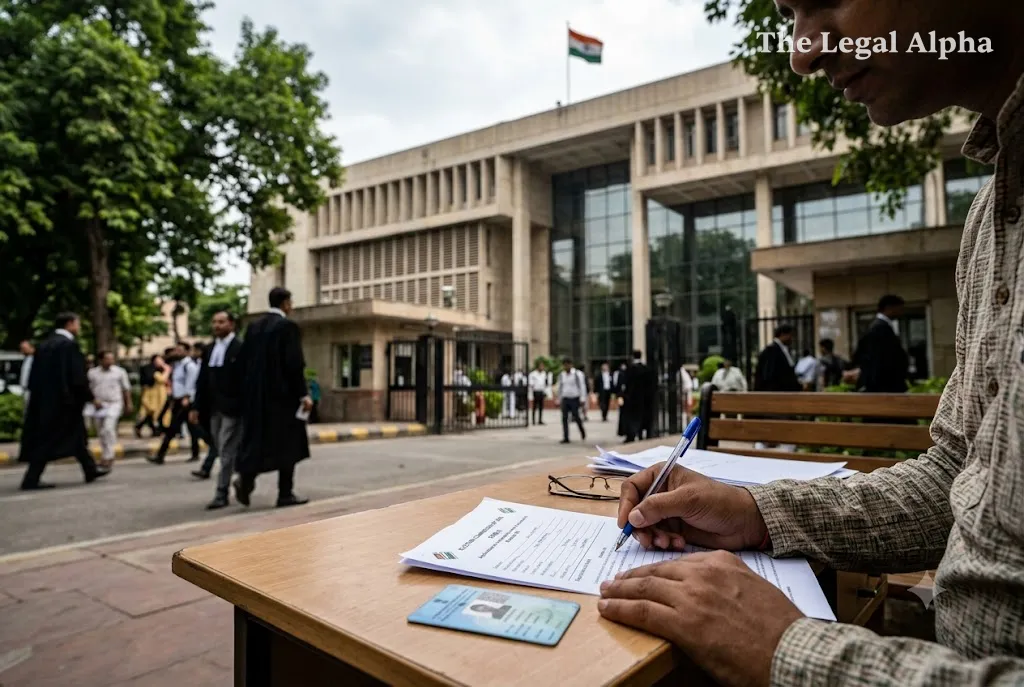
Parliamentary Speeches Cannot Override Plain Statute: Finance Ministry Defends IDBI Bank Disinvestment

The Union Ministry of Finance issued an official clarification affirming that no statutory provision prevents the Central Government from reducing its shareholding in IDBI Bank Limited. The statement responds to public discourse and media scrutiny questioning the legality of the privatisation following the government's approval of a major majority-stake sale to Canada’s Fairfax Financial Holdings.
Critics had pointed to parliamentary assurances made during legislative debates when the lender was corporatised in 2003, suggesting the state was obligated to retain a controlling interest. In response, the Ministry clarified that the enacted statute contains no such minimum threshold, pointing to settled jurisprudence that debates on the floor of the House cannot override enacted law.
Legal Topic
-
Area of Law: Banking Regulation & Corporate Law
-
Sub-topic: Disinvestment / Statutory Interpretation of Parliamentary Debates
Core Legal Issue
The controversy centres on whether ministerial assurances and speeches delivered during parliamentary debates can impose a binding legal constraint on the executive, particularly where the final text of the enacted statute deliberately omits that restriction.
Specifically, the issue concerns whether the Industrial Development Bank (Transfer of Undertaking and Repeal) Act, 2003 legally binds the Union Government to maintain a 51 percent majority shareholding, or if the statute permits the executive to dilute its equity without amending the Act.
What Did the Court / Authority Decide?
The Finance Ministry clarified that during the passage of the Industrial Development Bank (Transfer of Undertaking and Repeal) Act, 2003, an explicit amendment proposing to mandate a minimum 51 percent government equity holding was moved in Parliament, voted on, and formally rejected. Because the proposed restriction was rejected, the final law enacted by Parliament contained no statutory bar against divesting shares.
To substantiate this position, the Ministry relied directly on the December 17, 2018 ruling of the Delhi High Court in All India IDBI Officers' Association v. Union of India. In that decision, the High Court dismissed challenges to the dilution of the state's stake, holding that observations and speeches made inside Parliament cannot substitute, amend, or override an act of Parliament as enacted. Consequently, the Ministry confirmed that the transaction to transfer controlling interest to a private acquirer remains within statutory bounds.
Key Legal Points
-
Legislative Intent via Rejected Amendments: A statutory restriction that was formally proposed as an amendment and explicitly voted down during the legislative process cannot be read back into the Act through interpretation.
-
Hierarchy of Statutory Text over Parliamentary Debates: Under the rules of statutory interpretation, statements and ministerial assurances made on the floor of Parliament serve only as secondary external aids in cases of ambiguity; they cannot supplant or rewrite the express, unambiguous text of a statute.
-
Absence of a Statutory Floor: The Industrial Development Bank (Transfer of Undertaking and Repeal) Act, 2003 repealed the original 1964 charter without imposing a mandatory minimum state-holding requirement, distinguishing IDBI Bank from nationalised banks governed by the Banking Companies (Acquisition and Transfer of Undertakings) Acts.
-
Judicial Precedent Upholding Dilution: The Delhi High Court’s 2018 ruling already examined the legislative history of IDBI’s corporatisation and confirmed the government possesses full legal authority to bring its equity below controlling levels.
Relevant Law
-
The Industrial Development Bank (Transfer of Undertaking and Repeal) Act, 2003: The governing legislation that corporatised the erstwhile statutory corporation into a commercial banking entity without retaining a statutory minimum government shareholding clause.
-
The Industrial Development Bank of India Act, 1964 (Repealed): The initial charter under which IDBI operated as a statutory development financial institution.
-
Judicial Precedent: All India IDBI Officers' Association v. Union of India & Ors. (Delhi High Court, Dec 17, 2018), establishing that floor statements during debates cannot override enacted legislation.
Arguments of the Parties
Objectors and Employee Associations
Those challenging the disinvestment contended that during the 2003 parliamentary debates, ministerial commitments were given that the state would retain a controlling stake of at least 51 percent in the corporatised entity. Based on these assurances, objectors argued that the executive is bound by the legislative intent expressed on the floor of the House and cannot surrender public control without fresh legislative assent.
Union Finance Ministry
The government submitted that legislative intent is derived first and foremost from the plain text of the enacted statute. The Ministry highlighted that Parliament specifically considered and rejected an amendment that would have capped divestment at 51 percent. Therefore, the executive argued that floor speeches cannot create an enforceable legal prohibition where the legislature consciously decided against enacting one.
Why Does It Matter?
This clarification reaffirms a vital constitutional and administrative principle: policy commitments articulated during legislative debates do not translate into enforceable statutory duties unless incorporated into the final legislation.
For public sector enterprises and financial institutions, the development draws a clear line between statutory public sector banks—which require explicit legislative amendments to dilute state control below 51 percent—and corporatised entities where enabling statutes contain no equity floor. It insulates ongoing and future strategic disinvestment initiatives from challenges grounded in historical parliamentary speeches, providing commercial and regulatory certainty to prospective institutional investors.
Legal Takeaway
Speeches and assurances made during legislative debates cannot alter or override the plain text of an Act passed by Parliament. Because the IDBI (Repeal) Act of 2003 contains no statutory floor requiring majority government ownership, the Centre faces no legal barrier in diluting its equity.
Sources
Primary Source:
-
Official Clarification Statement, Ministry of Finance, Government of India (Issued October 17, 2026).
-
All India IDBI Officers' Association v. Union of India & Ors., W.P.(C) 9028/2018 (High Court of Delhi, decided on December 17, 2018).
Additional Sources:
-
Industrial Development Bank (Transfer of Undertaking and Repeal) Act, 2003 (Act No. 53 of 2003).
-
Official Announcement on Disinvestment Approval of IDBI Bank Limited (Cabinet Committee on Economic Affairs / DIPAM).