Delhi High Court Backs Form 6 Route for Deleted SIR Electors, Rules False Declaration Fears Misplaced
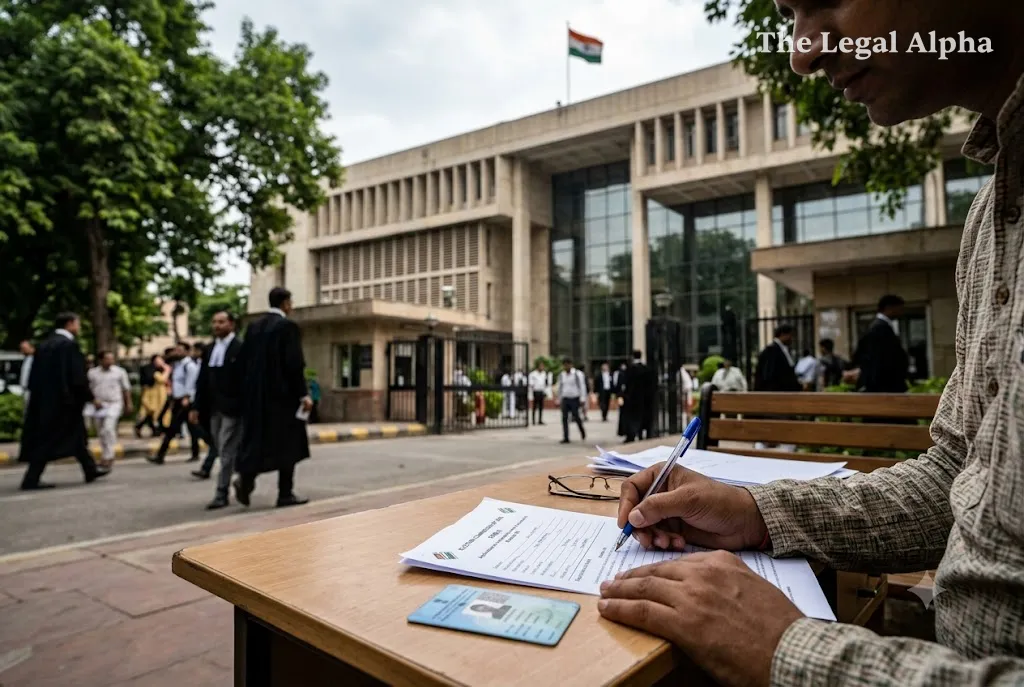
The Delhi High Court closed writ proceedings brought by electors whose names were struck from the capital's voter lists after they missed the door-to-door enumeration phase during the Special Intensive Revision (SIR) exercise. The petitioners had relocated from their earlier registered addresses and hesitated to submit Form 6—the standard statutory application for inclusion—fearing potential criminal exposure for making an improper declaration. The court dismissed those concerns as entirely unfounded, clarifying that filling out the form on the direct guidance of election authorities remains the valid legal mechanism to restore their franchise.
Legal Topic
-
Area of Law: Election Law & Constitutional Law
-
Sub-topic: Revision of Electoral Rolls / Restoration of Voting Rights
Core Legal Issue
The controversy centered on whether existing electors whose names were purged during a Special Intensive Revision can be required to seek re-inclusion via Form 6 under the Registration of Electors Rules, 1960.
Specifically, the court addressed whether filing Form 6—which includes declarations primarily designed for first-time or fresh applicants—exposes previously registered voters to allegations or penal liabilities for tendering a false statement.
What Did the Court Decide?
A Division Bench comprising Justice Dinesh Mehta and Dr. Justice Aditi Choudhary disposed of the writ petition, declining to treat the administrative requirement as punitive or irregular.
The court held that because the recommendation to submit Form 6 came directly from the Election Commission of India's (ECI) counsel acting on explicit instructions from the Electoral Registration Officer (ERO), any fear of being prosecuted for a false declaration was unfounded.
The Bench granted the petitioners liberty to submit Form 6, directing the authorities to process any such applications strictly in accordance with statutory procedures, thereby terminating the writ proceedings and disposing of all pending interlocutory applications.
Key Legal Points
-
Protection from Mala Fide Prosecution: Electors submitting statutory forms under the advice and instruction of the ERO and ECI counsel cannot be presumed to act in bad faith or face false-declaration penalties.
-
Administrative Pathway Clarified: Form 6 serves as a permissible procedural conduit to reclaim electoral registration when physical enumeration could not be completed during an intensive revision.
-
Obligation of the Registration Authority: Once an affected citizen submits the requisite application, the electoral machinery is bound to evaluate and process it under established statutory standards without arbitrary exclusion.
Relevant Law
-
Representation of the People Act, 1950: Section 22 and Section 23 (Correction of entries and inclusion of names in electoral rolls).
-
Registration of Electors Rules, 1960: Rule 13 and Rule 26, prescribing Form 6 (Application for inclusion of name) and Form 8 (Correction/transposition of entries).
-
Constitution of India: Article 326 (Elections to the House of the People and to the Legislative Assemblies of States to be on the basis of adult suffrage).
-
Judicial Precedent: Nilotpal Datta & Anr. v. Election Commission of India & Ors. (2026 LiveLaw (Del) 1014).
Arguments of the Parties
The Petitioners: Appearing in person, the petitioners contended that they were bona fide registered voters who were unavailable during the door-to-door drive solely because they had shifted residences. They argued that being compelled to submit Form 6 instead of having their entries restored or transposed under Form 8 could be construed as tendering a false declaration, exposing them to legal penalties.
The Respondent (Election Commission of India): Standing Counsel for the ECI submitted that the appropriate administrative remedy available under the Registration of Electors Rules, 1960, for re-entering the roll is Form 6. The Commission highlighted that the Electoral Registration Officer had actively offered procedural assistance to facilitate the application, and confirmed that the submission would be dealt with lawfully rather than treated as a misrepresentation.
Why Does It Matter?
Intensive revision drives frequently result in large-scale roll deletions when residents move homes, leading to confusion over how dropped voters can restore their status before election cut-offs. This ruling provides practical clarity by confirming that the standard Form 6 route remains accessible to electors dropped during an SIR exercise. More importantly, it insulates citizens from the apprehension of legal retaliation or perjury when following instructions given by election officers, streamlining the path back onto the voter list.
Legal Takeaway
Voters whose names are purged during an intensive roll revision can safely utilize Form 6 to apply for re-enrolment without fearing legal jeopardy for false declarations, provided the submission follows the guidance of the Electoral Registration Officer.
Sources
Primary Source:
-
High Court of Delhi: Nilotpal Datta & Anr. v. Election Commission of India & Ors. [W.P.(C) 70131/2026], Order dated October 14, 2026 (Citation: 2026 LiveLaw (Del) 1014).
Additional Sources:
-
High Court Reporting & Legal Briefs: LiveLaw & Swarajya reports on Special Intensive Revision (SIR) proceedings and electoral roll restoration (October 2026).