Over 2 Million Flagged Electors Verified as Delhi Election Authority Progresses with Special Intensive Revision
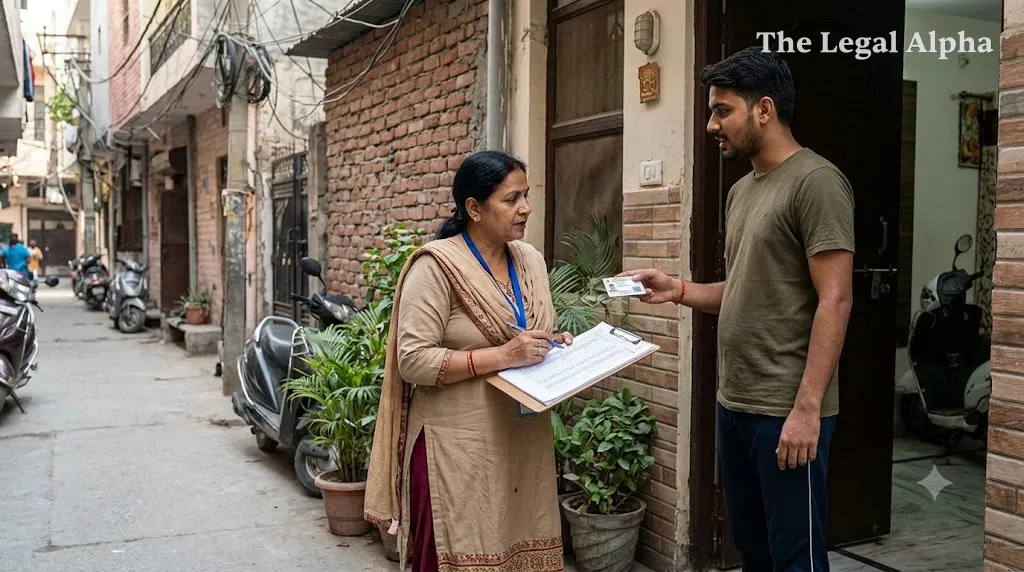
The Office of the Chief Electoral Officer (CEO) of Delhi has cleared and verified approximately 2 million (20 lakh) voter entries out of nearly 3.3 million flagged for logical errors or missing historical mapping. This large-scale verification has unfolded under the ongoing Special Intensive Revision (SIR) 2026 across the National Capital Territory.
The exercise aims to purify the electoral rolls ahead of final publication. Authorities mobilized thousands of Booth-Level Officers (BLOs) and Electoral Registration Officers (EROs) to conduct physical doorstep visits, verify identity documentation, and reconcile discrepancies without disenfranchising genuine voters.
Legal Topic
Area of Law: Election Law / Constitutional Law
Sub-topic: Electoral Roll Revision and Voter Franchise Rights
Core Legal Issue
The fundamental legal issue concerns whether the statutory mechanisms used by election authorities to clean and update electoral rolls adhere to the principles of natural justice and statutory protections against arbitrary disenfranchisement.
Specifically, it examines the balance between the Election Commission of India's constitutional obligation to maintain accurate, fraud-free electoral lists and the procedural safeguards required before a citizen's fundamental democratic franchise is curtailed or subjected to deletion notices.
What Did the Court / Authority Decide?
The Chief Electoral Officer of Delhi confirmed that roughly 60% of flagged entries have been successfully reconciled and retained after targeted field-level verification.
The authority directed Assistant Electoral Registration Officers (AEROs) and BLOs to immediately process documentation—including declarations, proofs of age, and residency papers—and upload resolved records without waiting for administrative cut-offs. The election administration reiterated that receiving an inquiry or verification notice does not constitute summary deletion, granting electors extended windows and special camps throughout October to resolve unmapped entries before the final list is issued.
Key Legal Points
-
Presumption in Favor of Inclusion: Statutory revision procedures require administrative scrutiny to verify residency and identity, rather than assuming flagged or unmapped entries represent fraudulent voters.
-
Compliance with Natural Justice: Individual notices and physical verification serve as requisite procedural steps prior to any potential omission or deletion under statutory electoral rules.
-
Constitutional Custodianship: The Election Commission of India operates under a constitutional mandate to maintain complete and accurate rolls, subject to high administrative thresholds when altering registration status.
-
Burden of Verification: While the primary administrative burden rests upon poll machinery to reconcile database mismatches, statutory mechanisms provide citizens avenues for claims, objections, and immediate rectification.
Relevant Law
-
Constitution of India: Article 324 (superintendence, direction, and control of elections) and Article 326 (elections based on adult suffrage).
-
Representation of the People Act, 1950: Section 21 (preparation and revision of electoral rolls) and Section 22 (correction of entries in electoral rolls).
-
Registration of Electors Rules, 1960: Rule 10 through Rule 23, governing the publication of draft rolls, notice issuances, inquiry procedures, and claims and objections.
Arguments of the Parties
Electoral Authorities
The Chief Electoral Officer maintained that the SIR is a necessary audit driven by objective criteria, designed to eliminate duplicate entries, update moved residences, and map untraced citizens. The authority argued that no eligible citizen is being arbitrarily removed and that the large-scale verification of over 20 lakh electors demonstrates the administration's active campaign to protect genuine voter inclusion.
Political Parties and Rights Litigants
Opposition parties and civil society petitioners argued that automated or sweeping algorithmic flagging creates severe risks of wrongful disenfranchisement, particularly for marginalized and migratory populations. They contended that strict notice deadlines and onerous document burdens disproportionately exclude vulnerable voters, urging extensive field audits and pauses on mass expulsions.
Why Does It Matter?
This massive administrative cleanup highlights the growing legal and procedural tensions surrounding automated database scrubbing and voter list management. As election commissions increasingly rely on software to spot "logical discrepancies," administrative oversights can easily result in genuine citizens facing sudden verification burdens.
The Delhi verification drive sets an administrative precedent for how electoral offices handle bulk anomalies without resorting to unilateral deletions. For the broader legal system, it underscores that technological roll updates must remain subordinate to due process, door-to-door validation, and transparent claims mechanisms.
Legal Takeaway
Flagging an elector for database discrepancies does not strip them of their statutory right to vote. Election authorities must provide fair notice, active verification, and a reasonable opportunity to be heard before altering or removing any valid entry from the electoral register.
Sources
Primary Source:
-
Official Press Communication and Public Directives, Office of the Chief Electoral Officer, Delhi (Special Intensive Revision 2026).
Additional Sources:
-
Representation of the People Act, 1950 & Registration of Electors Rules, 1960.
-
Electoral Roll Revision Bulletins, Press Trust of India / ANI News Reports.