Omitted Voters Using Form 6 for Re-Enrolment Will Not Face Criminal Prosecution, Election Commission Tells Supreme Court
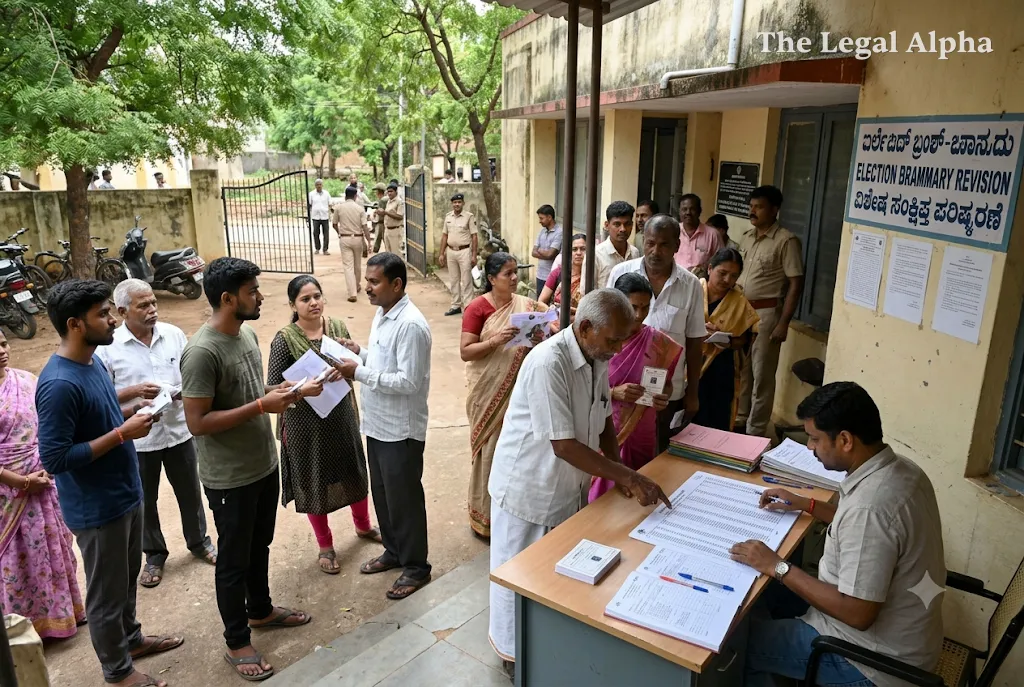
The Election Commission of India (ECI) has informed the Supreme Court that citizens whose names were left out of draft electoral rolls during the ongoing Special Intensive Revision (SIR) will not face criminal prosecution if they submit Form 6 to get their names restored.
This assurance was placed on record in a supplementary affidavit filed on November 14, 2026, by Deputy Election Commissioner Bhanu Prakash Yeturu. The filing came in response to a writ petition brought by Rakesh Kumar Singh (alias Rakesh Singh) concerning the conduct of the SIR in Delhi and the internal decision-making processes of the Commission.
The matter is being heard by a Supreme Court bench comprising Chief Justice of India Surya Kant, Justice Joymalya Bagchi, and Justice V. Mohana. Because Form 6 is traditionally used by first-time voters applying for fresh registration, many excluded voters feared that filling it out after having been registered in earlier rolls could expose them to criminal liability for making a false declaration. The ECI's formal commitment on affidavit aims to remove that fear ahead of the next scheduled hearing on November 19, 2026.
Legal Topic
Area of Law: Election Law / Constitutional Law
Sub-topic: Electoral Roll Revision and Voter Registration Procedure
Core Legal Issue
The central legal question before the Supreme Court is whether the Election Commission of India acted within its statutory and constitutional bounds by directing previously registered voters—whose names were omitted during a Special Intensive Revision—to apply for re-inclusion using Form 6, a form designed primarily for new electors.
Specifically, the dispute examines whether requiring prior voters to submit Form 6 creates a legal contradiction under the Registration of Electors Rules, 1960, and exposes citizens to penal consequences under Section 31 of the Representation of the People Act, 1950, which penalises false declarations made in connection with electoral rolls. Alongside this procedural question, the petition also challenges whether major administrative directives regarding the SIR were taken collectively by the three-member Commission.
What Did the Court / Authority Decide?
No final judgment has been delivered yet, as the Supreme Court has listed the matter for further hearing on November 19, 2026. However, in its November 14 supplementary affidavit, the ECI placed several formal administrative decisions and assurances on record:
-
Immunity from Prosecution: The ECI confirmed that Electoral Registration Officers (EROs) will not initiate penal action under Section 31 of the Representation of the People Act, 1950, against any applicant merely because they were enrolled in a previous voter list and used Form 6 for re-inclusion during or after the SIR, provided they are not currently registered in any other constituency and their declaration is otherwise lawful.
-
Nationwide Public Clarification: The Commission placed on record its November 3, 2026 circular directing Chief Electoral Officers (CEOs) across all States and Union Territories to widely publicise this clarification—including in local languages—so that omitted voters are not deterred from applying.
-
Alternative Relief for ASDD Voters: Citing a subsequent directive dated November 6, 2026, issued to CEOs in Delhi, Maharashtra, Haryana, Andhra Pradesh, Jharkhand, Telangana, and Nagaland, the ECI stated that electors excluded from draft rolls under the Absent, Shifted, Dead, or Duplicate (ASDD) category may submit simple enumeration forms to the ERO of their current residence. Those who shifted within the same State do not need to file Form 8, and booth-wise lists of excluded electors with reasons for deletion are being displayed afresh.
-
No Duplicate Submissions Needed: Voters who have already submitted Form 6 to restore their names do not need to file enumeration forms again.
The broader legal validity of using Form 6 for previously enrolled voters and the procedural challenges to the SIR remain pending before the Supreme Court.
Key Legal Points
-
Protection Against Section 31 Liability: Section 31 of the Representation of the People Act, 1950 criminalises making false statements or declarations in writing during the preparation or revision of electoral rolls. The ECI's binding assurance before the Supreme Court shields omitted voters from prosecution solely on account of prior enrolment.
-
Alignment with High Court Precedent: In its November 3 circular, the ECI noted that allowing omitted prior electors to apply through Form 6 aligns with the Delhi High Court's ruling in Nilotpal Datta & Anr. v. Election Commission of India & Ors. (decided October 14, 2026), which addressed concerns that non-first-time voters risked making false declarations by using Form 6.
-
Institutional Accountability and Collective Decision-Making: Addressing allegations that SIR decisions bypassed the other two Election Commissioners, the ECI stated on affidavit that all policy decisions were approved unanimously and detailed a revised November 4, 2026 work allocation order keeping the IT/ICT Division under the supervision of a Senior Deputy Election Commissioner.
-
Safeguarding Franchise Over Technicalities: Following earlier oral observations by the Supreme Court on October 28 urging the Commission to proactively reach out to left-out electors, the ECI's twin circulars (dated November 3 and November 6) prioritise preventing disenfranchisement over strict form-based distinctions, while still screening against duplicate registrations.
Relevant Law
-
Representation of the People Act, 1950 (Section 31): Prescribes punishment (imprisonment up to one year, or fine, or both) for making a false declaration in connection with the preparation, revision, or correction of an electoral roll, or the inclusion or exclusion of any entry.
-
Registration of Electors Rules, 1960 (Rule 13 & Form 6 / Form 8): Governs applications for inclusion of names in an electoral roll (Form 6) and applications for shifting of residence or correction of entries (Form 8).
-
Constitution of India (Article 324): Vests the superintendence, direction, and control of elections and the preparation of electoral rolls in the Election Commission of India.
-
Precedent: Nilotpal Datta & Anr. v. Election Commission of India & Ors. (W.P.(C) No. 14955/2026, Delhi High Court, decided October 14, 2026).
Arguments of the Parties
Petitioner
The petitioner, Rakesh Kumar Singh, and supporting counsel (including Senior Advocate Prashant Bhushan during related hearings) contended that requiring previously registered voters to fill out Form 6 treats established electors as first-time applicants. They argued that this creates structural confusion, leaves voters anxious about potential criminal liability despite administrative assurances, and departs from the Supreme Court's October 28 observations regarding the use of enumeration forms and Form 8 for voters placed on the ASDD list. The petition also alleged that key directives on the SIR and Form 6 were issued without the formal concurrence of all three members of the Commission.
Respondent (Election Commission of India)
The ECI submitted that the declaration format in Form 6 has been in force since August 1, 2022, and that permitting excluded voters to seek re-inclusion via Form 6 is a lawful, practical measure to ensure no eligible citizen is left off the final roll. The Commission maintained that its November 3 and November 6 directives remove any risk of prosecution under Section 31, simplify re-enrolment for ASDD-categorised voters through enumeration forms, and prevent duplicate entries. It further denied any breakdown in internal governance, asserting that all SIR decisions were taken collectively by the full Commission.
Why Does It Matter?
Electoral roll revisions sit at the heart of democratic participation, yet procedural ambiguity during large-scale clean-up drives can inadvertently deter legitimate voters from exercising their franchise. When citizens whose names vanish from draft rolls are told to use a form meant for new voters, the threat of a one-year prison term under Section 31 of the Representation of the People Act, 1950 becomes a real psychological and legal barrier.
By placing an explicit no-prosecution guarantee on affidavit before the Supreme Court and directing state election officials to publicise it in local languages, the ECI has removed immediate legal jeopardy for thousands of voters navigating the SIR in Delhi and other states. At the same time, the ongoing litigation underscores the judiciary's insistence that administrative convenience must not blur statutory procedures or shift the burden of bureaucratic errors onto ordinary citizens.
Legal Takeaway
Voters whose names were omitted from draft electoral rolls during the Special Intensive Revision can safely apply for re-inclusion using Form 6—or submit an enumeration form if listed under the ASDD category—without fearing criminal prosecution for having been registered previously. Applicants must simply ensure they are not enrolled in any other constituency and that all details provided in their application are accurate.
Sources
Primary Source:
Supplementary Affidavit filed by the Election Commission of India on November 14, 2026, before the Supreme Court of India in Rakesh Kumar Singh @ Rakesh Singh v. Election Commission of India; ECI Circular No. 23/2026-ERS (Vol.-II) dated November 3, 2026, and ECI Communication dated November 6, 2026.
Additional Sources:
-
Supreme Court of India proceedings in the Delhi Special Intensive Revision matter (bench of CJI Surya Kant, Justice Joymalya Bagchi, and Justice V. Mohana).
-
Delhi High Court order in Nilotpal Datta & Anr. v. Election Commission of India & Ors. (W.P.(C) No. 14955/2026, decided October 14, 2026).