Ninth Circuit Upholds Federal Wild Horse Management, Ruling Law Does Not Mandate Rigid Gather Timetables
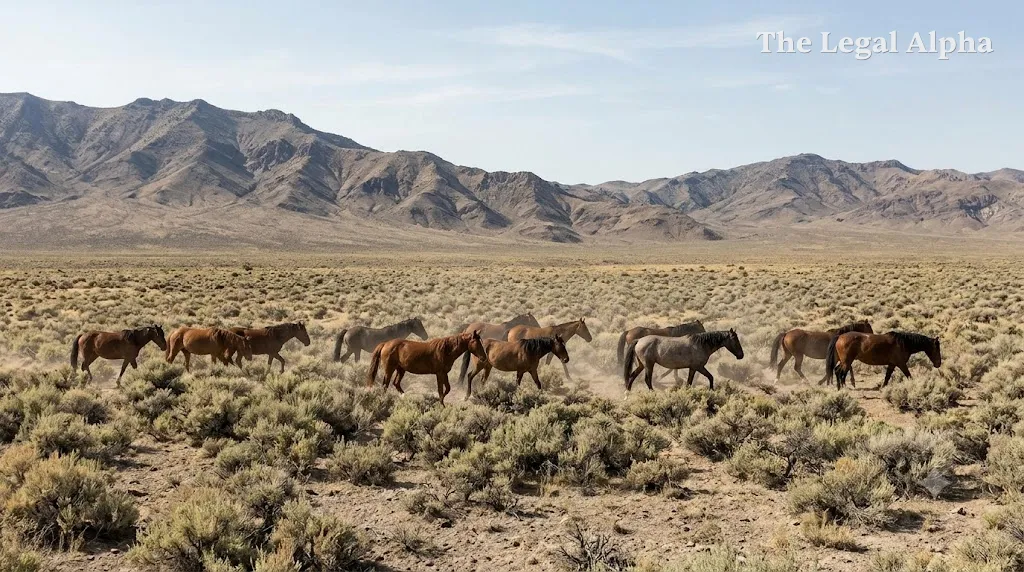
A federal appellate court affirmed that the United States Bureau of Land Management possesses the administrative discretion to manage and remove excess wild horses without adhering to strict, mandatory deadlines demanded by commercial ranchers.
The dispute arose in Nevada, where livestock operators Colvin & Son, LLC and Stone Cabin Ranch challenged federal management plans covering the Little Fish Lake Joint Management Area and the Stone Cabin Complex. Facing populations that exceeded established environmental thresholds, the ranchers filed suit seeking to compel federal authorities to execute rapid roundups. On October 29, 2026, the United States Court of Appeals for the Ninth Circuit affirmed a lower court ruling in favor of federal officials, holding that federal gather plans complied with statutory standards.
Legal Topic
-
Area of Law: Environmental and Administrative Law
-
Sub-topic: Public Lands Management / Wildlife Protection
Core Legal Issue
The controversy centered on the statutory interpretation of the Wild Free-Roaming Horses and Burros Act of 1971, specifically its command that federal land managers must "immediately remove excess animals" once overpopulation is determined.
The legal question before the appellate court was whether the statutory directive to act "immediately" requires the Bureau of Land Management to adopt fixed, mandatory operational timetables in its removal plans, or whether the agency may balance removal timelines against practical hurdles such as animal welfare, available funding, and operational feasibility.
What Did the Court Decide?
The Ninth Circuit affirmed the district court’s grant of summary judgment in favor of the Department of the Interior and the Bureau of Land Management.
Writing for the panel, the court held that the statutory immediacy mandate requires the agency to implement gather plans as promptly as logistically and reasonably possible, rather than under an inflexible calendar. The court determined that the agency did not exceed its statutory discretion by declining to impose binding removal deadlines or by accounting for practical realities, including weather events, contractor availability, and humane handling protocols. The judgment resolves the legal challenge against the validity of the gather plans, leaving the agency's broad managerial discretion intact.
Key Legal Points
-
Statutory commands for "immediate" agency action must be read alongside procedural directives that prescribe careful, humane handling and multi-stage processes.
-
Federal land managers retain broad discretion to balance statutory population caps with practical constraints, including physical terrain, weather, and budget availability.
-
Management plans do not run afoul of federal law merely because they do not commit the agency to an enforceable date-specific gather schedule.
-
Conditions placed on subsequent or maintenance gathers do not invalidate an agency's overarching commitment to achieving long-term ecological balance.
Relevant Law
-
Wild Free-Roaming Horses and Burros Act of 1971 (as amended, 1978): 16 U.S.C. § 1331 et seq.
-
Removal of Excess Animals Provision: 16 U.S.C. § 1333(b)(2), governing determinations of appropriate management levels and immediate removals
-
Administrative Procedure Act: 5 U.S.C. § 706, governing judicial review of federal agency action and claims of unreasonable delay
-
Judicial Precedents: American Wild Horse Campaign v. Bernhardt (9th Cir. 2020) and Friends of Animals v. Burgum (9th Cir. 2026), addressing statutory balancing between species preservation and rangeland health
Arguments of the Parties
Appellants
The ranching entities argued that the plain meaning of the statute requires swift, compulsory eradication of overpopulations once horse counts exceed established appropriate management levels. They contended that the ten-year gather plans formulated by federal authorities were legally defective on their face because they lacked firm dates and allowed roundups to be delayed based on administrative and budgetary considerations. According to the appellants, omitting mandatory timelines unlawfully frustrates the statutory command for immediate removal.
Appellees
The federal government contended that the statutory scheme must be viewed as an integrated whole. The Department of the Interior submitted that Congress directed excess animals to be gathered in a humane manner, which necessitates evaluating logistics, weather, holding capacities, and fiscal limitations. The agency argued that fulfilling its obligations "as promptly as logistically and reasonably possible" satisfies the statute without subjecting the government to arbitrary judicial deadlines.
Why Does It Matter?
This decision clarifies the scope of federal agency discretion across millions of acres of public land in the western United States. By refusing to convert the word "immediately" into an actionable, inflexible timetable, the court shielded public land administrators from private litigation attempting to force accelerated operations when resources or conditions do not permit.
For commercial grazing permittees, the ruling underscores the high legal barrier to compelling government intervention on federal ranges. For environmental groups and wild horse advocates, it affirms that animal welfare and logistical feasibility remain legitimate factors when federal agencies schedule gathering operations.
Legal Takeaway
Statutory directives requiring an administrative agency to act "immediately" do not compel rigid operational timetables if the governing statute simultaneously mandates humane, multi-step procedures. Where an agency proceeds as promptly as practical circumstances allow, courts will not rewrite resource management plans to enforce arbitrary deadlines.
Sources
Primary Source
-
Colvin & Son, LLC, et al. v. Doug Burgum, et al., United States Court of Appeals for the Ninth Circuit, Docket No. 25-1888 (Opinion filed October 29, 2026).
Additional Sources
-
United States Bureau of Land Management Public Rangeland Records, Little Fish Lake and Stone Cabin Complex Environmental Assessments.
-
Public Law 92-195 (Wild Free-Roaming Horses and Burros Act) and Public Law 95-514 (Public Rangelands Improvement Act of 1978).