Two-Option Answer Keys Fail Rationality Test: Allahabad High Court Orders UPESSC to Delete Flawed Questions and Re-evaluate UPTET Results Across the Board
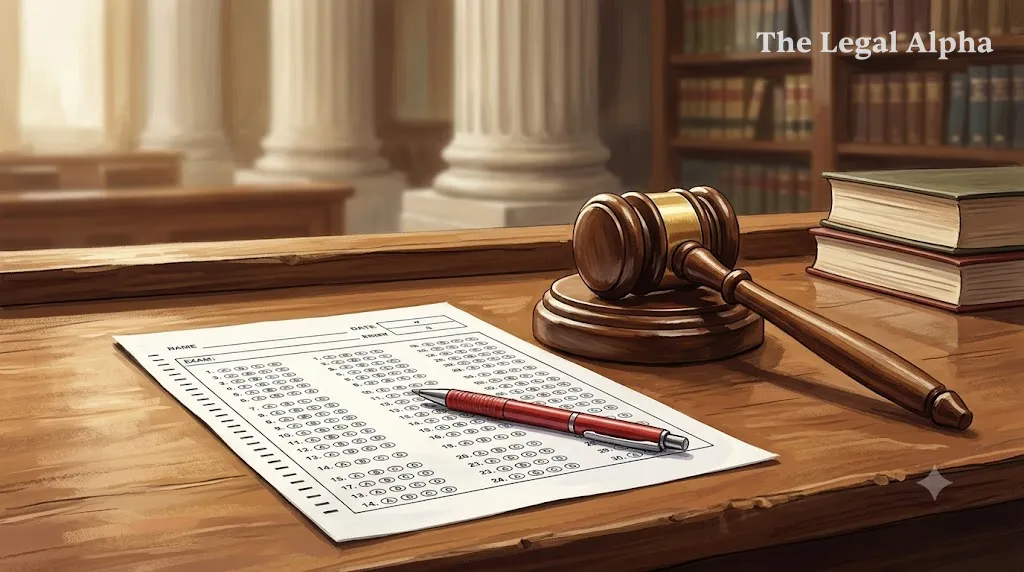
The Allahabad High Court intervened in the evaluation process of the Uttar Pradesh Teacher Eligibility Test-2026, directing the Uttar Pradesh Education Service Selection Commission to scrap two ambiguous multiple-choice questions from the assessment.
Justice Vinod Diwakar passed the ruling on a petition moved by Vijay Sonkar and three other candidates. In its final answer key, the Commission had recognized two correct options each for Questions 36 and 37 in the master set, granting marks exclusively to examinees who had chosen one of those two answers. The High Court ruled this approach legally untenable, ordering the Commission to exclude both questions, treat the paper as evaluated out of 148 marks instead of 150, and recalculate the scores and revised scorecards for the petitioners as well as all similarly situated candidates across the State.
Legal Topic
-
Area of Law: Administrative Law / Service & Education Law
-
Sub-topic: Public Examination Standards / Answer Key Ambiguity and Arbitrary Evaluation
Core Legal Issue
The controversy centered on whether an examining authority can sustain an evaluation framework that awards marks only to candidates selecting one of two officially approved choices for an inherently flawed or ambiguous objective question.
The court had to determine whether validating multiple correct answers in a single-response examination distorts the merit-testing mechanism under Article 14 of the Constitution, and whether the proper remedy was deleting the questions altogether and recalibrating the qualifying marks proportionately.
What Did the Court Decide?
Justice Vinod Diwakar directed the Commission to completely exclude Questions 36 and 37 from the master question paper.
The court ordered that the examination be treated as comprising 148 questions rather than 150, with the qualifying cutoff recalculated using the prescribed percentages against this revised base. Crucially, the bench held that this relief must be applied uniformly to all affected candidates across the board and cannot be restricted solely to the four petitioners who approached the court. The Commission was directed to recompute the scores and issue corrected scorecards accordingly.
The bench noted that the Commission had already dropped Question 38 from the same examination paper. There was no rational or intelligible basis to treat Questions 36 and 37 differently when their options were equally flawed and ambiguous.
Key Legal Points
-
Multiple-choice questions that admit more than one valid option cease to operate as a reliable objective assessment tool for distinguishing knowledgeable candidates from unknowledgeable candidates.
-
Awarding marks only to examinees who fortuitously picked one of two accepted options introduces arbitrariness into public examinations and cannot be legally sustained.
-
When an objective test item contains fatal ambiguities, the legally sound remedy is complete deletion of the question and a proportionate re-computation of the total score, rather than subjective option-splitting.
-
Judicial relief addressing systemic flaws in public recruitment or eligibility evaluations must apply uniformly to all similarly placed candidates to avoid selective discrimination.
Relevant Law
-
Constitution of India: Article 14 (Equality before the law and protection against arbitrary state action) and Article 226 (High Court writ jurisdiction).
-
Judicial Precedents:
-
Smt. Shimla Singh v. State of Uttar Pradesh (Allahabad High Court, UPTET 2018 precedent on question deletion).
-
Ran Vijay Singh & Ors. v. State of Uttar Pradesh (Supreme Court guidelines on judicial interference in expert evaluation keys).
-
Decisions in Ashok Yadav and Rishal concerning public examination evaluations with defective questions.
-
Arguments of the Parties
Petitioners Counsel for the petitioners submitted that the four candidates had scored marginally below the 82-mark qualifying threshold—securing normalized scores between 80.40 and 81.39. They pointed out that while the provisional key indicated only option (D) as correct for both questions, the final answer key introduced two correct options—(B) and (D) for Question 36, and (A) and (D) for Question 37. They contended that selecting two correct answers in a single-choice paper created confusion and denied fair evaluation to candidates who were misled by the flawed question framing.
Respondent / Examining Authority The Commission maintained that its expert body had examined the objections raised by aspirants and determined that two choices carried merit. As a result, credit was extended to any candidate who marked either of the approved answers. The authority argued that awarding marks to candidates who picked either of the viable options adequately preserved fairness without needing to disturb the overall examination architecture.
Why Does It Matter?
This decision reinforces strict standards of accountability for recruitment and eligibility bodies conducting large-scale public examinations. Examining boards frequently attempt a shortcut when faced with drafting errors by acknowledging multiple choices as correct in the final key. The High Court has made it clear that doing so skews the playing field against candidates who may have identified the confusion or hesitated due to ambiguous choices.
By ordering the recalculation over 148 questions and mandating blanket application for all candidates, the judgment provides vital relief to thousands of teaching aspirants who missed the eligibility threshold by fractions of a mark, while cautioning authorities against arbitrary evaluation methods.
Legal Takeaway
When an examining authority acknowledges that an objective question has multiple correct answers, the question loses its discriminatory test validity. Rather than distributing marks selectively to those who guessed one of the accepted choices, public law mandates deleting the flawed questions and recalculating cutoffs uniformly across the total candidate pool.
Sources
-
Primary Source: Judgment and order dated October 28, 2026, passed by Justice Vinod Diwakar of the Allahabad High Court in Writ-A Petition filed by Vijay Sonkar & 3 Ors. v. State of Uttar Pradesh & Ors.
-
Additional Sources: Uttar Pradesh Education Service Selection Commission (UPESSC) official final evaluation records; Press Trust of India (PTI) legal reporting.