Maharashtra Electoral Office Urges Election Commission to Amend Form 6 Over False Declaration Risks for Purged Voters
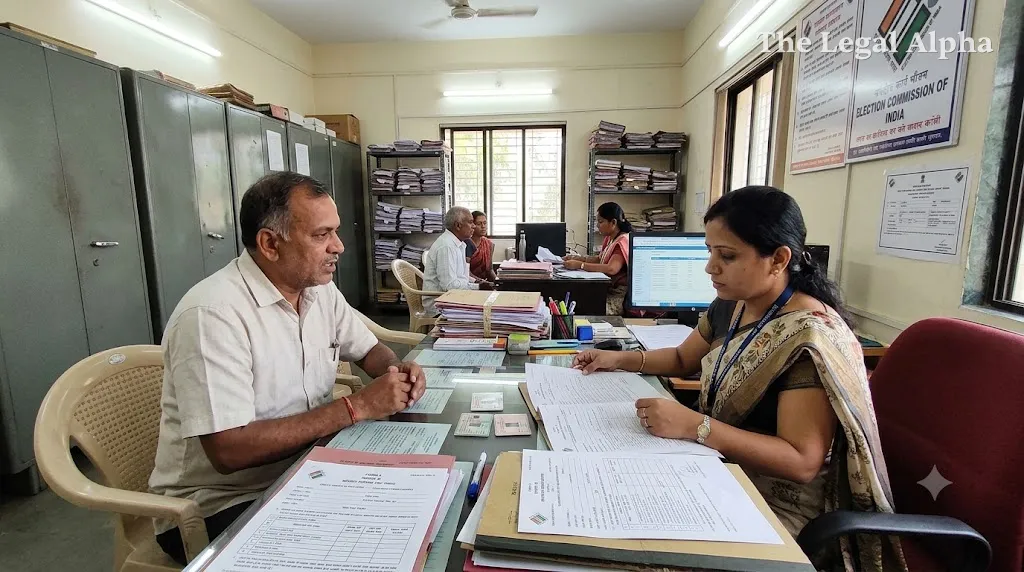
Maharashtra’s Chief Electoral Officer has formally approached the Election Commission of India (ECI) to overhaul Form 6—the statutory application used to add names to the electoral roll.
During the ongoing Special Intensive Revision (SIR) exercise, thousands of established voters whose names were purged or omitted are being instructed to use Form 6 to restore their voting rights. However, Form 6 is titled "Application Form for New Voters" and requires an applicant to swear a mandatory declaration confirming that they are seeking inclusion for the first time. Because making an inaccurate sworn declaration attracts penal consequences under election law, the state poll authority has asked the ECI to drop the "New Voters" label, provide an alternative declaration for previously registered voters, and permit applicants to record their existing EPIC details.
Legal Topic
Area of Law: Election Law / Constitutional Law
Sub-topic: Electoral Roll Revisions / Statutory Declarations / Section 31 RPA
Core Legal Issue
The primary legal conundrum concerns whether an administrative authority can mandate the use of a statutory form designed exclusively for first-time registrants to reinstate previously enrolled voters without forcing citizens to sign a legally false declaration.
Under statutory election framework, signing a declaration claiming first-time registration when an elector has held an active voter identification for years risks violating verification standards and invites penal liability. The core question is whether statutory forms framed under the Registration of Electors Rules can be modified or adapted to reconcile administrative re-enrolment drives with penal safeguards under the parent Act.
What Did the Court / Authority Decide?
The Election Commission of India has received the proposal sent by the Maharashtra Chief Electoral Officer and is reviewing the procedural and legal feasibility of amending the statutory template or forwarding proposed rule revisions to the Union Ministry of Law and Justice.
Concurrently, the issue of using Form 6 for omitted electors has surfaced before the Supreme Court of India. A three-judge bench of the apex court observed that it had not sanctioned any unnotified modifications to Form 6 and noted it is considering judicial directions to streamline re-inclusion mechanisms, advancing upcoming hearings to address the Delhi and national SIR roll revisions.
Key Legal Points
-
Penal Hazard in Sworn Declarations: Form 6 mandates a formal declaration that the applicant has not been registered anywhere else and is enrolling for the very first time, creating statutory contradictions for erroneously deleted voters.
-
Statutory Sanctions: Section 31 of the Representation of the People Act, 1950, establishes that false written statements or declarations during roll preparation or revision constitute a criminal offence punishable by up to one year of imprisonment, a fine, or both.
-
Delegated Legislation and Rule-Making: Prescribed electoral application formats are rooted in the Registration of Electors Rules, 1960; altering statutory declarations across pan-India portals typically necessitates central administrative coordination or statutory notifications.
-
Judicial Review of Electoral Processes: The Supreme Court is reviewing whether ad-hoc administrative workarounds during Special Intensive Revisions compromise procedural propriety or create arbitrary hurdles for disenfranchised citizens.
Relevant Law
-
Section 31, Representation of the People Act, 1950: Penalty for making false declarations or statements concerning electoral rolls.
-
Section 28, Representation of the People Act, 1950: Power of the Central Government, in consultation with the Election Commission, to make rules for the compilation and revision of rolls.
-
Registration of Electors Rules, 1960 (Rule 13 and Rule 26): Statutory framework prescribing Form 6 (inclusion), Form 7 (objection/deletion), and Form 8 (correction/transposition).
Arguments of the Parties
Maharashtra Electoral Authorities:
The State Chief Electoral Officer highlighted that field-level Electoral Registration Officers (EROs) and citizens face genuine procedural traps under the current regime. State authorities submitted that forcing struck-off voters to apply under a form labeled "New Voters" exposes honest electors to technical perjury, while denying them the chance to retain their historical voter identification records.
Election Commission / Central Machinery:
While formal amendments to statutory rules usually require coordination with the Union Law Ministry, election authorities previously directed 20 states and union territories where the SIR process completed to employ Form 6 as an immediate administrative route to restore left-out electors. The regulatory perspective has centered on facilitating rapid voter re-entry onto the roll, treating inclusion forms as the standard gateway for administrative onboarding.
Why Does It Matter?
This development exposes a critical operational gap where administrative shortcuts directly clash with statutory criminal liabilities. For tens of thousands of citizens struck off rolls during intensive verification drives, complying with administrative restoration instructions inadvertently places them in technical breach of the law by forcing them to swear false affidavits.
Fixing Form 6 would safeguard citizens against criminal exposure, preserve administrative audit trails via previous EPIC tracking, and provide clear uniform directions to ground-level registration officers across all jurisdictions undergoing intensive roll purges.
Legal Takeaway
Electoral procedures cannot require citizens to commit statutory misrepresentation merely to reclaim their fundamental franchise. Unless Form 6 is amended to accommodate re-registrations, forcing struck-off voters to declare themselves first-time applicants creates an irreconcilable conflict with Section 31 of the Representation of the People Act, 1950.
Sources
Primary Source:
-
Statutory framework and declarations under Form 6 read with Section 31 of the Representation of the People Act, 1950, and Registration of Electors Rules, 1960.
-
Communications from the Office of the Chief Electoral Officer, Maharashtra to the Election Commission of India.
-
Supreme Court proceedings regarding Form 6 and Special Intensive Revision (SIR) procedures.
Additional Sources:
-
Official filings and press reporting on Maharashtra CEO submissions and ECI revision drives.