Madras High Court Dismisses Challenge to State Restriction on Religious Events in School Grounds as Premature
The Madurai Bench of the Madras High Court dismissed a public interest litigation challenging a Tamil Nadu Government Order (GO) that places general restrictions on holding religious events in educational institutions.
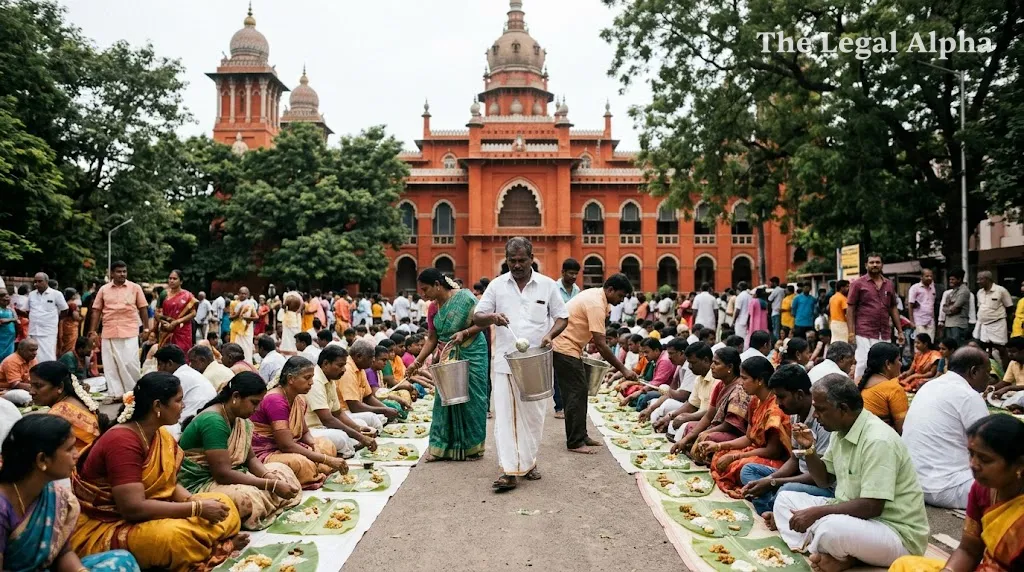
The petitioner approached the High Court apprehending that authorities would enforce the government notification to halt the annual Thirukalyana Virundhu—a traditional community feast organised for roughly 10,000 devotees during the famed Chithirai festival—at the playground of Sethupathi Higher Secondary School in Madurai. A division bench comprising Justice P. Velmurugan and Justice R. Poornima refused to entertain the challenge, ruling that the plea was founded on mere speculation rather than an active prohibition against the festival feast.
Legal Topic
Area of Law: Constitutional Law / Administrative Law
Sub-topic: Judicial Review / Maintainability of Writ Petitions on Apprehension
Core Legal Issue
The principal issue before the court was whether a writ petition under Article 226 of the Constitution can be maintained to invalidate or read down a policy guideline when no concrete, adverse administrative action has been taken against the petitioner.
The court had to determine whether an apprehension that a general regulatory policy might be invoked to prevent a customary cultural and charitable gathering creates an actionable cause of action.
What Did the Court Decide?
The division bench dismissed the petition as premature.
Upon examining the challenged Government Order, the bench noted that the administrative directive does not explicitly ban the Thirukalyana Virundhu or mention any specific traditional festival. Instead, it establishes an across-the-board policy governing religious programmes inside school premises. The judges held that because the petitioner's challenge arose entirely from an unverified anticipation that officials might block the gathering, judicial intervention was unwarranted at this stage.
Key Legal Points
-
Absence of Concrete Injury: The court reiterated that judicial review cannot be invoked in a vacuum based on speculative apprehension of executive action.
-
General Regulatory Scope vs. Specific Bans: A broad administrative instruction regulating events on school grounds cannot be treated as a specific veto against a customary cultural function unless an explicit prohibitive order is passed by the competent authorities.
-
Prematurity of Writ Petitions: When an administrative authority has not formally rejected permission or issued an adverse notice under a policy, a writ petition challenging the underlying policy remains premature.
Relevant Law
-
Article 226 of the Constitution of India: Power of High Courts to issue writs for the enforcement of fundamental rights and for any other purpose.
-
Relevant Tamil Nadu School Education Department Guidelines / Government Order: Executive notifications regulating the conduct of non-academic and religious gatherings inside school premises.
Arguments of the Parties
Petitioner The petitioner submitted that the Thirukalyana Virundhu has been conducted for years during school vacation periods without interfering with academic sessions. The organizers serve meals to approximately 10,000 devotees through voluntary public contributions and community volunteer work, operating entirely without state financial assistance. The petitioner argued that the government notification fails to differentiate ordinary religious programmes from long-standing cultural, charitable, and heritage traditions, creating genuine fear that the venue would be denied.
The State The authorities maintained that the policy order merely establishes uniform governance concerning the use of educational campuses and does not target any single cultural or charitable assembly.
Why Does It Matter?
This ruling underscores the procedural threshold required to sustain writ litigation against government policies. Courts consistently decline to interpret regulatory guidelines in the abstract without a formal order or tangible refusal from the state.
For organizers of cultural and charitable events hosted on educational properties, the decision clarifies that legal remedies must follow concrete administrative action. Organizers must first formally seek administrative sanction; an anticipatory challenge to an overarching policy document will be turned away for lack of immediate cause of action.
Legal Takeaway
Constitutional courts will not strike down or interpret general executive policies on the basis of subjective apprehension alone. A party seeking judicial review must establish a ripened dispute resulting from an actual administrative decision or an immediate, demonstrable injury.
Sources
Primary Source:
-
Madras High Court (Madurai Bench) Order in PIL concerning Chithirai Festival Thirukalyana Virundhu at Sethupathi Higher Secondary School Grounds, Madurai (Bench of Justice P. Velmurugan and Justice R. Poornima).
Additional Sources:
-
The Times of India, "Plea against prohibiting religious feast at school binned", Madurai Edition.
-
The New Indian Express, "Madras HC bins as premature plea alleging ban on Chithirai feast in school".