Karnataka High Court Urges Restraint Among Neighbours as Apartment Garbage Row Escalates into Criminal Cross-Cases
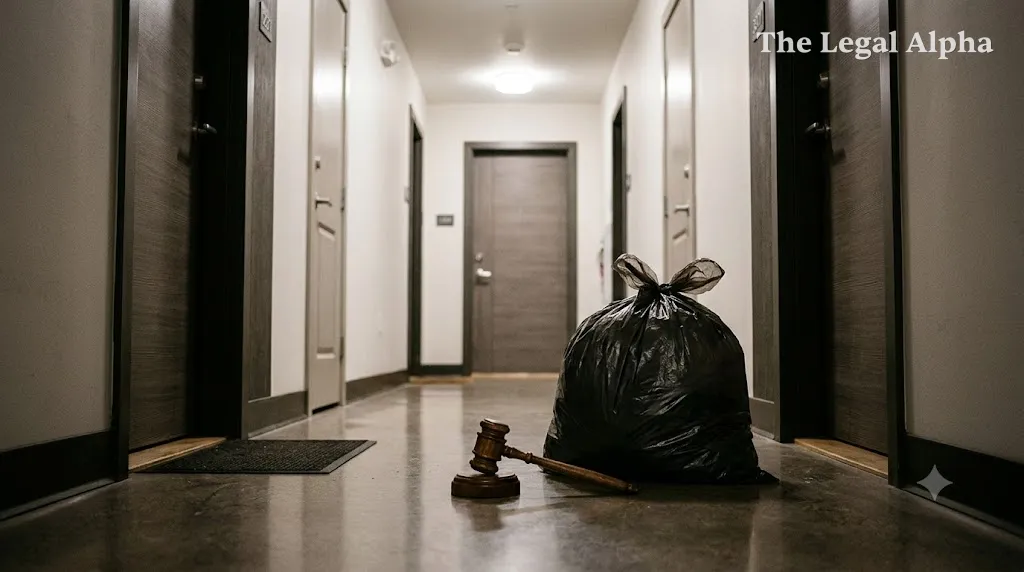
A dispute over household waste left in the shared area of a Bengaluru apartment complex escalated into a violent altercation, severe injuries, and cross-complaints of criminal violence.
The confrontation—which resulted in fractures and other physical injuries—led both resident couples to register criminal counter-cases against one another at the Parappana Agrahara police station. The parties approached the Karnataka High Court invoking its inherent powers to quash the criminal proceedings. Refusing to terminate the cases at the threshold, the High Court declined to quash the proceedings, observing that where allegations involve physical violence and demonstrable bodily injury, criminal culpability and individual liability must be tested at trial rather than prematurely stifled.
Legal Topic
Area of Law: Criminal Law and Procedure
Sub-topic: Quashing of FIRs and Criminal Proceedings / Inherent Powers of the High Court
Core Legal Issue
The legal question before the High Court was whether cross-complaints arising out of a private residential dispute could be quashed under the court's inherent jurisdiction when the record reveals counter-allegations of physical violence, aggravated hurt, and medical records corroborating fractures.
The court had to balance its discretion to prevent the abuse of criminal process in trivial personal disagreements against the obligation to let the law take its course when the altercation escalates to cognizable offences resulting in serious bodily harm.
What Did the Court Decide?
Justice Suraj Govindaraj dismissed the petitions seeking to quash the criminal proceedings, directing that the cases proceed in accordance with law.
-
The court held that it was impermissible at this pre-trial stage to ascertain who initiated the violence or to weigh the comparative culpability of each individual.
-
Observing that medical records documented serious injuries, including fractures, the bench held that prima facie cognizable offences had been made out, necessitating a full criminal trial.
-
Emphasising civic restraint, the bench observed that while shared residential amenities—such as parking, common spaces, noise, and waste collection—often cause day-to-day frustration, they must not become "contests of ego".
-
Invoking the principle to "love thy neighbour," the court observed that living peacefully alongside others does not demand total agreement or the forfeiture of legal rights, but rather calls for mutual tolerance, dialogue, and lawful grievance redressal.
Key Legal Points
-
Threshold for Quashing: The High Court will not exercise its inherent jurisdiction to quash proceedings when counter-complaints are backed by medical evidence indicating grievous hurt or fractures.
-
Determination of Culpability: When cross-cases emerge from an open altercation, questions regarding who acted as the aggressor and who acted in private defence cannot be adjudicated summarily under quashing proceedings; they must be proved through evidence at trial.
-
Escalation of Minor Grievances: The court cautioned that setting criminal law in motion over routine residential differences creates severe, long-term legal peril—including prospective conviction—which could have been avoided by approaching residents' associations or civil dispute mechanisms.
Relevant Law
-
Section 482 of the Code of Criminal Procedure, 1973 (CrPC) / Section 528 of the Bharatiya Nagarik Suraksha Sanhita, 2023 (BNSS): Inherent powers of the High Court to prevent abuse of the process of any court or to secure the ends of justice.
-
Indian Penal Code, 1860 (IPC) / Bharatiya Nyaya Sanhita, 2023 (BNS): Provisions relating to voluntarily causing hurt, causing grievous hurt, and criminal assault arising from violent confrontations.
Arguments of the Parties
The Petitioners (Seeking Quashing):
The respective petitioners argued that the dispute was essentially a private, neighbourly disagreement over apartment upkeep that had been disproportionately criminalised. Both sides sought the intervention of the High Court to truncate the proceedings, contending that continuing the criminal prosecution amounted to an unnecessary hardship and an abuse of court process.
The State and Counter-Complainants:
The State, along with the respective respondents, submitted that the altercation went beyond a minor verbal clash. They pointed to the medical documentation and hospital records confirming physical attacks and fractures, contending that these constitute serious cognizable offences that cannot be dismissed at the threshold without examination of evidence.
Why Does It Matter?
This decision delivers a strong message to urban apartment residents and management committees on the boundaries between civic friction and criminal culpability.
As high-density apartment complexes proliferate in major cities, friction over shared resources—such as waste disposal corridors, parking spaces, and noise levels—is increasingly frequent. When apartment bodies and civic mediation channels fail to address minor complaints early, trivial grievances can spiral into physical altercations.
From a procedural standpoint, the order clarifies that the High Court will not serve as a convenient exit ramp for parties who allow mundane community disputes to cross the line into physical violence. Once severe bodily injuries are sustained and recorded, courts will not shield neighbours from the rigours of criminal prosecution.
Legal Takeaway
Civic inconveniences in shared apartment living must be addressed through dialogue, association bylaws, or lawful grievance forums. Once an everyday dispute descends into physical violence causing demonstrable injury, the High Court will not exercise its inherent powers to quash the cases, leaving all parties to face the formal criminal justice system.
Sources
-
Primary Source: High Court of Karnataka, Bengaluru, Criminal Petition proceedings arising out of Parappana Agrahara Police Station FIRs (Order by Hon'ble Justice Suraj Govindaraj).
-
Additional Sources: Court proceedings reporting via Bangalore Mirror, The Times of India, and The Indian Express.