Inaction Proves Fatal: New York Appeals Court Reaffirms Dismissal of Foreclosure Action Over Three-Year Default Delay
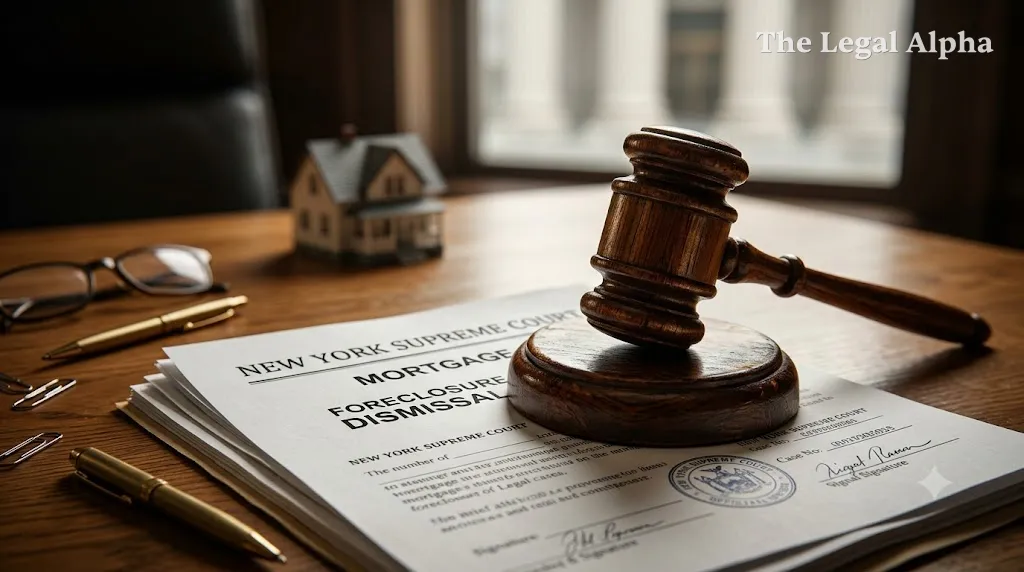
A New York appellate court affirmed the complete dismissal of a residential mortgage foreclosure lawsuit after a lender delayed taking formal proceedings toward a default ruling for nearly three years past the statutory cutoff.
The decision was handed down on October 22, 2026, by the New York Supreme Court, Appellate Division, First Department. The dispute stems from an action where the property owner failed to respond or appear following service of the summons and complaint in 2018. Rather than advancing the litigation within the strict time limits mandated by New York civil practice rules, the plaintiff mortgage servicer took no formal court action toward entry of judgment until 2021. Consequently, the appellate bench held that the action had been abandoned as a matter of law, shutting the door on the lender’s belated enforcement bid.
Legal Topic
-
Area of Law: Civil Litigation / Banking & Real Estate Law
-
Sub-topic: Mortgage Foreclosure / Default Judgments / Abandonment under CPLR 3215(c)
Core Legal Issue
The principal question before the appellate division was whether a foreclosing lender’s failure to take formal legal steps toward seeking a default judgment within one year of a borrower's default requires dismissal of the complaint as abandoned, and whether non-judicial administrative delay can qualify as sufficient cause to excuse a multi-year gap.
What Did the Court Decide?
The Appellate Division, First Department affirmed the lower court's dismissal, rejecting the lender's attempt to revive the proceeding.
The court held that under state procedural law, dismissal is mandatory when a plaintiff permits more than one year to pass without initiating proceedings for the entry of judgment, absent an adequate showing of reasonable cause and a meritorious claim. Because the lender waited until 2021—three full years after the responsive deadline had lapsed in 2018—without establishing a legally recognized justification, the foreclosure action was deemed abandoned and conclusively dismissed. The decision brings an end to the appeal and bars the plaintiff from proceeding under the current action.
Key Legal Points
-
Strict Statutory Deadlines: New York civil procedure imposes an affirmative duty on plaintiffs to take active proceedings for the entry of judgment within twelve months of a defendant's default in appearance or answering.
-
Administrative Delays Insufficient: Routine office communications, informal borrower correspondence, or internal portfolio/servicing transfers do not count as active court proceedings and fail to establish reasonable cause for years of inactivity.
-
Presumption of Abandonment: When the statutory deadline lapses without action, the case is deemed abandoned by operation of law unless the plaintiff meets the heavy dual burden of showing reasonable excuse and legal merit.
-
Judicial Discretion is Not Boundless: Courts cannot overlook prolonged systemic delays merely because a defendant never appeared to contest the debt.
Relevant Law
-
Section 3215(c) of the New York Civil Practice Law and Rules (CPLR): Mandates that if the plaintiff fails to take proceedings for the entry of judgment within one year after default, the court shall not enter judgment but shall dismiss the complaint as abandoned, unless sufficient cause is shown.
-
New York Real Property Actions and Proceedings Law (RPAPL): Governing frameworks applicable to foreclosure timelines and mandatory default procedures.
Arguments of the Parties
-
The Lender / Plaintiff:
The foreclosing party maintained that the underlying default on the secured note was uncontested and that internal administrative servicing hurdles or operational transitions accounted for the procedural lapse, arguing that dismissal represented an overly harsh penalty where borrower default was clear.
-
The Borrower / Defendant (and Lower Court Posture):
The position upholding dismissal maintained that CPLR 3215(c) leaves no room for open-ended shelf life in litigation. A party invoking the court's jurisdiction cannot sleep on its rights for years while a cloud hangs over real property, and informal internal activity does not cure statutory abandonment.
Why Does It Matter?
This ruling underscores the recurring risks institutional lenders face in volume-based loan servicing. In New York, foreclosure litigation is notoriously complex, and mortgage servicers frequently change hands during loan defaults.
The First Department’s refusal to pardon a three-year gap highlights that procedural rigor takes precedence over debt enforcement when plaintiffs do not monitor court timetables. For financial institutions, servicers, and foreclosure counsel, it sends an unequivocal warning: letting default matters sit idle risks permanent dismissal, potential statute-of-limitations traps, and the forfeiture of foreclosure rights under existing proceedings.
Legal Takeaway
Under New York law, a defendant's default does not give a lender an indefinite pass to delay. Plaintiffs must take concrete, formal legal steps to enter a default judgment within one year, or they risk having their foreclosure lawsuit thrown out entirely for abandonment.
Sources
-
Primary Source: Decision and Order of the Supreme Court of the State of New York, Appellate Division, First Department (Decided October 22, 2026).
-
Additional Sources: New York Civil Practice Law and Rules (CPLR § 3215(c)); Appellate Case Records and Reporting via Times of India / MSN Legal Desk (October 24, 2026).