Florida Appeals Court Affirms Homeowner’s $240,000 Award, Clarifying Vibration Loss Is Not Excluded Earth Movement
Florida’s Third District Court of Appeal affirmed a final judgment and jury verdict in favor of Miami homeowner Sandra Moise against Homeowners Choice Property & Casualty Insurance Company, concluding a coverage dispute spanning more than a decade.
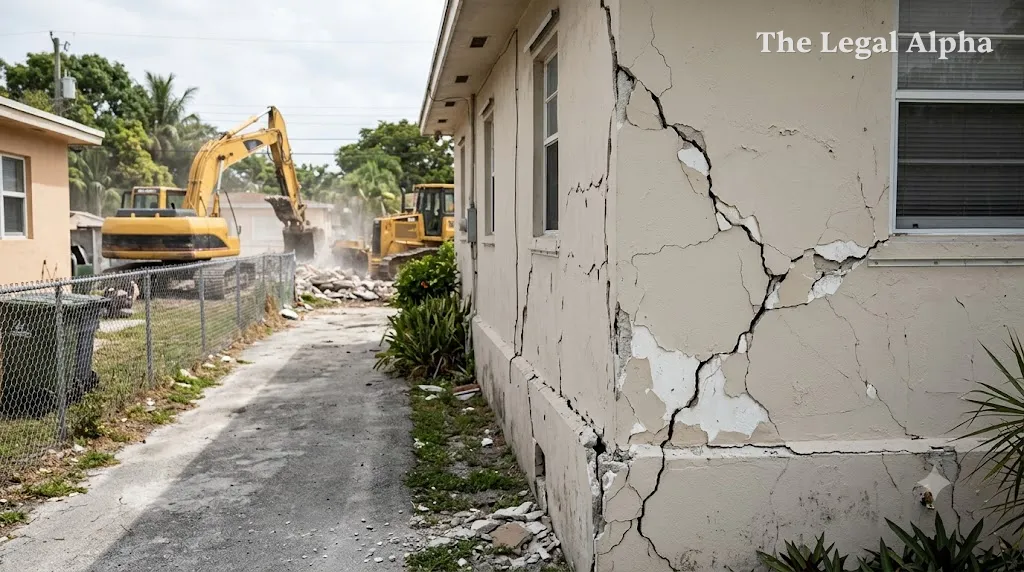
The litigation originated from a March 1, 2014 incident in which demolition activity at an adjacent residential property produced intense tremors that compromised the floors, walls, and ceiling of Moise’s residence. After the insurer formally denied coverage on June 6, 2014 by invoking policy exclusions related to earth movement and settlement, Moise initiated legal proceedings in August 2014. Following a trial court jury verdict that awarded Moise $240,000 in damages plus prejudgment interest, the insurer appealed, seeking to vacate the final judgment entered on May 1, 2024.
Legal Topic
-
Area of Law: Insurance Law
-
Sub-topic: Property Insurance / Policy Exclusions / Earth Movement & Vibration
Core Legal Issue
The fundamental legal question before the appellate court was whether physical structural damage caused strictly by shockwaves and vibrations traveling through subsoil constitutes excluded "earth movement" or "settling" within a standard homeowners insurance policy.
Additionally, the court examined whether monetary damages could be validly awarded alongside declaratory relief when the insured's operative complaint sought both a determination of coverage and compensation for the underlying physical loss.
What Did the Court Decide?
The Third District Court of Appeal affirmed the trial court’s final judgment in its entirety. The appellate panel determined that:
-
The trial court did not err in denying the insurer’s motion for summary judgment and properly submitted the factual cause of loss to the jury.
-
Damage generated by shockwaves and mechanical vibrations from third-party construction equipment is legally distinct from natural or physical displacement of soil under policy exclusions.
-
Conflicting expert testimonies concerning whether the cracks arose from vibrations or natural settling fell squarely within the jury's purview to evaluate and weigh.
-
Under Florida statutory law governing declaratory actions, monetary damages were appropriately awarded because the plaintiff sought both declaratory relief and consequential recovery for covered damages.
Key Legal Points
-
Vibration Distinct from Earth Movement: Transmission of mechanical energy or shockwaves through limestone and subsoil does not automatically trigger standard policy exclusions designed for physical shifting, sinking, or expansion of soil.
-
Jury Discretion on Competing Expert Evidence: When opposing experts disagree on whether damage was produced by transient external vibrations or pre-existing foundation settlement, the question of proximate causation is an issue of fact for the jury.
-
No Prejudicial Trial Error: Precluding argumentative assertions that vibrations equate as a matter of law to earth movement did not prevent the insurer from presenting its factual defense that settlement caused the cracks.
-
Supplemental Relief in Declaratory Actions: A complaint styled as a declaratory judgment action can sustain an award of money damages and prejudgment interest if monetary relief was pled and flows directly from the resolution of coverage.
Relevant Law
-
Florida Statutes Chapter 86 (Declaratory Judgments): Specifically Section 86.011 (jurisdiction to issue declaratory relief) and Section 86.061 (supplemental relief granted based on a declaratory decree when necessary or proper).
-
Florida Standard Property Insurance Jurisprudence: Established case precedent interpreting proximate cause doctrine and the strict construction of exclusionary clauses against insurers.
Arguments of the Parties
Appellant / Insurer (Homeowners Choice Property & Casualty Insurance Company):
The insurer argued that the structural damage fell strictly within policy exclusions for earth movement, soil shifting, and the settling or cracking of foundations. It asserted that the trial court erroneously interpreted the policy terms, improperly restricted evidence and argument regarding vibrations, and erred by entering a monetary damages award in an action centered on declaratory relief.
Appellee / Insured (Sandra Moise):
The homeowner argued that heavy equipment at the neighboring site generated powerful mechanical shockwaves that directly damaged her home’s foundation and superstructure. Her structural engineering expert established that the harm was caused exclusively by vibrational force rather than displacement, compaction, or subsidence of the underlying ground, rendering the earth-movement exclusion inapplicable.
Why Does It Matter?
This decision provides practical clarity on a recurring dilemma in urban property insurance: damage caused by adjoining heavy demolition, pile-driving, and excavation. Insurers routinely deny adjacent-property damage claims by categorizing all ground-transmitted disturbances as excluded "earth movement."
By preserving the legal distinction between soil displacement and shockwave transmission, the ruling prevents insurers from broadly stretching earth-movement exclusions beyond their natural meaning. It also reaffirms the procedural efficiency of Florida's Declaratory Judgment Act, confirming that insured policyholders need not file separate piecemeal actions to secure compensatory relief once coverage is judicially established.
Legal Takeaway
Policy exclusions for "earth movement" and "settling" do not automatically shield insurers from liability when physical damage is driven by external shockwaves or mechanical vibrations. Where ground material does not physically displace or subside, proximate causation remains a jury question subject to expert analysis.
Sources
-
Primary Source: Homeowners Choice Property & Casualty Insurance Company v. Sandra Moise, Opinion rendered October 28, 2026, Florida Third District Court of Appeal.
-
Additional Sources: Trial record, Eleventh Judicial Circuit Court in and for Miami-Dade County, Florida (Final Judgment entered May 1, 2024); Florida Statutes §§ 86.011, 86.061.