Federal Court Blocks Justice Department Program to Scrutinize State Voter Rolls Using Immigration Data
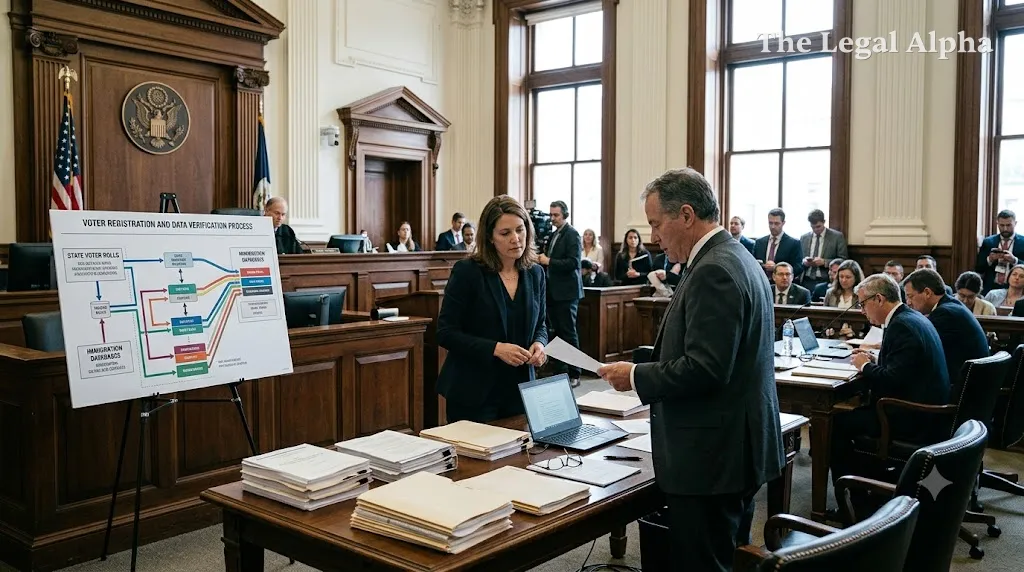
A federal district court in Washington, D.C., halted a contentious policy initiated by the U.S. Department of Justice aimed at collecting state voter registration lists and cross-referencing them against federal immigration databases. Under the challenged initiative, the DOJ sought detailed voter records—including personal identifiers such as dates of birth, driver's license details, and partial Social Security numbers—to identify purported non-citizens and prompt state officials to purge flagged individuals.
Voting rights organizations, led by Common Cause, filed suit challenging the program. The court ruled in their favor, finding that the federal government overreached its statutory mandate, ignored mandatory procedural safeguards, and impermissibly intruded into state-administered election processes.
Legal Topic
Area of Law: Election Law & Administrative Law
Sub-topic: Voter Registration / Federalism & Privacy Compliance
Core Legal Issue
The central question before the court was whether the Department of Justice possessed statutory authority to demand comprehensive state voter registries for nationwide immigration matching, and whether implementing such a data-matching directive without public notice or formal procedural rulemaking violated the Administrative Procedure Act and the Privacy Act.
A secondary question centered on constitutional federalism: whether executive branch agencies can unilaterally compel states to alter voter rolls, overriding state authority over election administration and statutory timelines established by Congress.
What Did the Court / Authority Decide?
The court granted summary relief to the plaintiffs and vacated the federal policy, ruling that the Justice Department acted outside the scope of powers conferred by Congress.
The court held that:
-
The DOJ lacked express authority under federal election statutes to mandate national voter list audits or compel states to cancel registrations based on immigration cross-checks.
-
The agency failed to satisfy the procedural requirements of the Privacy Act, which mandates public notice, opportunity for comment, and clear safeguards before federal systems of records are expanded or matched across agencies.
-
While the federal program was struck down, the ruling preserves the traditional, statutory authority of individual states to maintain their own voter rolls within federally prescribed rules.
Key Legal Points
-
Absence of Delegated Power: Federal executive agencies may only exercise powers expressly delegated by Congress; election oversight statutes do not grant the executive branch unilateral power to conduct systemic nationwide voter purges.
-
Administrative & Privacy Violations: Repurposing immigration verification tools—such as the Systematic Alien Verification for Entitlements (SAVE) framework—for widespread voter list audits without formal rule-making triggers actionable violations of the Privacy Act and the Administrative Procedure Act.
-
Integrity of Statutory Deadlines: Large-scale or automated list-matching programs close to elections run afoul of statutory protections designed to insulate eligible voters from erroneous removals.
-
Federalist Division of Responsibility: Primary authority over the administration and routine maintenance of voting rolls remains anchored with state election officials, not federal executive departments.
Relevant Law
-
National Voter Registration Act of 1993 (NVRA): 52 U.S.C. §§ 20501–20511 (governing voter registration maintenance and establishing the 90-day "quiet period" restricting systematic voter purges prior to federal elections).
-
Administrative Procedure Act (APA): 5 U.S.C. § 706 (empowering courts to set aside agency actions that are arbitrary, capricious, or beyond statutory jurisdiction).
-
Privacy Act of 1974: 5 U.S.C. § 552a (regulating federal agency collection, use, and cross-matching of personal records and requiring system-of-records notices).
-
U.S. Constitution, Article I, Section 4 (Elections Clause): Allocating primary authority over the time, places, and manner of holding federal elections to the states, subject to Congressional alteration.
Arguments of the Parties
Petitioner / Plaintiffs (Common Cause and Voters)
The plaintiffs argued that the Justice Department lacked congressional authorization to aggregate sensitive voter data and weaponize federal databases for list removal. They contended that immigration databases are prone to outdated records—particularly regarding naturalized citizens—and that using them for automated roll purges risks disenfranchising eligible voters. Additionally, they asserted that the DOJ bypassed mandatory Privacy Act publication procedures and infringed upon state autonomy in election administration.
Respondent (U.S. Department of Justice)
The DOJ maintained that it holds inherent and statutory authority to enforce federal election laws, including ensuring that only eligible U.S. citizens participate in federal elections. The department argued that cross-referencing registration records with immigration databases was a permissible investigative measure intended to assist states in complying with their statutory obligations to maintain clean and accurate voter rolls.
Why Does It Matter?
This decision establishes a critical judicial check on federal executive overreach into election administration. By reaffirming that federal agencies cannot repurpose administrative immigration systems into de facto election enforcement tools without clear legislative authorization, the ruling preserves statutory safeguards for voters—particularly naturalized citizens whose records often take time to update across disparate federal systems.
The judgment also protects individual privacy rights by enforcing the strictures of the Privacy Act against high-level federal data aggregation. Furthermore, it shields state election administrators from conflicting directives between federal executive mandates and state-level voter list management rules.
Legal Takeaway
Federal agencies cannot expand their administrative powers or repurpose databases into voter audit systems without explicit congressional authorization and strict compliance with the Privacy Act. The decision affirms that authority over voter roll maintenance resides fundamentally with the states, within the procedural guardrails established by Congress.
Sources
Primary Source:
-
Common Cause v. U.S. Department of Justice, Memorandum Opinion & Order (U.S. District Court for the District of Columbia, October 2026).
Additional Sources:
-
National Voter Registration Act of 1993, 52 U.S.C. § 20501 et seq.
-
Privacy Act of 1974, 5 U.S.C. § 552a
-
Administrative Procedure Act, 5 U.S.C. § 701 et seq.