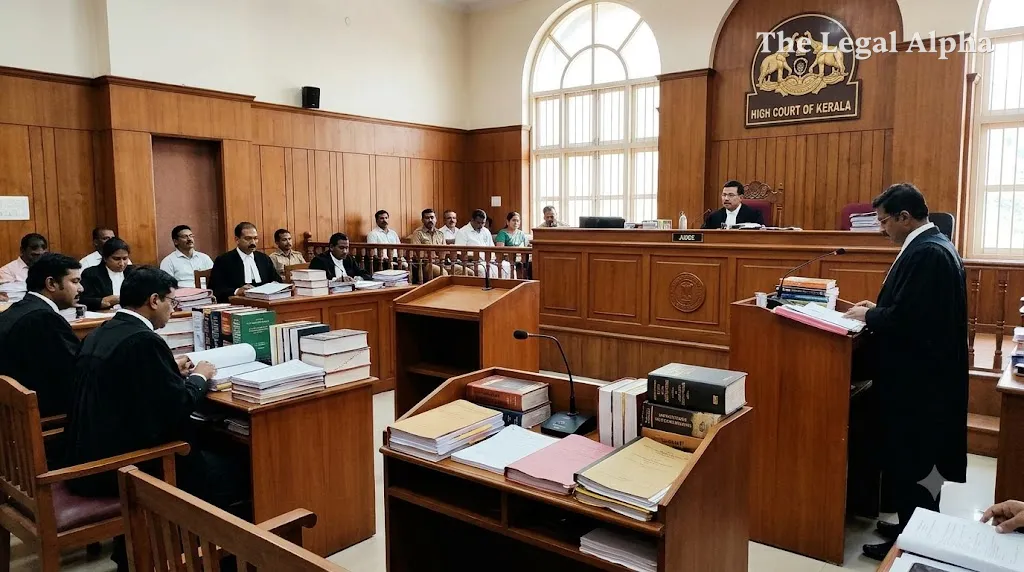
Facilitators of Fraudulent Identity Documents for Illegal Infiltrators Must Face Prosecution: Bombay High Court

The Bombay High Court has directed the Unique Identification Authority of India (UIDAI) to furnish all enrollment records and application documents submitted by an alleged illegal foreign national to state investigators within two weeks. The order came in a criminal petition filed by the State of Maharashtra through the Anti-Terrorism Squad (ATS).
Expressing grave concern over foreign nationals infiltrating Indian territory and subsequently obtaining official identity papers using forged credentials, the Division Bench of Justice A. S. Gadkari and Justice Kamal Khata made it clear that local facilitators and conspirators aiding such identity fraud must face rigorous criminal proceedings.
Legal Topic
-
Area of Law: Criminal Law / National Security & Identity Verification
-
Sub-topic: Aadhaar Fraud / Forgery / Border Infiltration and Conspiracy
Core Legal Issue
The core question before the High Court was whether the statutory authority governing national unique identification can be directed to disclose underlying enrollment records to state investigative agencies probing identity forgery, and to what extent facilitators who assist foreign nationals in acquiring domestic identity credentials can be held liable under penal statutes.
What Did the Court Decide?
The High Court allowed the petition brought by the State and issued categorical directions:
-
Directed the UIDAI to hand over all documents tendered during the enrollment process by the accused respondent to the investigating agency within two weeks from the date the order is uploaded to the court’s official portal.
-
Mandated that law enforcement agencies must identify, interrogate, and prosecute any facilitators, agents, or conspirators who assist foreign nationals in securing identity cards through bogus documentation.
-
Directed investigators to bring the probe to its logical conclusion expeditiously, reiterating that obtaining official papers on false pretenses constitutes an issue of serious public and national concern.
Key Legal Points
-
Expeditious State Investigation: Infiltration coupled with the acquisition of domestic identity documents threatens internal security and demands swift, thorough criminal investigation.
-
Prosecution of Facilitators: Criminal liability does not end with the unauthorized immigrant; local associates, middle-tier facilitators, and conspirators who supply forged paperwork must be prosecuted under applicable penal laws.
-
Inter-Agency Disclosure: Statutory confidentiality mechanisms cannot serve as an obstacle when an authorized investigating agency requires enrollment records to establish forgery and fraudulent procurement of identity papers.
Relevant Law
-
The Aadhaar (Targeted Delivery of Financial and Other Subsidies, Benefits and Services) Act, 2016: Provisions governing identity enrollment, confidentiality, and penalties for impersonation or furnishing false demographic information.
-
The Bharatiya Nyaya Sanhita, 2023 / Indian Penal Code, 1860: Offenses relating to cheating, forgery of official records, and criminal conspiracy.
-
The Foreigners Act, 1946: Provisions concerning unauthorized entry, residence, and aiding/abetting illegal entry.
Arguments of the Parties
Petitioner (State of Maharashtra / ATS)
The State argued that the accused, an illegal foreign national, obtained government identity records using counterfeit supporting documentation to pose as a domestic citizen. The prosecution contended that access to the original underlying application papers submitted during the enrollment was vital for tracing how the fraudulent verification took place and uncovering the wider racket assisting unauthorized entrants.
Respondents (UIDAI & Others)
The authority appeared through legal counsel to clarify its operational scope, statutory obligations, and data compliance frameworks regarding the production of record materials before state investigating bodies.
Why Does It Matter?
This ruling sharpens law enforcement focus on the supply-chain side of identity fraud. Often, enforcement actions only penalize the end user or undocumented immigrant. By directing an uncompromising inquiry into the facilitators—such as local documentation agents, forged stamp suppliers, and administrative conspirators—the High Court reinforces that local networks enabling unauthorized residency will face serious criminal liability. It also emphasizes procedural coordination between the UIDAI and state police agencies when identity papers are allegedly secured via forged root documents.
Legal Takeaway
Procuring official identity papers on fraudulent pretexts is not treated merely as a regulatory irregularity, but as a serious criminal conspiracy. Any intermediary or facilitator who aids foreign nationals in manufacturing false identities faces rigorous prosecution, and statutory bodies must cooperate with investigating agencies by furnishing enrollment records.
Sources
Primary Source:
-
High Court of Judicature at Bombay (Appellate Side): The State of Maharashtra v. Unique Identification Authority of India and Ors. [Neutral Citation: 2026:BHC-AS:42669-DB; Coram: Gadkari & Khata, JJ.]
Additional Sources:
-
Reports and legal case digests covering the Bombay High Court directives dated October 21–22, 2026.