Delhi Police Book Lawyers Following Shahdara Station Altercation; District Court Advocates Halt Judicial Work Across the Capital
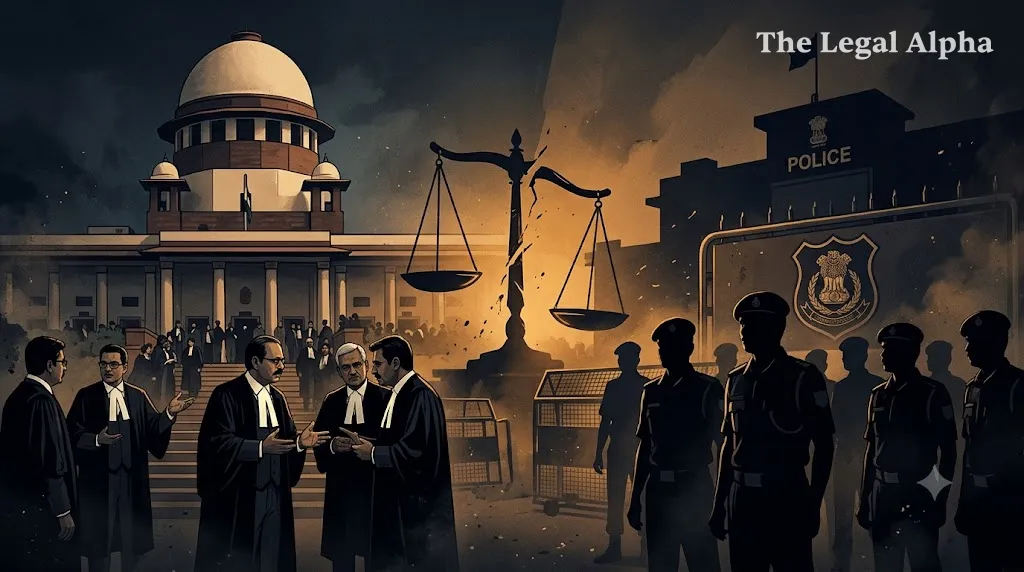
Delhi Police initiated criminal proceedings against a group of 15 to 20 advocates following an escalating confrontation inside the Shahdara police station. The First Information Report (FIR) stems from allegations of verbal abuse, obstruction of official duties, and physical misbehavior directed toward senior police personnel within the station premises.
In response to the criminal case and the underlying incident, the Coordination Committee of All District Courts Bar Associations of Delhi launched a one-day strike, completely suspending judicial work across all district courts in the capital. The legal fraternity stated that the protest was prompted by high-handed police conduct, alleging that an Assistant Commissioner of Police (ACP) drew a firearm and threatened lawyers during an inquiry into a separate assault case.
Legal Topic
-
Area of Law: Criminal Law
-
Sub-topic: Deterring Public Servants from Duty & Disruption of Judicial Administration
Core Legal Issue
The primary legal inquiry centers on whether the conduct of the advocates inside the police station satisfies the statutory ingredients of obstructing and using criminal force against public servants under the Bharatiya Nyaya Sanhita (BNS). Concurrently, the dispute raises procedural questions regarding the permissible limits of police authority, specifically whether the alleged brandishing of a service weapon against legal representatives constitutes an abuse of official power and criminal intimidation within an active law enforcement facility.
What Did the Court / Authority Decide?
-
Police Action: The Delhi Police officially registered an FIR against 15 to 20 advocates based on a complaint filed by the Assistant Commissioner of Police (Gandhi Nagar). The matter remains under active investigation, with authorities relying on station CCTV footage as primary evidentiary material.
-
Bar Association Action: The Coordination Committee resolved to abstain from all court proceedings for the day, formally demanding the immediate suspension of both the ACP and the concerned Station House Officer (SHO) pending an impartial inquiry.
-
Judicial Status: No court has rendered a final ruling on the merits or the validity of the allegations. The proceedings remain at the pre-trial investigative stage.
Key Legal Points
-
Application of New Penal Provisions: The charges mark an active deployment of newly codified offenses under the Bharatiya Nyaya Sanhita (BNS) concerning resistance to lawful public authority.
-
Reliance on Objective Digital Evidence: Internal CCTV surveillance records from the police station will serve as the determinative evidentiary foundation to evaluate the competing factual assertions.
-
Scope of Advocacy vs. Unlawful Obstruction: The case underscores the legal threshold separating aggressive professional representation of a client from unlawful interference with administrative and investigatory functions.
-
Institutional Impact of Work Abstentions: The strike once again brings into focus long-standing judicial directives regarding the legality of collective work boycotts by bar associations and their impact on litigants' fundamental access to justice.
Relevant Law
-
Bharatiya Nyaya Sanhita (BNS):
-
Section 221: Obstructing a public servant in the discharge of public functions.
-
Section 132: Assault or criminal force used to deter a public servant from discharge of duty.
-
Section 224: Threat of injury to a public servant.
-
Section 3(5): Joint liability arising from acts done in furtherance of a common intention.
-
Arguments of the Parties
Police Allegations (The Complainant)
According to the complaint submitted by ACP Manasvi Vashishth, a group of advocates initially confronted and questioned a head constable at the Karkardooma court complex before later assembling at the Shahdara police station. The police alleged that 15 to 20 advocates entered the SHO's office, leveled unsubstantiated bribery accusations regarding the handling of an earlier case, shouted abuses, and physically attempted to drag the SHO by his arm while obstructing routine duties.
Bar Association Contentions (The Advocates)
The Coordination Committee of All District Courts Bar Associations contended that the lawyers visited the police station to demand accountability regarding an assault on an advocate who had sustained severe head injuries. The Bar alleged that despite assurances that the attackers would be apprehended, the suspects were improperly released. The association further asserted that during the inquiry, the ACP exhibited high-handedness by displaying her service revolver to intimidate the advocates.
Why Does It Matter?
This conflict highlights the delicate institutional relationship between law enforcement agencies and legal practitioners—two essential pillars of the justice delivery system. When administrative friction escalates into criminal allegations and work stoppages, judicial operations stall, resulting in adjourned hearings, delayed bail applications, and compromised access for ordinary citizens. Furthermore, the case will serve as an early benchmark for how courts interpret and enforce public-obstruction provisions under the BNS during confrontations inside law enforcement facilities.
Legal Takeaway
Advocacy does not extend to the unlawful disruption of law enforcement duties, nor does official police authority permit excessive or intimidating displays of force against officers of the court. In such institutional clashes, contemporaneous digital records like CCTV footage govern the evidentiary outcome, while work stoppages carry significant legal and procedural consequences for the administration of justice.
Sources
-
Primary Source: First Information Report (FIR) registered at Shahdara Police Station under Sections 221, 132, 224, and 3(5) of the Bharatiya Nyaya Sanhita (BNS), based on the official complaint of ACP Manasvi Vashishth; and the official resolution issued by the Coordination Committee of All District Courts Bar Associations of Delhi.
-
Additional Sources: Media reporting and coverage from Times Now and IANS.