Delhi Metro Fatal Assault: Former IAS Officer and Son Sent to Judicial Custody Under Culpable Homicide Charges
A dispute over a reserved senior citizen seat aboard a Delhi Metro train resulted in the death of a 48-year-old passenger, leading to the arrest and judicial remand of a retired IAS officer and his advocate son.
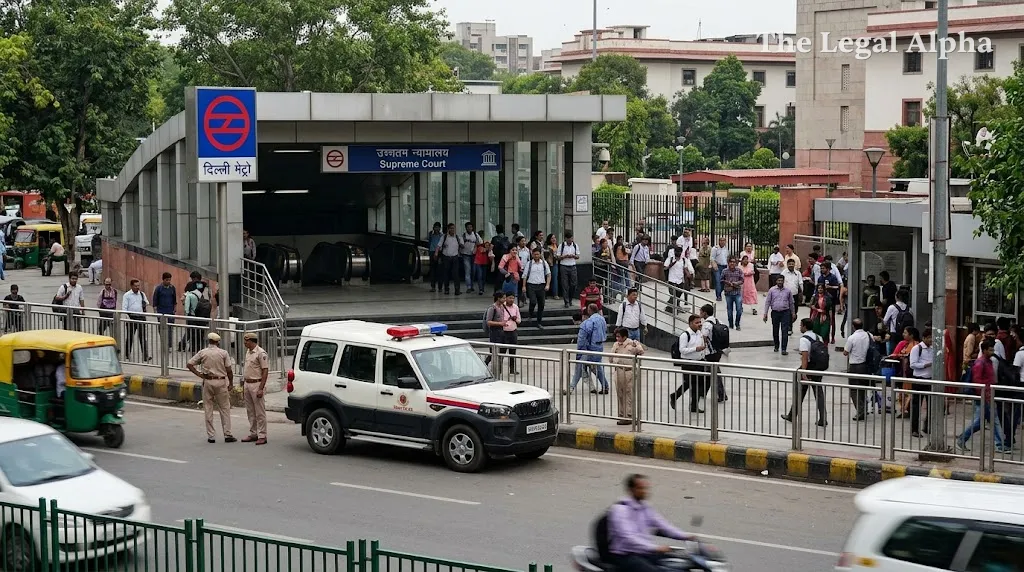
On October 8, 2026, the deceased, Pawan Sharma, was travelling with his mother, Durga Sharma, near the Supreme Court Metro Station when an altercation escalated between him and two co-passengers—former bureaucrat Sanjay Pratap Singh (65) and his son Sidharth Singh (36). According to the complaint, Sharma was allegedly pushed and struck during the altercation, causing him to fall heavily to the floor and sustain fatal blunt trauma. Metro personnel transported him to Lok Nayak Jai Prakash (LNJP) Hospital, where he was pronounced dead upon arrival.
Following an FIR lodged on October 9, 2026, at the Supreme Court Metro Police Station, Delhi Police arrested both accused individuals and produced them before the jurisdictional magistrate, who remanded them to 14 days of judicial custody.
Legal Topic
-
Area of Law: Criminal Law / Public Transit Offences
-
Sub-topic: Culpable Homicide / Joint Liability / Remand and Custody
Core Legal Issue
The primary legal determination centers on classifying the degree of criminal liability under modern penal provisions where a physical altercation—unaccompanied by conventional deadly weapons—causes death in a public space.
Specifically, the investigating agency and the magistrate must navigate whether the act demonstrates the requisite knowledge under Section 105 of the Bharatiya Nyaya Sanhita (BNS) that the assault was likely to cause death, or whether the conduct represents simple hurt escalating unexpectedly into a fatality, while also establishing the parameters of shared intention under Section 3(5) of the BNS.
What Did the Court / Authority Decide?
-
The jurisdictional magistrate declined immediate police custody or summary release and remanded both Sanjay Pratap Singh and Sidharth Singh to 14 days of judicial custody.
-
Delhi Police formally booked the accused under provisions governing culpable homicide not amounting to murder and common intention.
-
The court directed the preservation of evidence, while police continue examining CCTV footage from the coach and station alongside witness accounts from fellow commuters.
-
Regular bail applications, if moved by the defence, remain pending future hearing upon completion of initial investigative formalities.
Key Legal Points
-
Invocation of BNS Over IPC: The prosecution has applied the Bharatiya Nyaya Sanhita, 2023, reflecting offenses committed post-July 1, 2024, specifically charging Section 105 (culpable homicide not amounting to murder) instead of the former Section 304 of the Indian Penal Code.
-
Application of Joint Liability: Invoking Section 3(5) of the BNS requires the prosecution to substantiate that both father and son acted in furtherance of a shared criminal intention during the spontaneous brawl.
-
Relevance of Forensic Cause of Death: Because the fatality arose from a push and subsequent fall, the post-mortem report and forensic analysis of the head injury will be central to establishing whether the force used satisfies the statutory standard of culpable homicide.
-
Judicial Remand Standard: The magistrate’s decision to commit the accused to judicial custody preserves the integrity of the investigation, mitigating risks of witness intimidation given the high-profile administrative and legal standing of the accused.
Relevant Law
-
Section 105, Bharatiya Nyaya Sanhita, 2023 (BNS): Punishment for culpable homicide not amounting to murder.
-
Section 3(5), Bharatiya Nyaya Sanhita, 2023 (BNS): Joint criminal liability arising from acts done by several persons in furtherance of common intention.
-
Section 187, Bharatiya Nagarik Suraksha Sanhita, 2023 (BNSS): Procedure and power of the magistrate to order police or judicial remand during investigation.
-
Delhi Metro Railway (Operation and Maintenance) Act, 2002: Statutory provisions and bylaws governing passenger conduct and safety on metro premises.
Arguments of the Parties
Complainant and Prosecution The State and the complainant submitted that the accused initiated a physical confrontation over a seat designated for senior citizens, delivering blows and violently shoving the victim. The prosecution asserted that assaulting a commuter inside a moving transit car demonstrates sufficient knowledge of potential fatal harm, justifying the non-bailable charge of culpable homicide and warranting custodial detention to ensure witness cooperation.
Accused / Defence While formal bail pleadings are developing, the defence position maintains that the incident was a sudden, unpremeditated verbal dispute without any premeditation or lethal intention. The defence argues that the ensuing death was an unforeseen, tragic medical outcome rather than an intentional homicide, contending that the ingredients required under Section 105 of the BNS are not met and that custodial detention is unjustified for individuals with deep roots in society.
Why Does It Matter?
This development highlights the intersection of everyday public transit altercations with serious felony prosecutions under the newly implemented criminal codes. For transit authorities and the public, the case underscores the legal severity of micro-aggressions in crowded transit systems, demonstrating that spontaneous physical violence leading to fatal falls will be prosecuted as culpable homicide rather than minor assault.
For criminal jurisprudence, the matter illustrates how courts balance the absence of conventional weapons with the requirement of statutory "knowledge" of likely fatality under Section 105 of the BNS. It serves as a reminder to law enforcement and lower judiciaries regarding the strict evidentiary thresholds needed to sustain non-bailable homicide charges during initial remand stages.
Legal Takeaway
A physical shove or strike during a public dispute can cross the threshold into culpable homicide if it causes a fatal fall, exposing participants to severe non-bailable liability under Section 105 of the BNS regardless of prior intent. The ruling reinforces that status or profession offers no procedural shield against judicial custody when public violence turns fatal.
Sources
-
Primary Source: First Information Report (FIR), Supreme Court Metro Police Station (Registered October 9, 2026; under Sections 105 and 3(5) of the Bharatiya Nyaya Sanhita, 2023).
-
Additional Sources: Delhi Police Briefing; ANI News Report (October 13, 2026); Republic World Legal Report (October 13, 2026).