Delhi High Court Scrutinises Delhi University’s One-Year Master’s Admissions Amid Equal Opportunity Challenge
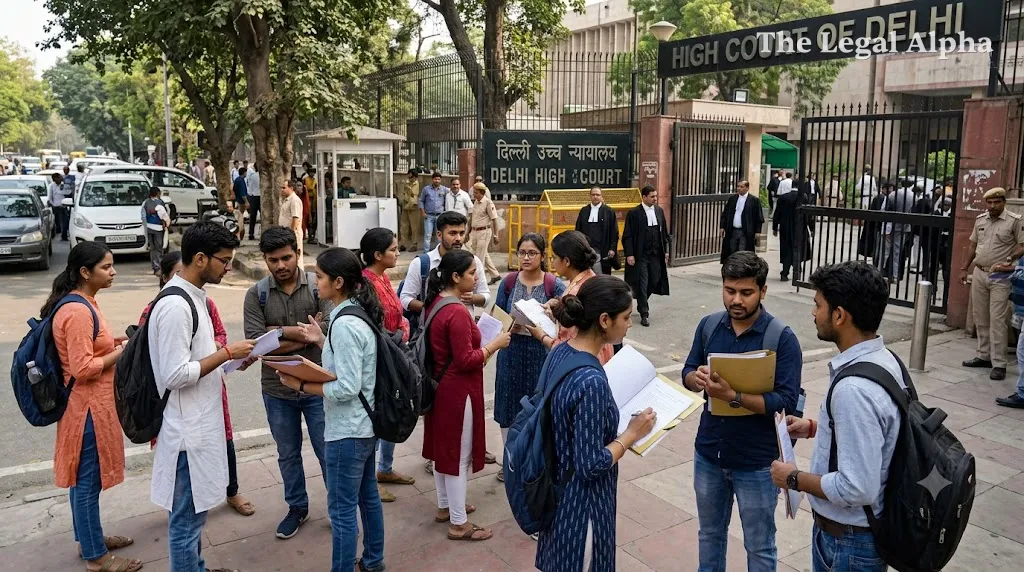
Around 100 students have approached the Delhi High Court through a cluster of writ petitions challenging the University of Delhi's admission framework for its newly launched one-year postgraduate programmes. The dispute stems from the university's decision to accord admission priority to graduates possessing four-year honours degrees over applicants holding four-year general or programme degrees under the Undergraduate Curriculum Framework (UGCF-2022).
The petitioners contend that the Programme-Specific Eligibility (PSE) priority structure unfairly handicaps non-honours four-year graduates, leaving seats unallocated and candidates shut out despite meeting core qualification standards.
Legal Topic
Area of Law: Education Law / Administrative Law
Sub-topic: University Admission Norms and Equality under Article 14
Core Legal Issue
The fundamental legal question before the court is whether an academic institution can create an internal hierarchy between different categories of four-year degree holders for postgraduate admissions without violating the mandate of Article 14 of the Constitution.
The court must assess whether conferring an absolute preference to honours degree holders over general degree holders—who have completed the same statutory duration of undergraduate study under the same curriculum framework—constitutes reasonable classification with an intelligible differentia, or amounts to arbitrary administrative discrimination.
What Did the Court / Authority Decide?
The Delhi High Court entertained the batch of writ petitions, issued procedural directions, and sought a formal response from the University of Delhi. The court has not struck down the admission criteria or stayed the admissions at this stage.
The proceedings remain actively pending, with the court directing the university and its Grievance Redressal Committee to examine the concerns regarding seat allocation, transparency, and eligibility requirements.
Key Legal Points
-
Test of Reasonable Classification: The dispute centres on whether distinguishing between honours and general four-year graduates bears a rational nexus to the objective of postgraduate admissions.
-
Transparency in Public Admissions: The petitions challenge the mid-stream notification of priority levels and the lack of clarity regarding vacant seats, dashboard updates, and spot counselling rounds.
-
Academic Policy vs. Judicial Review: While courts ordinarily grant wide latitude to universities in formulating eligibility norms, administrative policies remain subject to review if shown to be arbitrary, unfair, or procedurally flawed.
-
Demand for Common Merit: Petitioners are seeking judicial intervention to enforce a non-preferential, common merit list and to mandate dedicated postgraduate avenues for vocational and programme streams.
Relevant Law
-
Article 14 of the Constitution of India: Guarantee of equality before the law and protection against arbitrary state action.
-
Article 226 of the Constitution of India: High Court writ jurisdiction regarding administrative actions of state instrumentalities.
-
University Grants Commission (UGC) Guidelines / National Education Policy (NEP) Regulations: Framework governing four-year undergraduate programmes and one-year master’s eligibility.
-
University of Delhi Act and Bulletin of Information: Regulations governing admission procedures and programme-specific eligibility criteria.
Arguments of the Parties
Petitioner / Applicants The petitioners submitted that both honours and general programme students completed four years of study under the UGCF-2022 framework, making an absolute admission preference inherently unequal and discriminatory. They argued that the delayed notification of the PSE priority levels, combined with an opaque seat vacancy status and the absence of spot rounds, has caused merit-holding students to be excluded while seats remain unfilled.
Respondent / University of Delhi The university maintained that admission policies and priority classifications fall squarely within the academic autonomy of the institution. Officials contended that honours programmes involve deeper disciplinary specialisation and research credits, justifying distinct priority criteria for accelerated one-year master’s courses. The administration also indicated that seat capacities were expanded to accommodate surging application volumes, and that internal grievance bodies were reviewing procedural concerns.
Why Does It Matter?
As central universities align their academic architecture with the four-year undergraduate system, this dispute sets an important administrative precedent on how one-year master's degrees are structured. The court’s eventual ruling will clarify whether universities can legally tier degree variants from the same cohort, or whether they must treat all four-year graduates on a level playing field through unified entrance criteria.
Legal Takeaway
Academic bodies retain broad latitude in framing admission norms, but statutory selection rules must be clearly declared in advance and withstand Article 14 scrutiny. When an institution creates sub-categories within a common academic degree tier, the distinction must be grounded in an intelligible differentia directly related to the course's academic demands.
Sources
Primary Source: Delhi High Court writ proceedings (including Gaurav Sharma & Ors. v. University of Delhi, W.P.(C) 12558/2026 and connected petitions)
Additional Sources: University of Delhi Postgraduate Bulletin of Information (2026); UGCF-2022 Implementation Guidelines