Bombay High Court Reserves Verdict on NIA Challenge to Sachin Waze's Bail in Antilia Security Breach Case
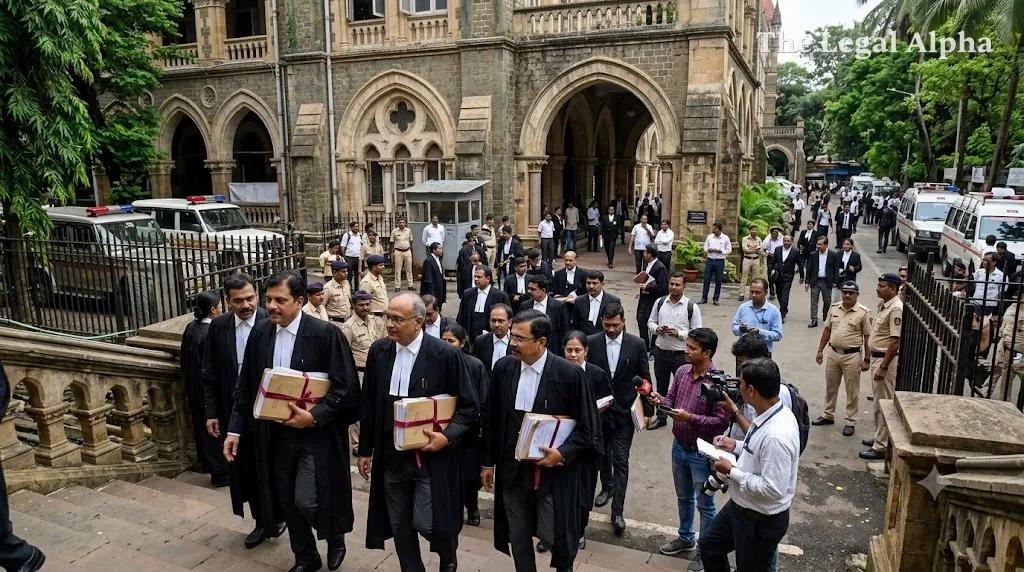
The Bombay High Court has concluded hearings and reserved its verdict on an appeal moved by the National Investigation Agency (NIA) challenging the bail granted to dismissed Mumbai police officer Sachin Waze.
Waze is a primary accused in the February 2021 incident involving an explosives-laden vehicle discovered near industrialist Mukesh Ambani's residence, 'Antilia', and the subsequent death of businessman Mansukh Hiran. A Special NIA Court granted him bail on September 29, 2026, holding that the prosecution had failed to establish a prima facie case under anti-terror provisions.
The central agency immediately contested the release, securing an interim stay on the trial court's order. A division bench comprising Justice Girish Kulkarni and Justice Neela Gokhale heard extensive arguments from both sides before reserving the matter for judgment. Until the bench delivers its final verdict, the stay on Waze's release remains in operation, keeping him in judicial custody at Thane Central Prison.
Legal Topic
-
Area of Law: Criminal Law / Special Penal Statutes
-
Sub-topic: Bail Jurisprudence / Anti-Terror Law (UAPA) / Appellate Review of Bail Orders
Core Legal Issue
The primary legal controversy centers on the threshold required to invoke anti-terror legislation against an individual accused of placing inert or low-grade explosive devices without an explicit organizational terror nexus.
Specifically, the High Court is evaluating whether planting gelatin sticks outside a private residence prima facie constitutes a "terrorist act" under Section 15 of the Unlawful Activities (Prevention) Act, 1967, thereby attracting the statutory bar on bail under Section 43D(5) of the Act. A related issue is whether the trial court committed a jurisdictional or factual error in assessing the prima facie credibility of the prosecution's evidence at the bail stage.
What Did the Court / Authority Decide?
The division bench did not pronounce an immediate judgment; it formally reserved its order after concluding final arguments.
Crucially, the High Court clarified that the interim stay granted against the Special Court's bail order will continue until the formal judgment is pronounced. As a consequence, Sachin Waze will remain in Thane Central Prison pending the outcome. During oral proceedings, the bench probed both sides intensely, questioning the central agency on the precise link between the explosives and Waze, while also scrutinizing the trial court's underlying reasoning.
Key Legal Points
-
Statutory Threshold Under UAPA: Examination of whether the facts satisfy Section 15 of the UAPA, which requires intent or likelihood to threaten the unity, integrity, security, or sovereignty of India, or to strike terror in people.
-
Scrutiny of Section 43D(5): Testing whether the Special Court correctly interpreted the embargo that bars bail if accusations appear prima facie true on examining the case diary and charge sheet.
-
Trial Court Inferences: Assessment of whether the trial judge overstepped into evaluating deep merits or made extraneous observations regarding witness testimonies during an interlocutory bail stage.
-
Interim Stay of Bail: Reaffirmation of appellate power to stay an accused person's release where immediate execution of a contested bail order could render the prosecution's appeal infructuous.
Relevant Law
-
Unlawful Activities (Prevention) Act, 1967 (UAPA):
-
Section 15: Defines a "terrorist act".
-
Section 43D(5): Restricts the grant of regular bail if the court forms an opinion that there are reasonable grounds for believing the accusation is prima facie true.
-
-
Code of Criminal Procedure, 1973 (CrPC) / Bharatiya Nagarik Suraksha Sanhita, 2023 (BNSS):
-
Provisions governing regular bail and appellate revision of bail orders.
-
-
Indian Penal Code, 1860 (IPC):
-
Section 302: Murder (invoked in the related death of Mansukh Hiran).
-
Section 120B: Criminal conspiracy.
-
-
Explosive Substances Act, 1908: Provisions relating to possession and endangering life via explosive materials.
Arguments of the Parties
Appellant (National Investigation Agency)
The NIA contended that the Special Court's bail order was fundamentally flawed and misdirected in law. The agency argued that Waze orchestrated a high-level conspiracy with the clear intention of creating terror and panic by planting explosives near the Ambani residence.
The agency further asserted that Waze played an active role in the subsequent murder of Mansukh Hiran to eliminate evidence. Counsel for the NIA maintained that the trial court made improper and unwarranted remarks about the investigation while erroneously concluding that the absence of physical panic among the victims diluted the terror charge.
Respondent (Sachin Waze)
Counsel appearing for Waze supported the Special Court's decision, arguing that the stringent provisions of the UAPA were improperly invoked. The defence submitted that the recovery of commercial explosive sticks without an assembled detonator or triggering mechanism does not satisfy the statutory threshold of a terrorist act intended to destabilize the nation or widespread public order.
The respondent contended that prolonged pre-trial incarceration since March 2021, coupled with the slow pace of trial and the absence of a prima facie case on terror allegations, fully justified the grant of bail.
Why Does It Matter?
This appeal brings into sharp focus the boundaries between targeted extortion/intimidation and statutory "terrorism" under India's special penal statutes. Over the past decade, appellate courts have increasingly scrutinized whether state and central agencies stretch the definition of a "terrorist act" under Section 15 of the UAPA to encompass serious, yet localized, conventional crimes.
The eventual decision of the Bombay High Court will provide essential guidance on how trial courts must evaluate UAPA bail applications when dealing with hybrid allegations involving both local homicides and high-profile security threats. It also illustrates the delicate judicial balance between safeguarding individual liberty during protracted trials and respecting statutory bars designed for national security offences.
Legal Takeaway
The invocation of the UAPA imposes an onerous statutory bar on bail that courts cannot circumvent without recording clear findings that the allegations are not prima facie true. The impending High Court ruling will clarify whether planting explosives as an act of intimidation against private individuals meets the rigorous legal definition of an anti-national terrorist offence.
Sources
-
Primary Source: Record of Proceedings before the Bombay High Court (Division Bench of Justice Girish Kulkarni and Justice Dr. Neela Gokhale), National Investigation Agency v. Sachin Waze, October 2026.
-
Additional Sources: Special NIA Court Bail Order (September 29, 2026); Proceedings reported by Press Trust of India (PTI) and secondary legal reportage.