Delhi High Court Rebukes DDA Over Alleged Encroachment of Vasant Kunj Housing Amenities
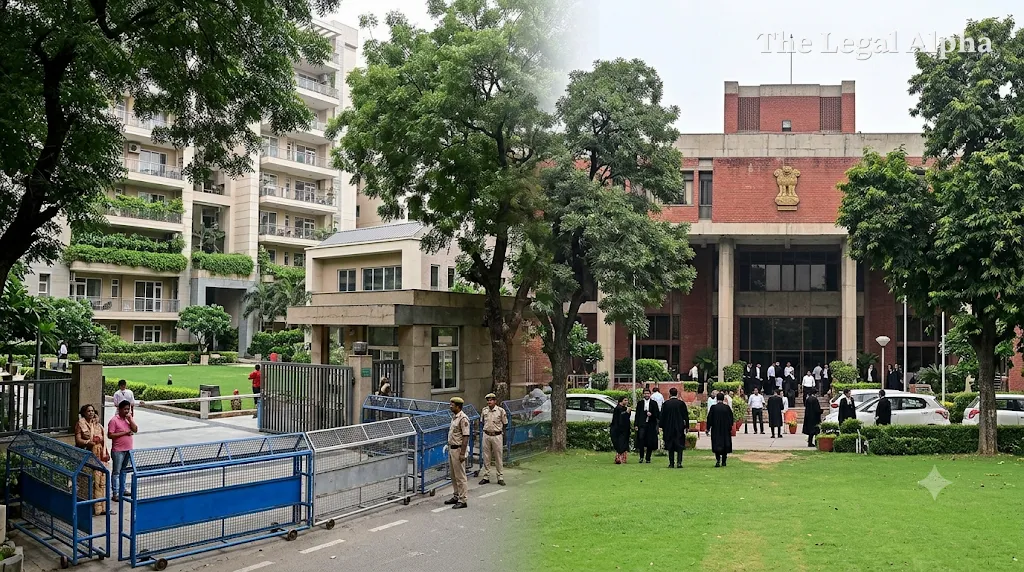
Residents of Kaveri Apartments, a housing complex built by the Delhi Development Authority (DDA) in South Delhi's Vasant Kunj (Sector D-6), have moved the Delhi High Court alleging that private encroachers have unlawfully taken over common public facilities within their society. According to the Residents' Welfare Association (RWA), the occupied spaces include the society's community centre, shopping complex, and designated green belt.
The dispute involves the Kaveri Apartments RWA—representing owners of 805 flats allotted during the 2010 Commonwealth Games housing project—and the DDA, the statutory land-owning and urban development body. Residents allege that private individuals have erected temporary boundary walls, fenced off the green belt, locked the rear entrance of the community centre, and stationed bouncers and private guards on the premises.
Following a police complaint at the Vasant Kunj Police Station and demonstrations outside the DDA office, the RWA sought judicial intervention. During a hearing on November 6, 2026, the Delhi High Court reprimanded the DDA for failing to protect the residents' interests and ordered the authority to take necessary action. Despite those judicial directions, the RWA—led by President Anil Paliwal—maintains that the DDA has yet to dismantle the temporary boundaries or unlock the community centre.
Legal Topic
Area of Law: Property and Urban Development Law
Sub-topic: Public Land Encroachment / Municipal & Statutory Duty
Core Legal Issue
The central legal question before the Delhi High Court is whether a statutory land-owning authority like the DDA can remain passive when common amenities and green spaces—earmarked under an approved residential layout plan and paid for through annual licence fees—are allegedly seized by private third parties.
Specifically, the court is examining the enforcement of the DDA's statutory duty to preserve public spaces within allotted housing schemes and ensure compliance with its judicial directions to remove unauthorized barriers.
What Did the Court / Authority Decide?
At the hearing on November 6, 2026, the Delhi High Court took a strong view of the DDA's inaction, reprimanding the agency and directing it to take appropriate steps to safeguard the rights and common facilities of Kaveri Apartments residents.
While the court issued clear interim directions instructing the DDA to act against the alleged encroachment, final adjudication on the broader dispute remains pending. As of mid-November 2026, the RWA has formally notified DDA officials that on-ground compliance—specifically removing the temporary boundary structures and unlocking the rear of the community centre—has not yet been executed.
Key Legal Points
-
Statutory Duty to Protect Common Areas: Once a development authority allots residential units under a sanctioned housing scheme, it retains an obligation to ensure that earmarked common facilities, such as community centres and green belts, remain accessible to residents rather than being diverted or usurped.
-
Effect of Licence Fee Payments: Regular payment of prescribed annual licence fees by an RWA reinforces the residents' legitimate claim to the uninterrupted use and upkeep of shared society infrastructure.
-
Accountability for Non-Compliance: Public authorities face judicial censure—and potential contempt proceedings—if they fail to execute court-mandated anti-encroachment measures within a reasonable timeframe.
-
Distinction Between Allegation and Proof: While the High Court has directed protective action, the specific claims regarding private guards, bouncers, and unlawful possession remain factual allegations subject to official verification and enforcement action by the DDA and local police.
Relevant Law
-
Delhi Development Act, 1957: Governs the planned development of Delhi and empowers the DDA under Sections 12, 29, and 30 to manage, regulate, and remove unauthorized constructions or encroachments on development land.
-
Article 226 of the Constitution of India: Empowers the High Court to issue writs and directions to statutory bodies like the DDA to compel the performance of public duties and protect citizens' rights against administrative inaction.
-
Public Premises (Eviction of Unauthorised Occupants) Act, 1971: Provides the statutory mechanism for government authorities like the DDA to evict unauthorized occupants from public land and community buildings.
Arguments of the Parties
Petitioner (Kaveri Apartments RWA)
The petitioner argued that rising real estate values in Vasant Kunj, driven by nearby residential growth and a proposed metro corridor, have attracted land grabbers to the complex's shared spaces. The RWA contended that residents have diligently paid all annual licence fees demanded by the DDA for the community centre and allied facilities—including dues for the 2025–26 and 2026–27 financial years—yet are being barred from using them by private guards and physical barricades. They further submitted that the DDA has failed to enforce even the High Court's November 6 directive to clear the site.
Respondent (Delhi Development Authority)
The DDA's detailed formal reply regarding the post-November 6 status is awaited, though the authority has been placed under direct judicial instructions to intervene and protect the residents' interests.
Why Does It Matter?
This dispute highlights a recurring vulnerability in large-scale public housing projects across urban India: the gap between paper allotments and on-ground enforcement. When shared amenities like parks, shopping complexes, and community halls are left poorly guarded by civic agencies, residents are often forced to litigate simply to access infrastructure they have already paid for through allotment costs and recurring licence fees.
For Resident Welfare Associations across Delhi and other metropolitan areas, the Delhi High Court's intervention underscores that courts will hold statutory authorities accountable for administrative inertia. At the same time, the reported delay in executing the court's November 6 order illustrates the practical hurdles residents face when converting judicial directions into physical clearance on the ground.
Legal Takeaway
Statutory housing authorities cannot collect licence fees for community facilities while leaving residents to fend off alleged encroachers on their own. When civic bodies fail to protect sanctioned public spaces, RWAs can invoke the High Court's writ jurisdiction to compel enforcement—and pursue further judicial remedies if court orders are not promptly implemented on the ground.
Sources
Primary Source:
Delhi High Court proceedings and directions dated November 6, 2026, concerning Kaveri Apartments RWA, Sector D-6, Vasant Kunj (connected docket: Residents Welfare Association Vasant Kunj D-6 Kaveri Apartments v. Delhi Development Authority, W.P.(C) 5331/2023).
Additional Sources:
-
Report on Kaveri Apartments encroachment and RWA representation (November 15, 2026).
-
Delhi Development Act, 1957 and Public Premises (Eviction of Unauthorised Occupants) Act, 1971.