Delhi High Court Demands Accountability From ASI, MCD, and Police Chiefs Over Unlawful Building at Raushanara Tomb
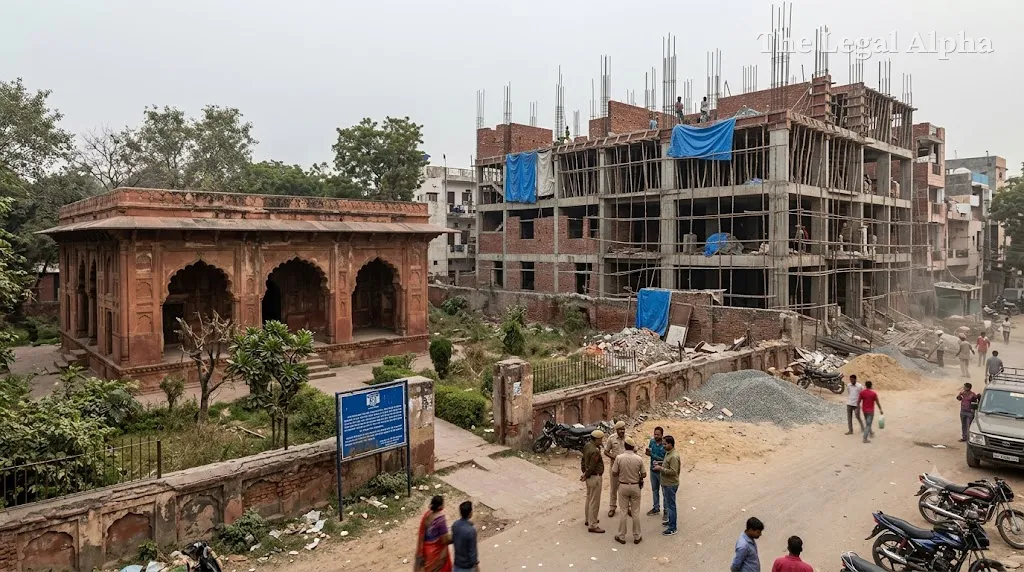
The Delhi High Court censured the Archaeological Survey of India (ASI), the Municipal Corporation of Delhi (MCD), and the Delhi Police for enabling the completion of an illegal building inside the regulated zone of the historically protected Tomb of Raushanara and Barahdari in Shakti Nagar.
Hearing a petition filed by local resident Manish Grover regarding unauthorized development on Singh Sahab Road, a division bench noted a systemic administrative failure spanning more than two years. Despite statutory notices from heritage authorities and a explicit court injunction prohibiting work on the site, official lethargy allowed the private builder to finish construction unabated.
Legal Topic
Area of Law: Heritage Protection and Municipal Law
Sub-topic: Enforcement of Regulated Monument Zones and Administrative Dereliction of Duty
Core Legal Issue
The dispute centers on whether municipal planning approval or an architect's sign-off can override statutory development bans within heritage buffer zones without explicit clearance from the designated heritage authority.
A secondary question before the bench is the legal culpability of regulatory bodies and law enforcement agencies when inter-departmental inaction directly defies court injunctions and statutory prohibitions, effectively shielding unlawful real estate development.
What Did the Court Decide?
The division bench comprising Acting Chief Justice Nitin Wasudeo Sambre and Justice Sanjay Sharma directed the Commissioner of the MCD, the Director of the ASI, and the Special Commissioner of Police to submit individual personal affidavits.
These senior heads must name the specific officers whose oversight and inaction allowed the unlawful structure to be completed. The bench underscored that the respondents are at liberty to take immediate statutory enforcement action under the law while clarifying that fixing personal administrative accountability remains non-negotiable.
Key Legal Points
-
Hierarchy of Statutory Clearances: Local body building sanction cannot substitute or bypass mandatory statutory approvals required from the ASI within protected and regulated monument perimeters.
-
Defiance of Injunctions: Failure by local police to execute judicial restraining orders constitutes a direct breakdown of lawful administration and borders on contempt.
-
Institutional Negligence: Extended delays—such as municipal bodies taking nearly a year to issue basic show-cause notices following heritage warnings—demonstrate actionable dereliction rather than administrative oversight.
-
Individual Bureaucratic Accountability: Top department heads must identify the officers on duty rather than shielding departmental lapses behind generalized institutional responses.
Relevant Law
-
Ancient Monuments and Archaeological Sites and Remains (AMASR) Act, 1958 (as amended in 2010): Sections regulating development and prohibiting unauthorized construction within prohibited (100m) and regulated (up to 200m further) zones around centrally protected monuments.
-
Delhi Municipal Corporation Act, 1957: Provisions governing building permits, unauthorized developments, and demolition powers under Sections 343 and 344.
-
Code of Civil Procedure, 1908 (Order XXXIX) / Inherent Powers under Article 226: Authority of constitutional courts to enforce compliance with interim restraining orders.
Arguments of the Parties
The Petitioner
The petitioner contended that the respondent authorities deliberately overlooked continuous construction activity inside a legally protected heritage area. Counsel pointed out that despite the ASI issuing a work-stop notice as early as February 2024 and the High Court issuing a restraining order in September 2025, no concrete ground-level enforcement occurred, allowing the building to reach completion.
The Property Owner
Counsel for the private builder argued that the construction was undertaken pursuant to permissions obtained from the MCD. The defense maintained that the owner acted in good faith after obtaining certification from a qualified planning architect, who affirmed that the layout adhered to all planning regulations and building bylaws.
The Authorities (ASI, MCD, and Police)
The agencies acknowledged that multiple warnings had been sent between departments, including the ASI's April 2024 communications urging police and municipal intervention. However, the court observed that their actions reflected an absence of urgency, with the MCD taking nearly a full calendar year to generate a show-cause notice and the police failing to enforce court-ordered stop-work mandates.
Why Does It Matter?
This ruling directly targets the bureaucratic inertia often exploited by illegal builders in metropolitan heritage corridors. By holding agency heads personally responsible for identifying delinquent subordinates, the High Court signals an end to the usual cycle where civic bodies, police stations, and heritage custodians pass blame while construction continues unchecked.
It reinforces that an architect's certification or municipal silence cannot legitimize building activity inside protected monument zones, establishing that public officials will face scrutiny if court orders are reduced to mere paper directions.
Legal Takeaway
Municipal building permits and private architect certifications are legally invalid if they bypass mandatory statutory clearances from the Archaeological Survey of India in regulated zones. Furthermore, when regulatory authorities and law enforcement ignore court stop-work orders, constitutional courts will pierce administrative shields to hold individual officials personally accountable.
Sources
-
Primary Source: Order of the Delhi High Court (Acting Chief Justice Nitin Wasudeo Sambre and Justice Sanjay Sharma), dated October 9, 2026, in Manish Grover v. Municipal Corporation of Delhi & Ors.
-
Additional Sources: Press Trust of India legal reportage, October 15–16, 2026; Statutory provisions under the Ancient Monuments and Archaeological Sites and Remains Act, 1958.