Delhi Air Pollution: Supreme Court Flags Unregulated Firecracker Sales Across Capital, Directs Centre and Police to Intervene
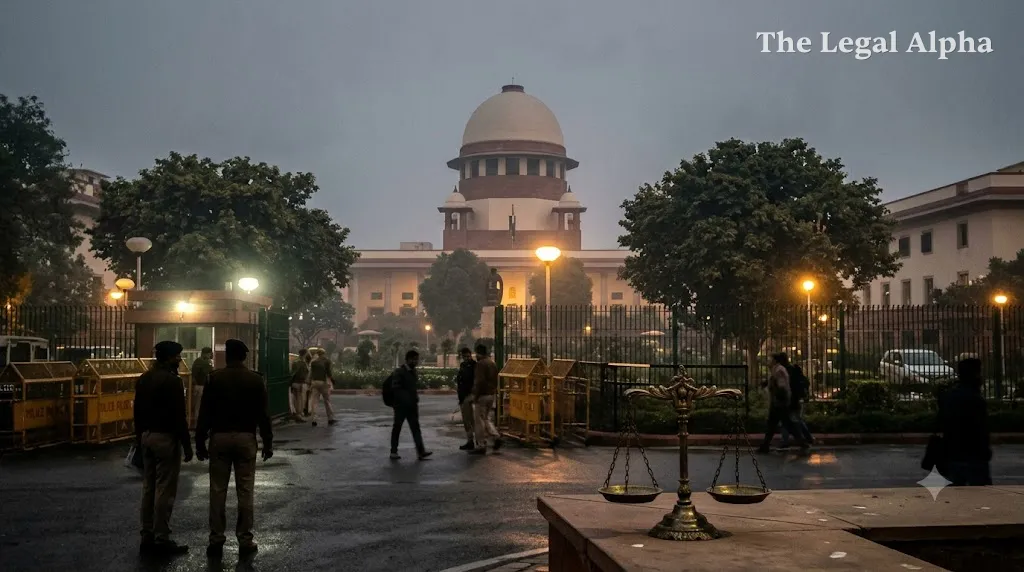
The Supreme Court of India flagged widespread ground-level violations concerning the sale of firecrackers in Delhi, directing the Union Government and law enforcement authorities to intervene immediately.
A Bench comprising Justice M.M. Sundresh and Justice Prasanna B. Varale acted upon investigative ground reports indicating that conventional, uncertified, and prohibited firecrackers were being sold openly in local markets ahead of Diwali. This development follows closely on the heels of the Court's conditional order permitting strictly certified green firecrackers for a narrow window, highlighting an immediate breakdown in municipal and regulatory enforcement.
Legal Topic
-
Area of Law: Environmental Law / Constitutional Law
-
Sub-topic: Air Pollution Control, Public Health & Enforcement of Regulatory Injunctions
Core Legal Issue
The principal issue is whether the executive and municipal enforcement machinery can effectively operationalise conditional judicial directives when an administrative regulatory regime lacks sufficient field-level oversight.
The Court was confronted with the question of how to prevent black-market substitution—where banned chemical formulations and forged QR codes displace scientific, laboratory-certified green alternatives—thereby threatening the fundamental right to clean air under Article 21 of the Constitution.
What Did the Court / Authority Decide?
The Supreme Court directed Additional Solicitor General Aishwarya Bhati, appearing for the Union Government, the Delhi Police, and the Commission for Air Quality Management (CAQM), to immediately look into the open sale of unauthorised firecrackers and enforce compliance.
The Bench observed that despite stringent directions restricting trade solely to certified green crackers at designated places, reports indicated that all categories—licensed, unlicensed, and crackers bearing questionable or absent QR codes—were circulating freely in Delhi markets.
While the Court did not revoke its earlier temporary relaxation window (governing permitted green cracker bursting on November 7 and 8), it placed the statutory authorities on notice that failure to halt illicit trade would invite strict accountability and potential contempt proceedings.
Key Legal Points
-
Regulatory Compliance Gap: The Bench emphasised that partial or conditional regulatory permissions cannot serve as a cover for the sale of completely banned or unverified pyrotechnics.
-
Traceability and Authenticity: The Court reiterated that only products certified by the Petroleum and Explosives Safety Organisation (PESO) and CSIR-NEERI bearing legitimate, trackable QR codes are permissible.
-
Executive Accountability: Primary responsibility for curbing clandestine sales, unapproved distribution points, and digital marketing rests squarely on law enforcement and CAQM field teams.
-
Restoration of Full Prohibition: The Bench maintained that any limited relaxation remains transitional, with an automatic return to a complete ban taking effect from November 9.
Relevant Law
-
Constitution of India: Article 21 (Right to clean environment and health as part of the Right to Life) and Article 48A (Directive Principle on environmental protection).
-
The Commission for Air Quality Management in National Capital Region and Adjoining Areas Act, 2021: Empowering statutory enforcement bodies to enforce graded anti-pollution measures.
-
The Environment (Protection) Act, 1986 & Explosives Act, 1884: Regulating hazardous chemical substances and licensing standards for explosive formulations.
-
Judicial Precedent: Arjun Gopal & Others v. Union of India & Others [Writ Petition (Civil) No. 728/2015], governing ongoing judicial oversight on firecracker bans and green cracker standards.
Arguments of the Parties
Petitioners / Public Interest Concerns
The broader public interest litigation initiated on behalf of minor citizens argued that recurring pre-winter air degradation in the National Capital Region imposes severe, irreversible health burdens on vulnerable populations. It was highlighted that regulatory compromises are routinely exploited on the ground, where traders conceal conventional crackers under the guise of green crackers or dispense with certifications entirely.
Union Government / Regulators
Additional Solicitor General Aishwarya Bhati, appearing on behalf of the Central Government, the Commission for Air Quality Management, and Delhi authorities, received the Court’s oral directions and undertook to communicate the infractions to the concerned enforcement wings to initiate necessary inspections and deterrent action.
Why Does It Matter?
This development exposes a persistent challenge in Indian environmental jurisprudence: the gap between judicial orders and street-level executive compliance. Whenever judicial benches attempt a balanced regulatory approach—such as carving out exceptions for green firecrackers—the lack of swift, verifiable enforcement mechanisms often leads to illegal dumping of toxic stock into local markets.
For commercial sellers and manufacturers, this intervention signals intensified police seizures, license inspections, and potential forfeiture of security deposits for dealing in uncertified inventory. For citizens, it underscores that the Court will not permit calibrated festive exceptions to compromise regional public health standards.
Legal Takeaway
A regulatory exception granted by the court does not dilute the underlying prohibition against banned products. Unless retailers strictly adhere to CSIR-NEERI verification, authorized sales locations, and legitimate QR coding, commercial dealing in firecrackers in Delhi-NCR remains illegal and punishable under criminal and environmental statutes.
Sources
Primary Source:
-
Arjun Gopal & Ors. v. Union of India & Ors., Supreme Court of India, Writ Petition (Civil) No. 728 of 2015 (Orders and proceedings dated November 2 and November 3, 2026, Coram: Justice M.M. Sundresh and Justice Prasanna B. Varale).
Additional Sources:
-
LiveLaw Court Reports & Analysis (Proceedings of Nov 2–3, 2026).
-
Commission for Air Quality Management in NCR & Adjoining Areas (Statutory Guidelines & Monitoring Briefings).