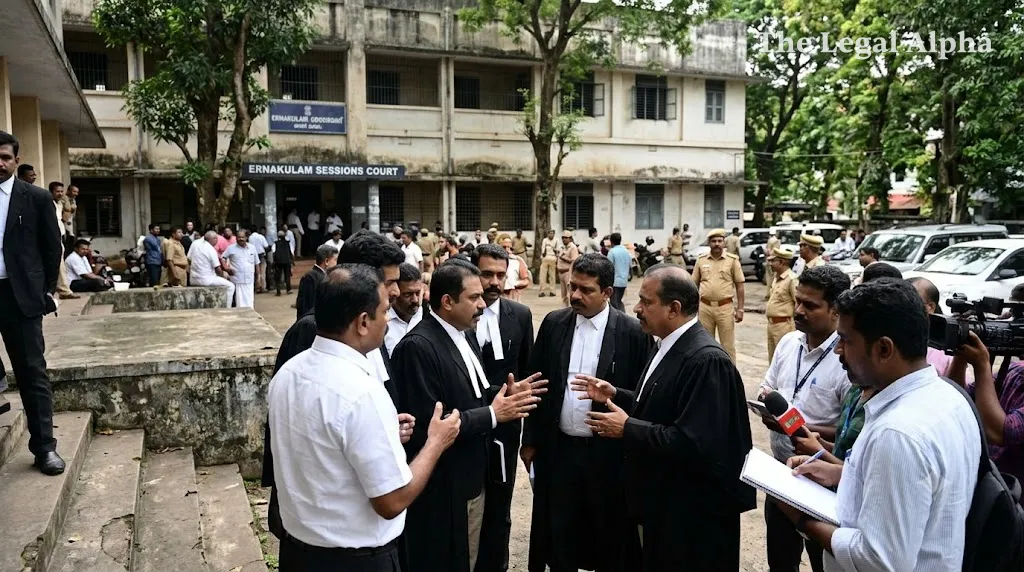
Cheranalloor Crash: Court Flags Contempt Concerns Over Interference Claims in Juvenile Bail Challenge

The Ernakulam Additional District Court took serious view of submissions alleging external interference and obstruction in the investigation into the fatal Cheranalloor car crash involving a minor driver.
The matter arises out of an early-morning accident on October 25, where a luxury Mercedes-Benz driven by a 17-year-old struck a two-wheeler, killing 55-year-old Jayabalakrishnan. The juvenile was subsequently granted bail by the Juvenile Justice Board. In response, both the State government and the victim's family moved the Additional District Court seeking the cancellation of the bail order.
During the hearing, the prosecution submitted that investigators had faced outside interference, preventing police from properly interrogating the juvenile. When questioned directly by the bench on whether he had faced operational obstruction, the investigating officer acknowledged that he had been unable to interview the juvenile.
Legal Topic
Area of Law: Criminal Procedure and Juvenile Justice
Sub-topic: Bail Cancellation, Investigation Integrity, and Criminal Contempt
Core Legal Issue
The court had to consider whether outside interference had obstructed the statutory investigation and tainted the proceedings before the Juvenile Justice Board, warranting the cancellation of bail granted to a child in conflict with law.
A secondary question was whether allegations of interference with the police probe and judicial apparatus rose to the threshold of criminal contempt for prejudicing or interfering with the due administration of justice.
What Did the Court / Authority Decide?
The Additional District Court characterized the allegations of interference as grave and cautioned that any attempt to prejudice or disrupt the course of judicial proceedings falls squarely within the framework of criminal contempt.
The court questioned the investigating officer on procedural propriety, asking why the police had not formally moved an application before the Juvenile Justice Board to seek formal permission to interview the minor. The court did not immediately revoke the bail order; the petitions filed by the prosecution and the victim’s family seeking cancellation remain under active consideration.
Key Legal Points
-
Allegations of third-party interference during an active investigation touching upon judicial proceedings engage Section 2(c) of the Contempt of Courts Act, 1971.
-
When a suspect is a juvenile under the protective umbrella of the Juvenile Justice Act, police investigators cannot bypass statutory procedure; any custodial interrogation or structured interview must be sought through formal applications to the Juvenile Justice Board.
-
Bail cancellation petitions require an evaluation of whether statutory bail granted to a juvenile was obtained improperly or whether subsequent conduct has compromised a fair and unimpeded investigation.
-
Courts will strictly scrutinize the line between legitimate parental support and unlawful interference with law enforcement when high-profile or judicial families are involved.
Relevant Law
-
Section 2(c), Contempt of Courts Act, 1971: Defines criminal contempt as publication or acts that scandalize the judiciary, prejudice or interfere with the due course of judicial proceedings, or obstruct the administration of justice.
-
Juvenile Justice (Care and Protection of Children) Act, 2015: Governs bail, detention, and inquiry procedures for children in conflict with the law, requiring police to route investigative requests involving minors through the Juvenile Justice Board.
-
Section 199A, Motor Vehicles Act, 1988: Imposes liability on vehicle owners and guardians when an offence is committed by a juvenile driver.
-
Bharatiya Nyaya Sanhita, 2023 (BNS): Governing relevant penal provisions concerning negligent driving, causing death by negligence, and destruction of evidence.
Arguments of the Parties
The prosecution and the victim's family contended that outside pressure and interference had impeded the investigation into the fatal crash, preventing officers from questioning the minor accused. They submitted that the Juvenile Justice Board's decision to grant bail was premature and flawed under the circumstances, necessitating its cancellation to ensure an unimpeded inquiry.
The defence maintained that the minor had been granted bail under applicable juvenile justice protections and that due process had been followed. It was urged that visits by family members to the police station were made strictly in their parental capacity, not to influence officers or obstruct the lawful course of justice.
Why Does It Matter?
This proceeding underlines the high evidentiary bar and strict procedural scrutiny that appellate courts apply when evaluating alleged interference in sensitive criminal probes. By directly invoking the contempt framework, the court signaled that any institutional or external meddling in ongoing inquiries will not be treated merely as an administrative irregularity, but as a potential offence against the administration of justice.
Furthermore, the court’s reprimand to the investigating officer reiterates that even in high-visibility cases, law enforcement agencies must strictly adhere to the procedure established under juvenile justice legislation rather than citing vague outside obstacles for procedural lapses.
Legal Takeaway
External interference in an active criminal investigation or judicial process directly invites scrutiny under criminal contempt law. In juvenile matters, investigators must obtain clear sanction from the Juvenile Justice Board rather than relying on informal investigative steps.
Sources
Primary Source:
Proceedings and oral observations of the Ernakulam Additional District & Sessions Court (November 2, 2026).
Additional Sources:
-
Case reportage and proceedings in the Cheranalloor accident bail review, The New Indian Express (November 2, 2026).
-
Ancillary proceedings before the Kerala High Court and police inquiry updates (The Times of India, Mathrubhumi, October–November 2026).