Beyond Accreditation: Supreme Court to Scrutinise Scope of Free Speech Protections for Independent Media and Content Creators
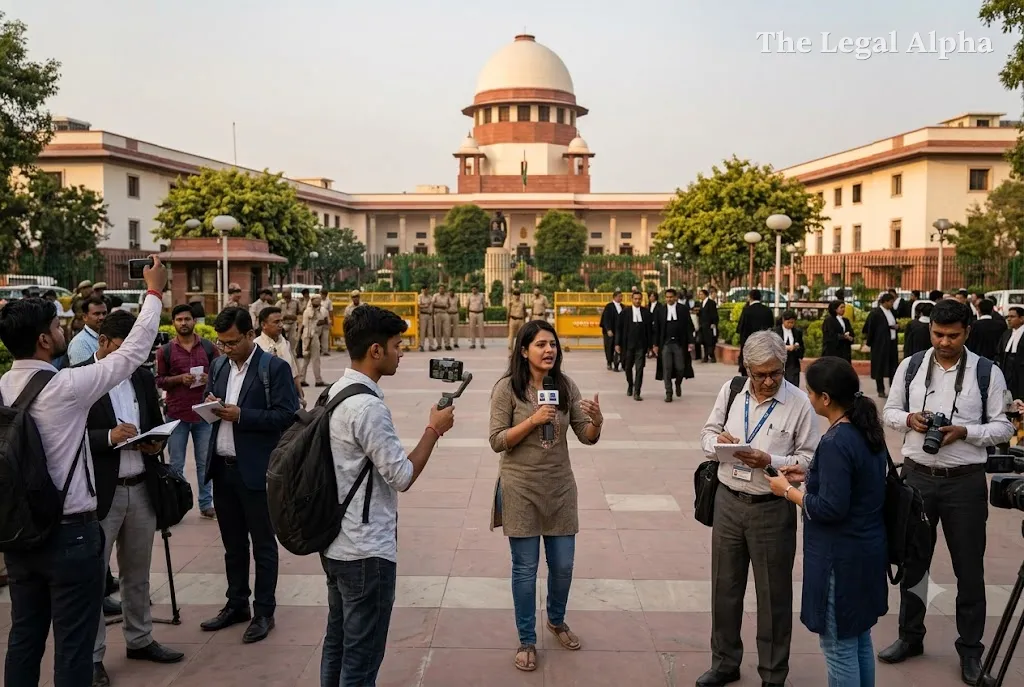
During hearings concerning police actions amid public demonstrations in New Delhi, the Supreme Court of India flagged a fundamental constitutional question: how should the law draw the line between accredited reporters, freelance journalists, and social media influencers when extending free speech protections?
A Bench comprising Chief Justice Surya Kant and Justice Joymalya Bagchi observed that granting blanket professional protections cannot be resolved by treating every citizen with a smartphone as a journalist. While the Bench intervened to protect an independent woman journalist facing coercive action following harassment allegations against an Assistant Commissioner of Police (ACP), the Court underscored that the evolving digital media ecosystem warrants comprehensive legal examination regarding tiered levels of speech protections.
Legal Topic
Area of Law: Constitutional Law / Media Law
Sub-topic: Freedom of Speech and Expression / Regulation of Digital Media and Journalism
Core Legal Issue
The core issue before the Court is whether the fundamental right to freedom of speech and expression elevates every citizen to the professional standing of a journalist, or whether statutory and constitutional safeguards must distinguish between institutional journalists, freelancers, and independent digital content creators.
In practical terms, the Court is confronted with the challenge of defining who qualifies for professional media immunity and workplace-style legal protections against state overreach in an era where digital tools blur the line between public interest reporting and online content creation.
What Did the Court / Authority Decide?
The Supreme Court issued notice on the batch of petitions arising from the Delhi protests and granted interim protection against coercive action to the woman journalist involved.
However, on the broader constitutional question, the Court did not lay down a final rule. The Bench held that the matter requires detailed judicial examination. Justice Bagchi highlighted that the law already recognises gradations—notably under statutory frameworks such as working journalists legislation—and indicated that the Court would formally evaluate what tiers of protection appropriately apply to accredited personnel, independent freelance reporters, and online influencers. The substantive issues remain pending for subsequent hearings.
Key Legal Points
-
Constitutional Distinction: The exercise of free speech under Article 19(1)(a) does not automatically confer the occupational status of an institutional journalist upon every individual citizen.
-
Dual Fundamental Rights: Professional journalism operates at the intersection of free speech and the freedom to practice a profession or trade under Article 19(1)(g), requiring distinct legal treatment.
-
Statutory Stratification: Existing labour and regulatory statutes, such as the Working Journalists framework, historically differentiate classes of media professionals—a principle that may guide digital-era media classifications.
-
Judicial Scrutiny of the Digital Sphere: The Court explicitly flagged the need to define where casual social media commentary or reel-making ends and bona fide public interest journalism begins.
Relevant Law
-
Article 19(1)(a) of the Constitution of India: Freedom of speech and expression.
-
Article 19(1)(g) of the Constitution of India: Freedom to practice any profession, or to carry on any occupation, trade, or business.
-
Working Journalists and Other Newspaper Employees (Conditions of Service) and Miscellaneous Provisions Act, 1955: Statutory classification defining working journalists and employment-linked safeguards.
Arguments of the Parties
Petitioners
Counsel representing journalists and affected individuals argued that independent reporters and freelancers play an indispensable democratic role by documenting ground realities during public protests. They submitted that arbitrary police detentions, physical force, and retaliatory state action against media persons violate the core guarantees of free expression and independent reporting, necessitating immediate judicial safeguards regardless of traditional institutional affiliation.
State / Union of India
Solicitor General Tushar Mehta submitted that with the proliferation of digital devices, virtually any individual operating a smartphone can claim to be an independent journalist while merely generating sensationalised content or short-form reels for social media popularity and commercial monetisation. The State maintained that while genuine harassment—particularly against women professionals—must not be tolerated, equal protection and consideration must be extended to law enforcement personnel discharging public duties.
Why Does It Matter?
This development touches the core of modern news dissemination and public accountability. For decades, legal protections, press passes, and institutional courtesies have rested on formal accreditation and employer-backed credentials. The rise of decentralised digital reporting has dismantled these barriers, allowing independent creators to reach massive audiences outside conventional editorial boardrooms.
If the Supreme Court formulates formal guidelines or establishes distinct categories of protection, it will carry profound consequences for freelance investigators, citizen journalists, and online commentators. A rigid standard risks excluding independent watchdogs from vital press protections during police crackdowns, whereas an absence of standards complicates law enforcement and invites abuse by bad-faith actors claiming journalistic immunity. The forthcoming adjudication will shape the contours of digital free speech and media accountability in India.
Legal Takeaway
Freedom of expression belongs to every citizen, but professional journalistic protections may not extend automatically to all forms of online content creation. The Supreme Court has initiated a crucial review to determine whether accredited reporters, freelancers, and digital influencers must be treated as distinct legal categories under the law.
Sources
Primary Source:
-
Supreme Court of India, Proceedings in Samriddhi Das v. Union of India and Ors. [Diary No. 64055 of 2026] and connected matters, Bench comprising Chief Justice Surya Kant and Justice Joymalya Bagchi (October 15, 2026).
Additional Sources:
-
Court proceedings and legal reports on hearings concerning Delhi protest coverage and police detentions (October 15–16, 2026).