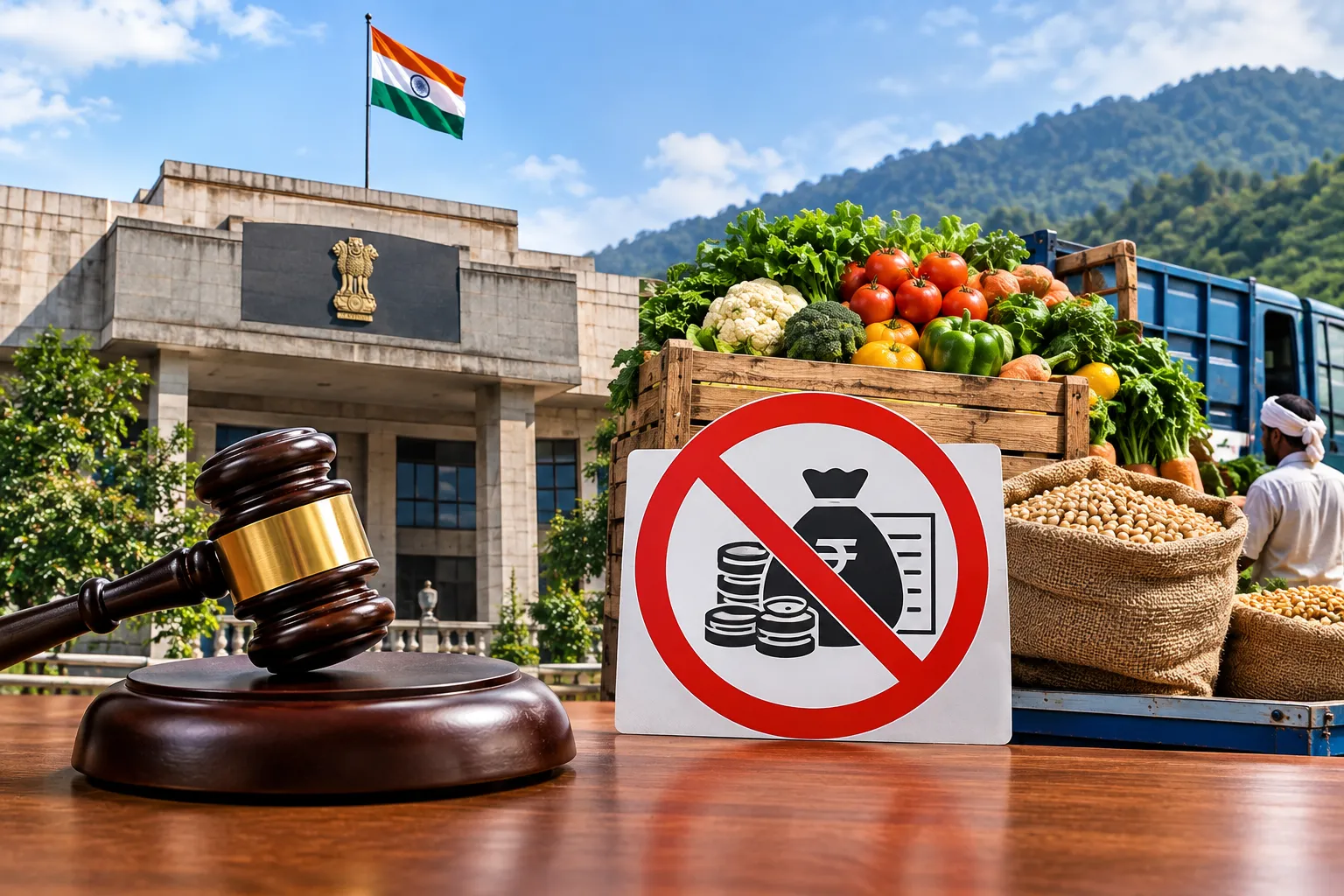
Uttarakhand High Court Strikes Down Development Cess on Farm Produce Brought from Outside State for Manufacturing: 'Mere Entry Cannot Attract Market Levy'
Court: High Court of Uttarakhand at Nainital
Bench: Division Bench of Chief Justice Manoj Kumar Gupta and Justice Subhash Upadhyay
Case Record: Writ Petition (M/B) No. 244 of 2025 | Neutral Citation: [2026:UHC:8829-DB]
Date of Pronouncement: September 30, 2026 | Reported: October 06-07, 2026 (LiveLaw ID: 553243)
The petitioners—Ashirwad Agro Industries and several other industrial processing and manufacturing enterprises operating within the State of Uttarakhand—regularly procure agricultural produce (including paddy, wheat, maize, legumes, and timber) from other states and transport it into their industrial factory premises situated within designated market areas in Uttarakhand. The imported agricultural produce is consumed strictly as industrial raw material to manufacture value-added end products such as flour, semolina (suji), starch, gluten, paper, laminate boards, and plywood. At no stage is the raw agricultural produce sold, bought, or commercially transacted in its original state within the local market area.
Notwithstanding the absence of any local sale or purchase transaction, the Uttarakhand Agricultural Produce Marketing Board (Mandi Parishad) and regional Market Committees issued statutory demand notices demanding 'Development Cess' from the petitioners. The authorities invoked the first proviso to Section 27(c)(v) of the Uttarakhand Agricultural Produce Marketing (Development and Regulation) Act, 2011, classifying the entry of out-of-state produce for factory processing as 'Other Secondary Arrival' liable to development cess. When the authorities threatened coercive recovery of cess arrears, the agro-processing units approached the High Court of Uttarakhand at Nainital by filing a batch of writ petitions [led by Writ Petition (M/B) No. 244 of 2025], challenging the constitutional validity and legislative competence of the state enactment.
Legal Topic
Constitutional Law & Fiscal Federalism – Seventh Schedule, Constitution of India (Entries 14, 28, and 66 of List II); Limits of State Legislative Competence in Market Fee and Cess Levies; Distinction Between Tax and Regulatory Fee; Impact of the 101st Constitutional Amendment (Abolition of Entry Tax under Entry 52 of List II); Application of the Supreme Court Precedent in Gujarat Ambuja Exports Ltd. v. State of Uttarakhand.
Core Legal Issue
Whether the State Legislature possesses the legislative competence under the Constitution of India to impose a 'Development Cess' on agricultural produce brought from outside the State into a local market area solely for manufacturing or processing, where no transaction of sale or purchase takes place within the market area.
What Did the Court / Authority Decide?
A Division Bench of the High Court of Uttarakhand at Nainital, comprising Chief Justice Manoj Kumar Gupta and Justice Subhash Upadhyay, allowed the writ petitions (Neutral Citation: 2026:UHC:8829-DB), declaring the first proviso to Section 27(c)(v) of the Uttarakhand Agricultural Produce Marketing (Development and Regulation) Act, 2011 unconstitutional and beyond the legislative competence of the State Legislature.
The Division Bench ruled that the State cannot levy a development cess on the mere entry of agricultural produce into a factory for processing when no sale or purchase occurs in the market area. The Court rejected the State's argument that re-labeling the levy as a 'development cess' (while excluding market fee) or categorizing the movement as 'Other Secondary Arrival' could validate the tax. Chief Justice Manoj Kumar Gupta held that the constitutional validity of a fiscal measure depends on its substantive legal incidence, not its statutory nomenclature. The Bench famously held: "The purpose for which the proceeds of a levy are utilized is distinct from the source of legislative power to impose the levy. The utilization of the amount collected for development of market infrastructure cannot by itself confer legislative competence if the event upon which the levy is imposed does not otherwise fall within the legislative field of the State." Consequently, the High Court quashed all impugned demand notices and recovery proceedings against the manufacturing units.
Key Legal Points
- Incidence Controls Legislative Competence: The Division Bench held that legislative competence to levy a tax or fee must be evaluated by looking at the real subject matter and taxable event of the levy, rather than statutory labels. Re-branding an invalid market fee as a 'development cess' cannot cure constitutional incompetence.
- Utilization Cannot Create Taxing Power: Chief Justice Manoj Kumar Gupta established the crucial fiscal principle that merely spending collected revenue on public roads, bridges, and market infrastructure cannot retroactively create legislative competence if the State lacks constitutional authority over the taxable event under List II.
- Binding Precedent of Gujarat Ambuja Applied: The High Court followed the Supreme Court's ruling in Gujarat Ambuja Exports Ltd. v. State of Uttarakhand, holding that the State cannot circumvent apex court judgments by shifting the identical levy into an amended proviso or inventing artificial terms like 'Other Secondary Arrival.'
- No Entry Tax Post-GST Amendment: The Court noted that following the 101st Constitutional Amendment Act, Entry 52 of List II (taxes on entry of goods into a local area) was deleted from the Constitution, preventing State legislatures from levying indirect entry taxes under the guise of agricultural marketing legislation.
- Protection of Bona Fide Inter-State Processing: The judgment shields agro-industrial processors across Uttarakhand from double taxation and unconstitutional local levies on raw materials legitimately procured in inter-state commerce.
Relevant Law
- First Proviso to Section 27(c)(v), Uttarakhand Agricultural Produce Marketing (Development and Regulation) Act, 2011: The statutory provision that purported to levy development cess on agricultural produce brought into the market area from outside the State for processing or manufacture.
- Seventh Schedule, List II (State List), Constitution of India: Specifically Entry 14 (Agriculture), Entry 28 (Markets and Fairs), and Entry 66 (Fees in respect of any of the matters in List II).
- Constitution (101st Amendment) Act, 2016: Abolished Entry 52 of List II, dismantling the power of States to impose entry tax on goods entering local areas.
- Gujarat Ambuja Exports Ltd. v. State of Uttarakhand (Supreme Court of India): Settled that agricultural produce brought from outside a State for manufacturing cannot be subjected to market fees in the absence of a sale or purchase in the market area.
Arguments of the Parties
- Contentions of the Petitioners (Ashirwad Agro Industries & Ors.):
- Represented by Senior Counsel Rajendra Dobhal along with a team of assisting advocates, the petitioners submitted that they are manufacturing units that import agricultural raw materials through inter-state commerce.
- Counsel argued that the raw produce undergoes irreversible industrial transformation into distinct commercial commodities (flour, starch, paper, plywood) inside private factories without using Mandi marketing yards or engaging in any local trading transactions.
- The petitioners contended that the State Legislature attempted to circumvent the Supreme Court's Gujarat Ambuja judgment by cosmetically dropping 'market fee' while continuing to collect the exact same impost under the label of 'development cess.'
- It was submitted that after the deletion of Entry 52 of List II by the GST Amendment, the State had zero constitutional power to tax the mere entry of goods.
- Contentions of the Respondents (State of Uttarakhand & Mandi Parishad):
- Represented by Senior Counsel A.S. Rawat and State Law Officers, the respondents argued that the Act of 2011 was enacted to develop and regulate agricultural markets under Entries 28 and 66 of List II.
- The State maintained that the levy was not a tax on sale, but a regulatory 'development cess' earmarked for creating and maintaining roads, bridges, and infrastructure that the petitioners' heavy trucks actively utilize.
- The Mandi Samiti argued that the first proviso to Section 27(c)(v) was independent and separable from previously invalidated provisions, and was necessary to prevent tax avoidance by large agro-industries.
Why Does It Matter?
This landmark judgment by the Uttarakhand High Court delivers substantial economic and constitutional clarity for agro-based industries, food processing plants, and paper/timber manufacturers operating across Uttarakhand and North India. For years, state agricultural marketing boards have routinely harassed manufacturing enterprises by setting up check-posts and slapping retrospective cess demands on raw materials simply passing through or entering factory gates.
By striking down the statutory proviso as ultra vires, the High Court firmly halts state overreach in inter-state trade. The Court’s ruling enforces the core principle of fiscal federalism post-GST: states cannot bypass the abolition of entry tax by dressing up local octroi as an agricultural 'development cess.' The verdict ensures that industrial processors who purchase raw materials lawfully outside the state are not penalized by protectionist and unconstitutional local levies, safeguarding ease of doing business and interstate trade under Article 301 of the Constitution.
Legal Takeaway
A State Legislature lacks legislative competence under List II of the Seventh Schedule to impose development cess or market fees on agricultural produce brought from outside the State into a factory for manufacturing or processing when no transaction of sale or purchase takes place within the market area. The utilization of revenue for constructing roads or market infrastructure cannot confer legislative competence if the underlying taxable event is beyond the State's constitutional domain.
Sources (Primary & Additional)
- Primary Judicial Order: High Court of Uttarakhand at Nainital, Ashirwad Agro Industries & Anr. v. State of Uttarakhand & Ors. [Writ Petition (M/B) No. 244 of 2025, Neutral Citation: 2026:UHC:8829-DB, Decided on September 30, 2026], per Division Bench of Chief Justice Manoj Kumar Gupta and Justice Subhash Upadhyay. Uttarakhand High Court Judgment Repository / IndianKanoon.
- Authoritative Legal Reporting (LiveLaw): Saksham Vaishya, "Mere Entry Of Produce From Outside State For Processing Without Sale In Market Area Cannot Attract Development Cess: Uttarakhand High Court" (Article ID: 553243, Published on October 06, 2026). LiveLaw Article.
- Authoritative National Media Reporting (Times of India): Kautilya Singh, "Mere entry of farm goods from outside cannot sustain development cess: HC" (Published on September 30, 2026). Times of India Article.
- Supreme Court Jurisprudence Analysis (SupremeToday): Legal Bureau, "Uttarakhand High Court Rules Mere Entry of Produce for Processing Without Sale Cannot Attract Cess" (Published on October 06, 2026). SupremeToday Coverage.