Bombay High Court Confiscates Smartphone and Slaps ₹10,000 Fine on Government Employee for Secretly Recording Courtroom Proceedings
Court: High Court of Judicature at Bombay
Bench: Justice G.S. Kulkarni and Justice Neela Gokhale
Jurisdiction: Suo Motu Contempt / Court Proceedings Discipline
Date of Pronouncement: October 06, 2026 | Reported: October 06-07, 2026 (LiveLaw ID: 553386)
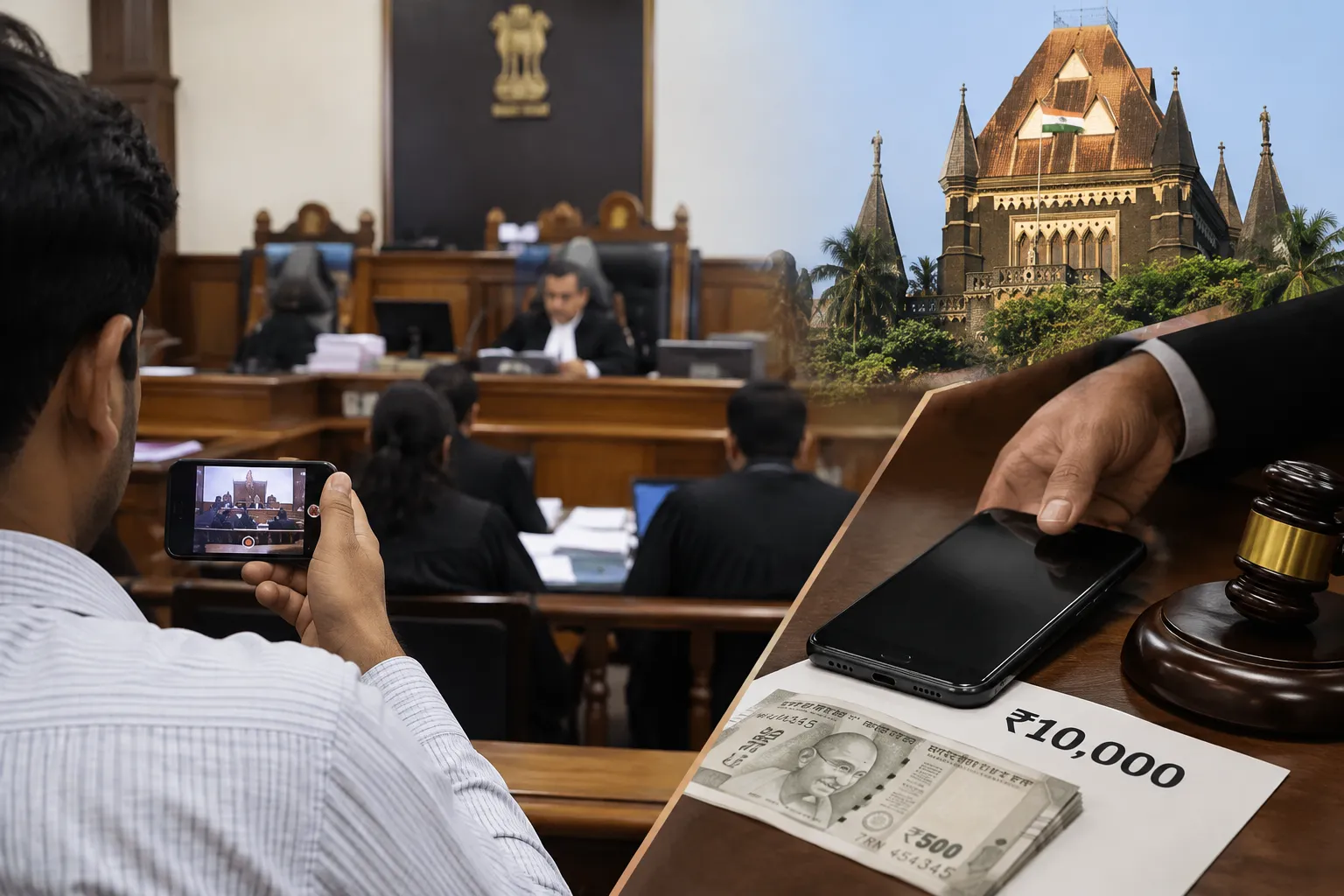
During regular judicial proceedings before the High Court of Judicature at Bombay, a Division Bench comprising Justice G.S. Kulkarni and Justice Neela Gokhale noticed an individual sitting in the courtroom audience with his mobile phone flashlight visibly illuminated, secretly pointing the camera at the judges and ongoing court proceedings. The person was immediately intercepted by court staff and identified as Dilip Wagh, an employee serving in a state government department. Notably, Wagh had no personal case or official business listed before the Court that day.
Upon interception, the court staff promptly seized the mobile handset. Although Wagh had hastily attempted to delete the video files to conceal his actions, the High Court’s Information Technology Department successfully recovered the recently deleted video recordings from the device’s internal storage, confirming that judicial hearings had been recorded without permission. Initiating suo motu contempt proceedings, the Division Bench called upon Wagh to explain his conduct. Faced with unequivocal forensic evidence, Wagh tendered an apology to the Court, claiming ignorance of the rules. The Division Bench took up the matter to determine whether such unauthorized recordings could be tolerated under the guise of open justice.
Legal Topic
Judicial Administration & Contempt Law – Contempt of Courts Act, 1971; Bombay High Court Live-Streaming and Recording of Court Proceedings Rules, 2022 (Rules 9.2 & 9.3); Principle of Open Justice vs. Courtroom Decorum and Sanctity; Suo Motu Judicial Discipline over Digital Misconduct in Courtrooms; Regulation of Electronic Devices in Judicial Chambers.
Core Legal Issue
Whether a member of the public or a government employee attending an open court session can record video proceedings on a personal mobile device without prior written permission, and what disciplinary and confiscatory measures may be imposed to deter the unauthorized recording and social media manipulation of judicial proceedings.
What Did the Court / Authority Decide?
The Division Bench comprising Justice G.S. Kulkarni and Justice Neela Gokhale disposed of the suo motu proceeding by accepting Wagh's apology to the extent of refraining from committing him to prison under the Contempt of Courts Act, 1971. However, the Court refused to let the contemnor off without strict disciplinary consequences, imposing a composite penalty of financial cost and permanent property forfeiture.
The High Court ordered the permanent confiscation and disposal/destruction of Wagh's seized mobile phone, directing the High Court IT Department to safely remove all personal data and execute a formal seizure panchnama. Furthermore, the Bench slapped a fine/cost of ₹10,000 on Wagh, directing him to deposit the amount with the Secretary, High Court Legal Services Authority, Mumbai, within two weeks (by October 19, 2026). The Court mandated that if he failed to pay, the sum would be recovered directly by his Head of Department from his monthly salary as arrears of land revenue. Warning Wagh and the public, the Bench cautioned that any repeat infraction would attract immediate criminal contempt proceedings.
Key Legal Points
- Open Justice Does Not Permit Unregulated Recording: The High Court held that while courts are open to the public to witness proceedings, open justice does not confer an unfettered right to record hearings on personal devices. Visitors must adhere strictly to courtroom etiquette and rules.
- Menace of Distorted Social Media Videos: The Bench expressed deep alarm at the rampant trend of unauthorized recordings being captured in courtrooms, which are subsequently 'manipulated in ways unimaginable and distorted versions posted on social media' to mislead the public and malign judicial authority.
- Heightened Duty on Public Servants: Justice G.S. Kulkarni noted that as a government employee, Wagh bore an even more onerous responsibility to uphold statutory rules and decorum compared to ordinary citizens, making his casual conduct inside a court of record intolerable.
- Forfeiture and Destruction of Recording Devices: The Court established that electronic devices used to unlawfully capture judicial proceedings are liable to permanent confiscation and destruction under Rule 9.2 read with Rule 9.3 of the Court Recording Rules, with IT oversight to protect personal data privacy.
- Salary Attachment for Default: To guarantee compliance with judicial fines, the Bench directed that failure to deposit the penalty would result in direct salary attachment executed by the contemnor's administrative department head.
Relevant Law
- Rules 9.2 & 9.3, Bombay High Court Live-Streaming and Recording of Court Proceedings Rules, 2022: Strictly prohibits any unauthorized recording, sharing, downloading, or broadcasting of live or in-person court proceedings by any person without prior written authorization from the High Court, providing that violations constitute contempt of court.
- Section 14, Contempt of Courts Act, 1971: Sets forth procedure and penalties for contempt committed in the presence or hearing of the High Court or Supreme Court.
- Article 215, Constitution of India: Vests High Courts with plenary inherent powers as courts of record to punish for contempt of themselves and to regulate procedure within their precincts.
- Swapnil Tripathi v. Supreme Court of India (2018) 10 SCC 639: Landmark ruling approving live-streaming of court proceedings while mandating strict regulatory guidelines to prevent unauthorized commercialization, distortion, or private recording of judicial footage.
Arguments of the Parties
- Stance and Apology of the Contemnor (Dilip Wagh):
- Wagh admitted that he had turned on his mobile camera and recorded a portion of the courtroom proceedings.
- He submitted that he did not possess any malicious intent or premeditated plan to publicize the footage, claiming that he was unaware of the strict prohibition against using mobile cameras inside courtrooms.
- The contemnor tendered an unconditional written apology, pleading that he was a government servant with a clean record and praying for leniency and discharge without formal punishment.
- Observations and Analysis of the Division Bench:
- The Division Bench remarked that Wagh had behaved inside the solemn precincts of the High Court "as if he was sitting in a garden or on the roadside," completely disregarding institutional decorum.
- The judges observed that Wagh had no case listed before the court, raising serious unanswered questions regarding his underlying motives for recording proceedings in secret.
- The Court emphasized that overlooking such conduct would render the statutory Live-Streaming and Recording Rules completely toothless and encourage a dangerous culture of sensationalist courtroom leaks on digital platforms.
Why Does It Matter?
This ruling addresses an urgent, fast-growing crisis in the modern Indian judicial system: the rise of unauthorized smartphone recordings, clickbait reels, and doctored courtroom clips circulated across platforms like YouTube, Instagram, and X. With several High Courts adopting official live-streaming, many citizens mistakenly assume that courtroom sessions are free-for-all public events that can be recorded, edited, and meme-ified for digital clout.
The Bombay High Court’s stern order sends a sharp deterrent message to litigants, government officials, and spectators. By enforcing permanent phone forfeiture and direct salary deductions, the Court establishes that courtroom doors may be open to the public, but the administration of justice is not public entertainment. It creates a robust precedent enabling judges across India to confiscate devices and levy immediate financial costs against courtroom digital disruptions, safeguarding judicial dignity and the privacy of advocates and litigants alike.
Legal Takeaway
Public access to open court hearings does not entitle attendees to record proceedings on personal mobile phones. Unauthorized recording violates statutory court recording rules and constitutes contempt of court. Offending devices are liable to permanent confiscation and destruction, and violators face monetary penalties recoverable directly from salary, reinforcing that courtroom solemnity and digital decorum must be preserved at all costs.
Sources (Primary & Additional)
- Primary Judicial Order: High Court of Judicature at Bombay, In Re: Unauthorised Recording of Court Proceedings (Court on its own motion) v. Dilip Wagh (Suo Motu Proceeding, Decided on October 06, 2026), per Division Bench of Justice G.S. Kulkarni and Justice Neela Gokhale. Bombay High Court Order Repository / LiveLaw PDF Upload.
- Authoritative Legal Reporting (Bar & Bench): Legal Bureau, "Bombay High Court slaps ₹10k fine on man for recording court hearings on mobile cam" (Published on October 07, 2026). Bar & Bench Article.
- Authoritative Legal Reporting (LiveLaw): Narsi Benwal, "Bombay High Court Seizes Man's Phone For Recording Court Proceedings, Imposes ₹10,000 Costs" (Article ID: 553386, Published on October 06, 2026). LiveLaw Article.