J&K&L High Court Mandates State Compensation for Civic Water Pipelines Running Through Private Land Even if Laid Prior to Landowner's Purchase
Court: High Court of Jammu & Kashmir and Ladakh at Srinagar
Bench: Justice Wasim Sadiq Nargal
Case Record: OWP No. 439/2018 (IA No. 01/2018)
Date of Pronouncement: September 28, 2026 | Reported: October 06, 2026 (LiveLaw ID: 553235)
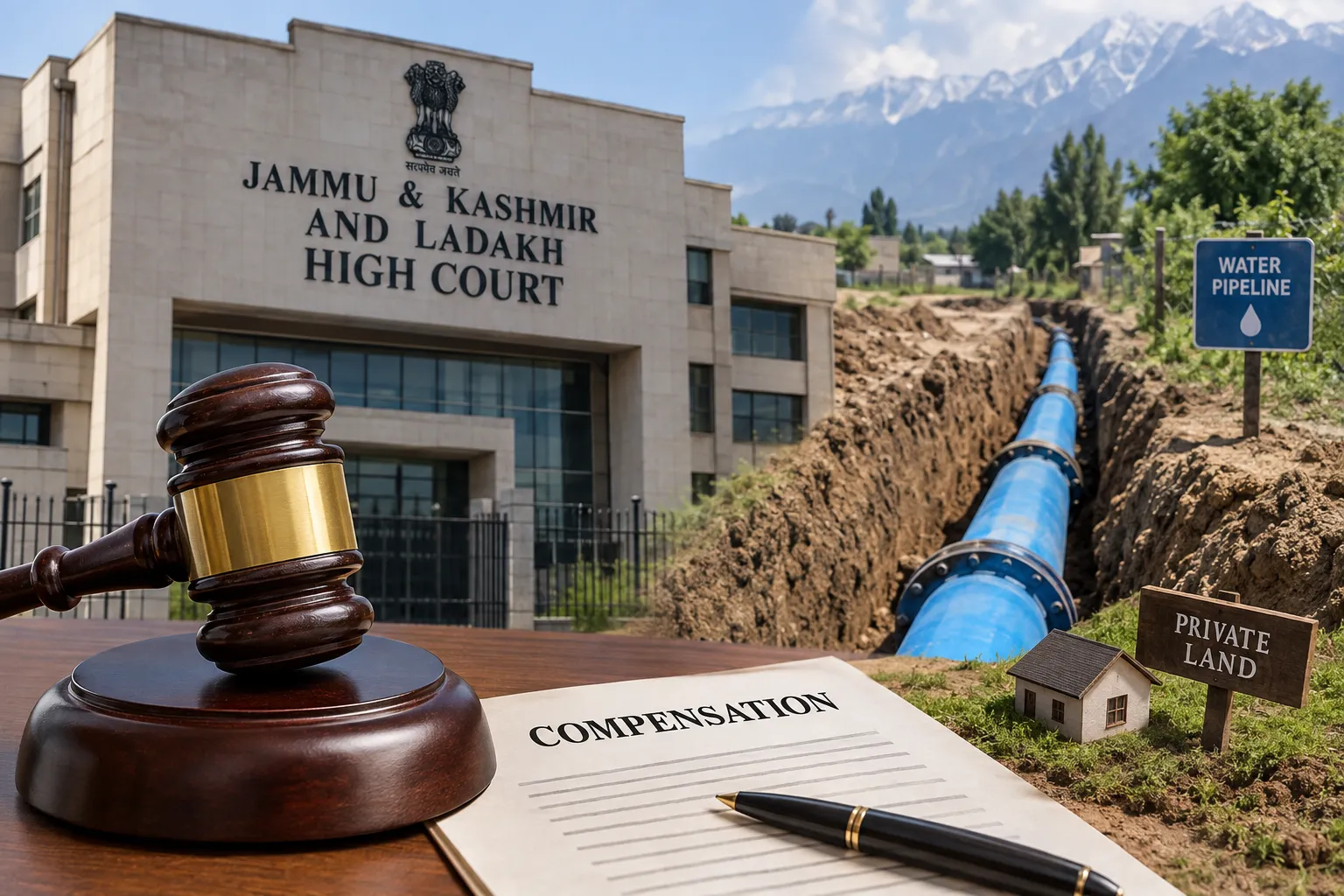
The petitioners, Mst. Haleema and another individual, purchased a parcel of private land in the Kashmir Valley in 2012 through registered sale deeds. Subsequent to their purchase, the petitioners discovered that the Public Health Engineering (PHE) Department of the State of Jammu and Kashmir (now the Union Territory of Jammu & Kashmir) had laid subterranean and surface water supply pipelines passing directly through their property to facilitate drinking water distribution to adjacent localities. This infrastructural installation severely encumbered the private land, depriving the owners of its full use, developmental potential, and peaceful enjoyment.
When the petitioners approached the PHE authorities seeking either the relocation of the pipelines, payment of compensation for the land occupied, or the formal assessment of use-and-occupation charges, the departmental authorities refused relief. The State contended that the pipelines had been laid prior to 2012 under an earlier public utility project, asserting that because the petitioners purchased the property with pre-existing pipelines in place, they lacked the locus standi to claim compensation or challenge the departmental occupation. Aggrieved by this administrative stonewalling, the landowners instituted a writ petition (OWP No. 439/2018) before the High Court of Jammu & Kashmir and Ladakh at Srinagar, invoking the constitutional guarantee under Article 300A of the Constitution of India.
Legal Topic
Constitutional & Property Law – Article 300A of the Constitution of India; Doctrine of Eminent Domain; Compulsory Expropriation vs. Permissible Police Powers; Continuing Interference with Proprietary Rights; Section 89 of the Jammu and Kashmir Water Resources (Regulation and Management) Act, 2010; Land Acquisition and Assessment of Use-and-Occupation Rent.
Core Legal Issue
Whether the State can resist paying compensation, rent, or damages to a bona fide purchaser of private land occupied by public water supply pipelines on the ground that the infrastructure was laid prior to the purchase, or whether the ongoing physical occupation constitutes a continuing violation of the constitutional right to property under Article 300A.
What Did the Court / Authority Decide?
The High Court of Jammu & Kashmir and Ladakh, through a Single Judge Bench comprising Justice Wasim Sadiq Nargal, allowed the writ petition and decisively rejected the State's preliminary objection. Justice Nargal ruled that the continued physical occupation and passage of public water pipelines through private land constitutes a 'continuing interference with proprietary rights.' The Court held that in the absence of lawful acquisition or compensation paid to the owners, the State cannot defeat a legitimate constitutional claim merely because the infrastructure predated the petitioners' registered title.
The High Court directed the Chief Engineer, PHE Department, Kashmir, to constitute a dedicated statutory committee under Section 89 of the J&K Water Resources (Regulation and Management) Act, 2010, within two weeks. The committee was ordered to conduct an on-site inspection, examine all revenue and departmental records, demarcate the exact area under occupation, and assess the nature and quantum of damage and use-and-occupation charges. Justice Nargal further ruled that if the State intends to retain the land permanently for public water supply, it must formally initiate statutory land acquisition proceedings. Crucially, the Court directed that any compensation and rental arrears determined by the competent authority must be disbursed promptly, failing which the amount shall carry interest at 6% per annum calculated retrospectively from the date of the land's purchase in 2012 until actual realization.
Key Legal Points
- Ongoing Physical Encroachment is a Continuing Wrong: Justice Wasim Sadiq Nargal clarified that the State's continued retention of private land for utility pipelines without acquisition represents an ongoing invasion of ownership. A subsequent purchaser inherits all legal and equitable remedies to challenge uncompensated deprivation.
- Constitutional Human Right under Article 300A: Reaffirming established constitutional jurisprudence, the Court emphasized that although the right to property ceased to be a fundamental right after the 44th Constitutional Amendment, it remains a protected constitutional human right under Article 300A; no citizen can be dispossessed without explicit statutory sanction and fair compensation.
- Limits of the Doctrine of Eminent Domain: The High Court observed that while the sovereign possesses the power of Eminent Domain to appropriate private assets for public utility, a democratic welfare state governed by the rule of law cannot arrogate power beyond constitutional limits or expropriate private citizens without procedure established by law.
- Mandatory Statutory Assessment under Section 89: The Court activated the statutory machinery under Section 89 of the J&K Water Resources Act, 2010, requiring an inter-departmental expert committee to conduct joint revenue demarcation and quantify rental charges for utility easements.
- Retrospective Interest Penalty for Delay: To ensure compliance, the Court imposed a 6% per annum default interest penalty running from the date of acquisition (2012) to the date of payment if the departmental authorities fail to disburse the assessed sum within the stipulated timeline.
Relevant Law
- Article 300A, Constitution of India: Dictates that no person shall be deprived of his property save by authority of law. While not a fundamental right, it is a human right and constitutional guarantee requiring fair procedure and compensation.
- Section 89, Jammu and Kashmir Water Resources (Regulation and Management) Act, 2010: Empowers the state government and designated authorities to inspect, enter upon, and assess damages, compensation, and charges for laying pipelines, channels, and water supply infrastructure across private land.
- Right to Fair Compensation and Transparency in Land Acquisition, Rehabilitation and Resettlement Act, 2013 (RFCTLARR Act): Governs compulsory state acquisitions, mandating market valuation, solatium, and rehabilitation where land is permanently appropriated for public purpose.
- Doctrine of Eminent Domain & Continuing Tort: The legal principle establishing that unauthorized and continuous state occupation of private land gives rise to a recurring cause of action, disabling the state from setting up pleas of laches or prior construction against landowners.
Arguments of the Parties
- Contentions of the Petitioners (Landowners):
- Represented by Advocate Manzoor Ahmad Dar, the petitioners contended that they are the lawful absolute owners of the land having acquired valid title via registered sale deeds executed in 2012.
- It was submitted that the PHE Department's water pipelines run directly through their property without any formal acquisition notification, consent, or payment of compensation.
- Counsel argued that unauthorized occupation by the state constitutes an ongoing deprivation of proprietary rights, rendering Article 300A meaningless if the state can appropriate private property gratis under the guise of public utility.
- The petitioners urged that the state be directed either to dismantle and shift the pipelines or to initiate formal acquisition proceedings and disburse comprehensive use-and-occupation rent from the date of purchase.
- Contentions of the Respondents (State / PHE Department):
- Represented by Government Advocate Jahangir Ahmad Dar, the State opposed the writ petition, arguing that the pipelines were laid decades ago for community drinking water supply prior to the petitioners purchasing the land.
- The State argued that the petitioners purchased the property with open eyes, fully aware of the presence of the pipeline network, and therefore waived any objection to the departmental easement.
- It was contended that public funds could not be expended on compensation to subsequent buyers who allegedly bought encumbered land at discounted rates, and that a summary writ proceeding was inappropriate to adjudicate complex compensation calculations.
Why Does It Matter?
This ruling by the High Court of Jammu & Kashmir and Ladakh is a landmark affirmation of constitutional property rights against administrative high-handedness and uncompensated state encroachments. Government departments routinely lay civic utilities—such as water pipelines, sewage lines, electricity transmission towers, and optical fiber cables—across private land without initiating formal land acquisition, often defending their actions under the umbrella of 'urgent public interest' or asserting that subsequent buyers have no claim.
Justice Nargal's judgment firmly shuts the door on this departmental practice. By classifying the physical presence of public infrastructure on unacquired private land as a 'continuing interference with proprietary rights,' the judgment establishes that the state cannot acquire prescriptive rights through unlawful inertia. Subsequent buyers who inherit or purchase land retain full constitutional protection under Article 300A to demand rent, compensation, or acquisition. Furthermore, by linking non-payment to a 6% retrospective interest penalty dating back over a decade to 2012, the decision imposes concrete fiscal accountability on administrative departments that use private land without compensation.
Legal Takeaway
The State cannot invoke the prior installation of public utility infrastructure to defeat a private landowner's claim for compensation under Article 300A of the Constitution. Continued occupation of private land by state agencies without formal acquisition or compensation constitutes a continuing interference with property rights, entitling bona fide purchasers to both use-and-occupation rent and retrospective statutory interest from the date of title acquisition.
Sources (Primary & Additional)
- Primary Judicial Order: High Court of Jammu & Kashmir and Ladakh at Srinagar, Mst. Haleema & Anr. v. State of Jammu & Kashmir & Ors. (OWP No. 439/2018, IA No. 01/2018, Judgment reserved on September 24, 2026, pronounced on September 28, 2026), per Justice Wasim Sadiq Nargal. LiveLaw Judgment PDF Link.
- Authoritative Legal Reporting (LiveLaw): LiveLaw News Network, "State Must Pay Compensation For Continued Use Of Private Land For Water Pipelines, Even If Laid Before Purchase: J&K High Court" (Article ID: 553235, Published on October 06, 2026). LiveLaw Article.
- Authoritative Regional Reporting (Kashmir Life): Legal Bureau, "Jammu Kashmir HC Orders Compensation, Rent for Private Land Used by PHE Water Pipelines Since 2012" (Published on September 30, 2026). Kashmir Life Coverage.