Texas Supreme Court Bars Private Property Inspection in Neighborhood Dispute
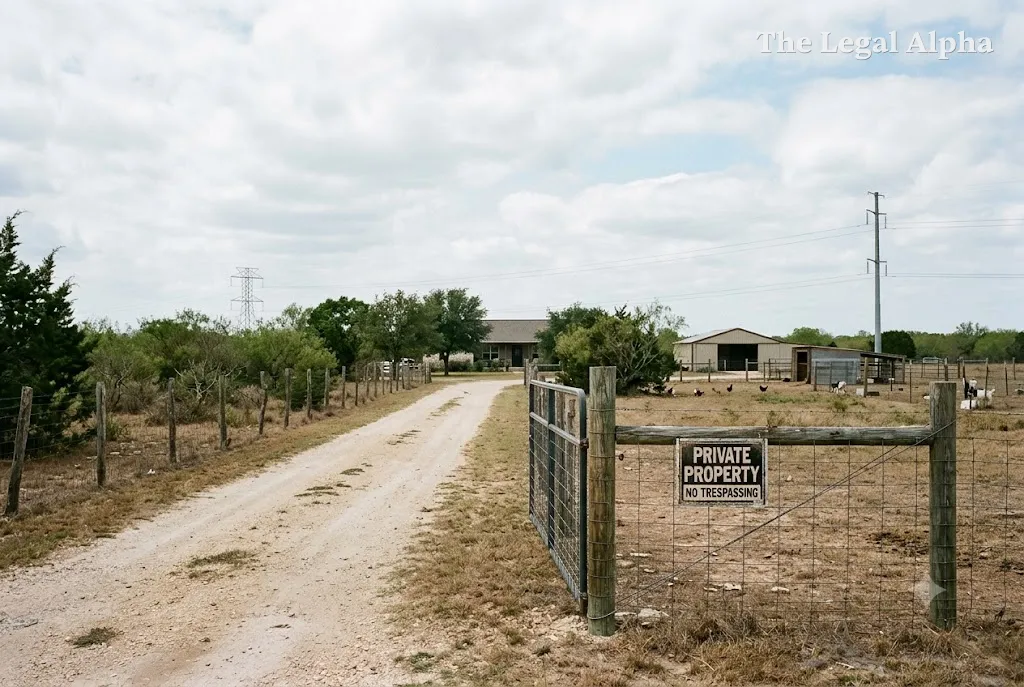
The Texas Supreme Court issued a ruling blocking a judicial order that permitted neighbors to enter and inspect a 14-acre private property. The dispute originated between landowner Pamela Bosco and her neighbors, James and Carolyn Bierschwale, in Hays County over the presence of livestock, including emus, ostriches, goats, and approximately 30 chickens. The neighbors alleged that keeping these animals breached neighborhood deed restrictions and residential limits. While the trial court initially granted an order authorizing an on-site property inspection, the state supreme court intervened to protect private property rights from unjustified intrusion.
Legal Topic
-
Area of Law: Civil Procedure and Property Law
-
Sub-topic: Judicial Discovery Orders and Homestead Protection
Core Legal Issue
The core legal question centered on whether constitutional and statutory property protections are overridden by judicial discovery requests (entry upon land) in civil neighbor disputes.
Specifically, the court addressed whether a trial judge may authorize entry onto private property simply to collect evidence when the requested information could be acquired through less invasive and more proportionate alternatives.
What Did the Court Decide?
The Supreme Court vacated the inspection order and granted Pamela Bosco's petition for a writ of mandamus. The court determined that the trial court's order constituted a clear abuse of discretion and violated the proportionality requirement governing discovery.
The ruling established that physical property inspections should not be granted as routine discovery in neighborhood conflicts, but must instead serve as a last resort when viable alternatives are absent. The underlying dispute remains pending, though evidence must now be collected via ordinary legal channels that respect property boundaries.
Key Legal Points
-
The Proportionality Principle: Civil procedure rules require courts to restrict discovery demands when information is reasonably obtainable through less burdensome or less costly means.
-
Homestead Safeguards: The inviolability of a home and private residential property carries strong constitutional protections against improper intrusion under the guise of litigation.
-
Necessity Standard: Court-ordered entry onto real property in neighborhood disagreements cannot serve as a fishing expedition or a lever for interpersonal pressure between opposing parties.
Relevant Law
-
Texas Rules of Civil Procedure, Rule 192.4 (Discovery Limitations and Proportionality).
-
Texas Rules of Civil Procedure, Rule 196.7 (Entry Upon Land for Inspection).
-
Texas Constitution, Article XVI (Homestead Protections).
-
Established mandamus standards concerning overly broad discovery orders.
Arguments of the Parties
The Relator (Pamela Bosco): Argued that an inspection order targeting her homestead infringed upon constitutionally shielded private property rights. She emphasized that the neighbors had already accumulated exterior photographs and recordings documenting the animals' locations, rendering physical entry unnecessary and an invasion of privacy.
The Real Parties in Interest (James and Carolyn Bierschwale): Contended that the relator was actively violating residential deed restrictions and neighborhood guidelines due to unpermitted structures and livestock. They argued that a direct physical inspection was indispensable for securing accurate measurements, evaluating conditions, and substantiating their claims.
Why Does It Matter?
This decision delineates clear boundaries around judicial authority to permit site inspections in everyday neighbor litigation. It signals to litigators and judges that property rights take precedence over a party's desire for cumulative discovery, restricting intrusive inspection orders unless strictly justified.
Legal Takeaway
Court-ordered entry onto an adverse party's private property in civil disputes remains an extraordinary measure, not an automatic entitlement. Courts must rigorously enforce proportionality standards and exhaust less intrusive alternatives before authorizing an on-site inspection.
Sources
-
Primary Source: Supreme Court of Texas, In re Pamela Bosco, Docket No. 25-0421.
-
Additional Sources: Texas Rules of Civil Procedure (Rules 192.4 & 196.7); Hays County District Court and Third Court of Appeals records.