Supreme Court Upholds Quashing of ₹388 Crore Demand Against Gaursons Over Ghaziabad Land Exchange
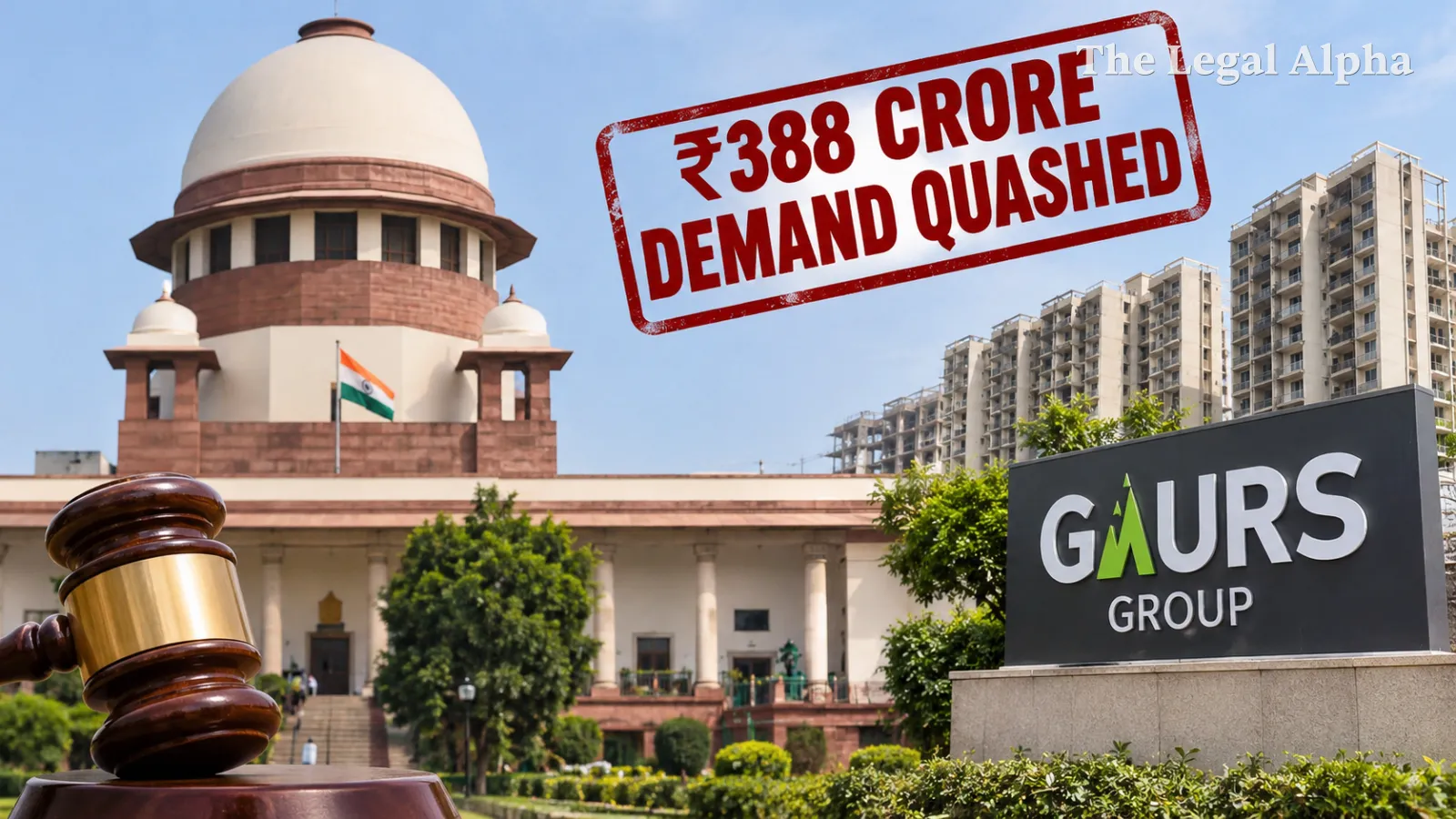
The Supreme Court of India has dismissed appeals filed by the Uttar Pradesh Government and the Uttar Pradesh Avas Evam Vikas Parishad, upholding the decision of the Allahabad High Court that set aside a ₹388 crore demand raised against real estate developer M/s Gaursons India Pvt. Ltd.
The dispute concerns approximately 12.047 acres of land in Ghaziabad allotted to the developer under an exchange arrangement. The Housing Board had sought to charge the developer at the prevailing bulk sale rate, despite an earlier agreement under which the replacement land was to be provided without additional consideration.
A Bench comprising Justice Pamidighantam Sri Narasimha and Justice Alok Aradhe delivered the judgment on November 17, 2026, in Uttar Pradesh Avas Evam Vikas Parishad & Anr. v. M/s Gaursons India Pvt. Ltd. & Ors.
The Court also extended the time granted to the State Government to take a fresh decision concerning the allotment of 450 economically weaker section (EWS) and low-income group (LIG) flats.
Legal Topic
Area of Law: Property Law and Administrative Law
Sub-topic: Land Exchange, Government Land Allotment, Contractual Obligations and Legality of Additional Financial Demands
Core Legal Issue
The central issue before the Supreme Court was whether the Uttar Pradesh Housing Board could impose a fresh financial liability of ₹388 crore on a developer for alternative land allotted through a registered exchange deed, particularly when the original land acquired by the Board had not been returned or compensated for.
The Court also examined whether restrictions contained in an earlier compromise and exchange arrangement could automatically be imposed on a different parcel of land subsequently allotted under a fresh registered instrument.
What Did the Supreme Court Decide?
The Supreme Court found no merit in the appeals filed by the Uttar Pradesh Government and the Housing Board. It upheld the Allahabad High Court's decision setting aside the Chief Secretary's June 2022 order and the consequential demand notice issued in September 2022.
The Court observed that the Housing Board had retained and developed the originally acquired land, which was more valuable than the alternative land subsequently provided to the developer. Having retained that property without compensating the original landowners, the Board could not demand further payment for the substituted land.
The Bench also clarified that the 2016 exchange deed was a fresh registered instrument executed with the State Government's no-objection. Its terms permitted residential construction, subject to approval by the competent authority. The restrictions contained in the earlier arrangement could not automatically be extended to the substituted property.
The Court dismissed Civil Appeal Nos. 9025, 9026 and 9027–9028 of 2026. It further extended by three months, from the date of its judgment, the time available to the State Government to take a decision concerning the allotment of 450 EWS/LIG flats.
Key Legal Points
-
The restrictions imposed under the 1995 compromise applied to the originally acquired land and did not automatically extend to every alternative parcel subsequently allotted by the Housing Board.
-
The 2004 exchange arrangement failed because the Housing Board allotted land that had already been resumed for a bird sanctuary.
-
The 2016 exchange deed was an independent registered instrument that expressly recognised the substituted property as residential freehold land.
-
The developer had already paid approximately ₹32.45 crore in land conversion charges.
-
The Housing Board could not demand additional consideration after retaining and developing the more valuable original land without compensating the original landowners.
Relevant Law
Uttar Pradesh Avas Evam Vikas Parishad Adhiniyam, 1965
The legislation governing the powers and functions of the Uttar Pradesh Housing Board, including its land development schemes.
Uttar Pradesh Zamindari Abolition and Land Reforms Act, 1950
Section 117(6) was referred to in the proceedings concerning the resumption of the disputed Arthala land.
Supreme Court Compromise Order dated March 20, 1995
The compromise established the original terms governing the adjustment and exchange of 12.047 acres of acquired land, including the condition that neither party would pay consideration for the exchange.
Registered Exchange Deed dated January 25, 2016
The instrument governing the subsequent allotment of residential freehold land in the Siddharth Vihar Scheme.
Arguments of the Parties
Uttar Pradesh Government and Housing Board
The State Government argued that the original restrictions concerning water purification and open land continued to bind the substituted property.
It also contended that the 2016 exchange deed had been executed without properly considering the earlier restrictions. The authorities relied on the Special Investigation Team report, alleging collusion between Housing Board officials and the developer.
The State further argued that refusing to impose the prevailing bulk sale rate would cause a financial loss exceeding ₹388 crore to the public exchequer.
Gaursons India Pvt. Ltd.
The developer argued that its predecessors had surrendered the original 12.047 acres, which the Housing Board subsequently retained and developed without paying compensation.
It submitted that the 2004 exchange failed because the alternative land allotted by the Board was already affected by restrictions relating to a bird sanctuary.
The company also pointed out that the 2016 registered exchange deed permitted residential construction and that it had already paid approximately ₹32.45 crore in conversion charges. It therefore opposed the fresh financial demand.
Why Does It Matter?
The judgment highlights the importance of contractual certainty in government land allotments and registered exchange arrangements.
Government authorities cannot automatically impose conditions from an earlier exchange deed upon a subsequently allotted property when the later registered instrument establishes a different set of rights and obligations.
The decision also has implications for real estate developers and homebuyers who rely on registered government allotments. In this case, residential construction had already taken place, involving 2,476 general houses and 450 EWS/LIG flats, creating third-party rights in favour of purchasers.
Importantly, the Supreme Court did not express any opinion on the SIT report or the allegations of collusion. It left the authorities free to take action in accordance with law. Therefore, dismissal of the appeals should not be interpreted as a judicial clearance of those allegations.
Legal Takeaway
The Supreme Court has reaffirmed that government authorities must honour the terms of registered exchange arrangements and cannot impose additional financial liabilities contrary to the governing agreement. Restrictions attached to an earlier parcel cannot automatically survive when the original exchange fails and a fresh registered instrument governs the substituted property.
Sources
Primary Source:
- Supreme Court of India, Uttar Pradesh Avas Evam Vikas Parishad & Anr. v. M/s Gaursons India Pvt. Ltd. & Ors., 2026 INSC 1233, decided November 17, 2026.
Additional Sources: