Supreme Court Strikes Down Two Uttar Pradesh Pension Laws, Protects Retirement Rights of Regularised Employees
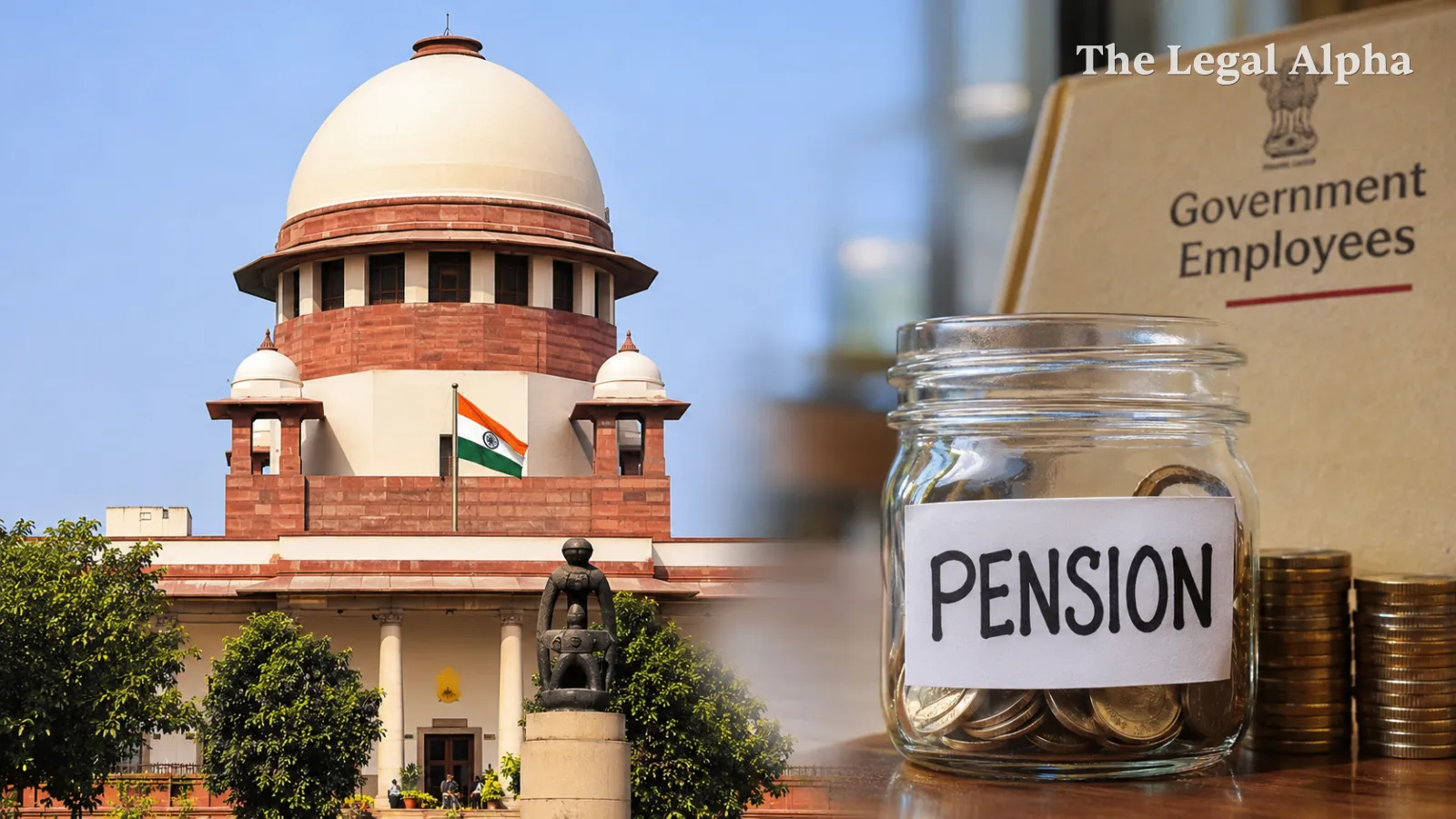
The Supreme Court of India has declared two Uttar Pradesh laws unconstitutional for excluding the service period of work-charged, temporary, daily-wage and muster-roll employees from pension calculations, even after their services were regularised.
In its judgment dated November 18, 2026, a Bench comprising Justice Dipankar Datta and Justice Satish Chandra Sharma struck down the Uttar Pradesh Qualifying Service for Pension and Validation Act, 2021, and the Uttar Pradesh Entitlement to Pension and Validation Act, 2025.
The decision provides significant relief to serving and retired government employees who had worked for several years before being absorbed into the regular government establishment but faced difficulties in receiving pensionary benefits for their earlier service.
The Court held that the State could not rely on the nature of an employee's initial appointment to deny retirement benefits after the employee had been regularised under an applicable scheme.
Legal Topic
Area of Law: Constitutional Law and Service Law
Sub-topic: Pensionary Benefits, Regularisation of Government Employees and Validity of Retrospective Legislation
Core Legal Issue
The central question before the Supreme Court was whether the Uttar Pradesh legislature could enact laws retrospectively excluding pre-regularisation service from pension calculations after the Supreme Court had already addressed the issue in its earlier judgment in Prem Singh v. State of Uttar Pradesh (2019).
The Court also examined whether the 2021 and 2025 enactments genuinely corrected the legal and constitutional defects identified in the earlier judgment or merely attempted to preserve the same exclusion through new legislative provisions.
Another important issue was whether the State could continue treating employees according to the temporary or work-charged nature of their original appointments after their services had been regularised and they had become part of the regular government establishment.
What Did the Supreme Court Decide?
The Supreme Court declared both the 2021 and 2025 Uttar Pradesh pension validation laws ultra vires the Constitution of India.
The Bench held that once an employee is regularised under a duly formulated scheme, the original character of the appointment cannot subsequently be used to deny pensionary and retirement benefits attached to regular government service.
The Court relied on its earlier ruling in Prem Singh, which recognised that qualifying service rendered in a work-charged establishment must be considered for pension purposes in the circumstances covered by that decision.
It also explained that legislation intended to validate an earlier legal position must actually remove the defect identified by the judiciary. Merely introducing fresh statutory language or retrospectively validating previous exclusions is insufficient.
The Court issued the following directions:
-
Eligible retired government employees can approach the competent authority with complete details of their employment and service history to claim pension and other retirement benefits.
-
Authorities must examine and decide each claim within six months of receiving it.
-
Pensionary benefits must be calculated in accordance with the principles laid down in Prem Singh, including the applicable restriction on monetary benefits.
-
Before rejecting a claim that appears unacceptable, authorities must provide the claimant an opportunity of hearing and issue a reasoned order.
-
Whenever a claim is accepted, the authority must provide a detailed statement showing payments made and the respective payment categories.
-
Delayed payment beyond the prescribed period will attract simple interest at 9% per annum.
The Court also clarified that the usual restriction on monetary benefits would not apply to claims filed by heirs or legal representatives of employees who retired and died before the 2019 Prem Singh judgment, provided they establish their entitlement through unimpeachable evidence.
Arguments of the Parties
Employees / Petitioners
The employees argued that they had served various Uttar Pradesh government departments for several years before their services were regularised. They contended that the State could not retrospectively disregard their earlier service when determining pension eligibility.
They further submitted that the 2021 and 2025 laws reproduced the same discriminatory exclusion that the Supreme Court had already addressed in Prem Singh. According to them, changing the statutory definition of qualifying service did not remove the underlying constitutional defect.
State of Uttar Pradesh
The State argued that work-charged establishments were legally and administratively different from regular government establishments. It maintained that pension entitlement depended on the applicable statutory service rules and that regularisation did not automatically convert earlier service into substantive regular appointment.
The State also defended the legislature's authority to prescribe pension eligibility retrospectively, subject to constitutional limitations. It argued that the two enactments had altered the statutory framework and were legally valid.
Relevant Law
Constitution of India
-
Article 14: Guarantees equality before the law and protection against arbitrary discrimination.
-
Article 16: Provides equality of opportunity in matters of public employment.
-
Article 21: Protects life and personal liberty and was considered in the constitutional examination of the pension restrictions.
Uttar Pradesh Retirement Benefits Rules, 1961
- Rule 3(8): Concerns the determination of qualifying service for pension and was previously read down by the Supreme Court in Prem Singh.
Civil Service Regulations
- Regulation 370: Relevant to the treatment of service in work-charged establishments for pension purposes.
Important Supreme Court Precedent
Prem Singh & Others v. State of Uttar Pradesh (2019) 10 SCC 516.
In this judgment, the Supreme Court held that qualifying service rendered in a work-charged establishment must be considered for pension in the circumstances covered by the ruling. The present judgment reaffirmed the legal position established in that decision.
Why Does It Matter?
The judgment has important implications for government employees who spent substantial periods working in temporary, work-charged, daily-wage or muster-roll capacities before their eventual regularisation.
For many such employees, excluding their earlier service could significantly affect their qualifying service and pension entitlement, despite years of work for government departments.
The ruling also clarifies an important constitutional principle: although legislatures have the authority to frame and amend service and pension laws, they cannot simply reproduce a legal defect already identified by the judiciary through retrospective legislation.
The decision is particularly relevant to retired employees who may have been denied pensionary benefits because their earlier service was excluded from the qualifying period. However, entitlement will depend on the employee's service history and whether the individual falls within the scope of the judgment.
The six-month deadline for deciding claims also places a clear responsibility on the competent authorities to examine applications rather than leave eligible retirees waiting indefinitely.
Legal Takeaway
The Supreme Court has reaffirmed that the nature of an employee's initial appointment cannot automatically be used to deny pensionary benefits after regularisation under an applicable scheme. The judgment also establishes that retrospective legislation must genuinely cure an identified constitutional defect rather than reproduce an exclusion previously rejected by the Court.
Sources
Primary Source:
- Supreme Court of India, Uttar Pradesh Ground Water Department Non Gazetted Employee Association (Regd.) & Another v. The Chief Secretary & Others, 2026 INSC 1252, judgment dated November 18, 2026.
Additional Sources: