Supreme Court Refuses to Revive Karnataka’s Bike Taxi Ban, Leaving Ola, Uber and Rapido Services Operational
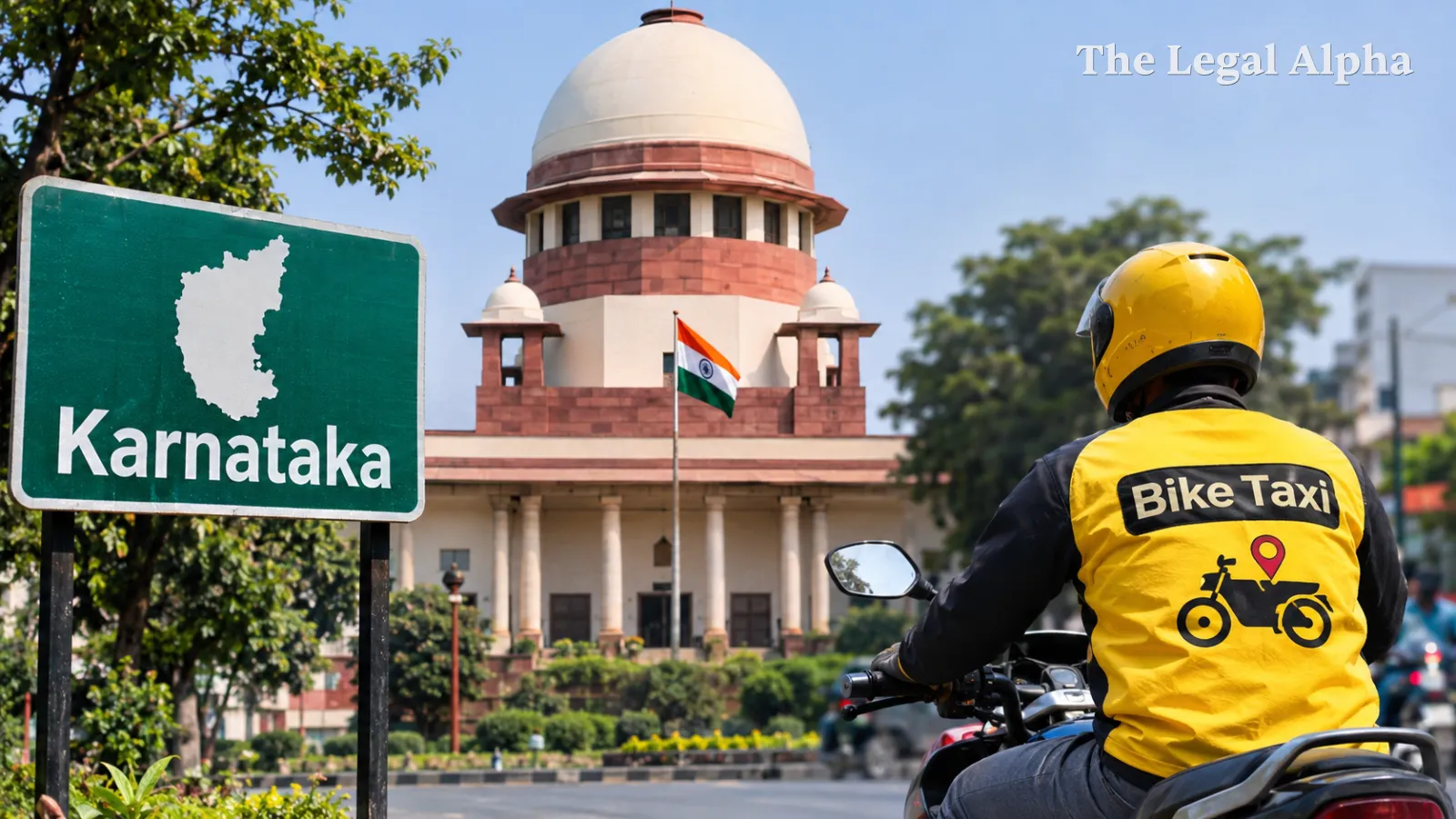
The Supreme Court of India has dismissed the Karnataka government's challenge to a Karnataka High Court ruling that permitted bike taxi services in the State. The decision allows motorcycle-based taxi services operated by aggregators such as Ola, Uber and Rapido to continue, subject to applicable registration, permit and regulatory requirements.
What Happened?
On November 20, 2026, a Bench comprising Justice Satish Chandra Sharma and Justice N. Kotiswar Singh dismissed the Karnataka government's appeal against the High Court's January 23, 2026 judgment.
The dispute arose after a single-judge Bench of the Karnataka High Court had directed bike taxi operators to stop their services until the State government introduced an appropriate regulatory framework.
Ride-hailing companies, motorcycle owners and the Bike Taxi Welfare Association challenged that decision, arguing that motorcycles could legally be registered and operated as transport vehicles.
Legal Topic
Area of Law: Motor Vehicles Law and Constitutional Law
Sub-topic: Transport Vehicle Registration, Contract Carriage Permits and Regulation of App-Based Mobility Services.
Core Legal Issue
The central legal question was whether the Karnataka government could prevent motorcycle owners and ride-hailing aggregators from operating bike taxi services on the ground that motorcycles could not be used as transport vehicles or contract carriages.
The Supreme Court was also required to consider the State's regulatory concerns, including passenger safety, insurance protection and the appropriate framework for commercial motorcycle-based transportation.
What Did the Supreme Court Decide?
The Supreme Court dismissed the Karnataka government's challenge, leaving the Karnataka High Court's decision undisturbed.
The High Court's January 23 judgment had held that motorcycle owners could apply to register their vehicles as transport vehicles and seek permission to operate them as contract carriages.
It also clarified that transport authorities could not reject such applications merely because the vehicles were motorcycles. However, the authorities retained the power to impose appropriate conditions in accordance with law.
During the Supreme Court proceedings, Justice Sharma observed that bike taxis should be regulated rather than prohibited. He also referred to their affordability and convenience for commuters, particularly women.
The detailed Supreme Court judgment is awaited. Therefore, the dismissal should not be interpreted as granting unconditional permission to every bike taxi operator.
Key Legal Points
-
Motorcycle registration: Motorcycles can be registered as transport vehicles under the legal framework recognised by the Karnataka High Court.
-
Permit eligibility: Motorcycle owners can apply for contract carriage permits to operate bike taxis.
-
Regulatory authority: The State retains the power to impose reasonable conditions governing bike taxi operations.
-
Passenger safety: Safety and insurance concerns remain relevant regulatory considerations and cannot simply be ignored.
-
Regulation versus prohibition: The Supreme Court's observations favour regulating bike taxi services rather than imposing a blanket prohibition.
Relevant Law
Motor Vehicles Act, 1988
-
Section 2(7): Definition of contract carriage.
-
Section 2(47): Definition of transport vehicle.
-
Section 67(3): State government's powers concerning the regulation of road transport.
-
Section 74(2): Conditions that may be attached to contract carriage permits.
-
Section 93: Licensing and regulation of transport aggregators.
Karnataka On-Demand Transportation Technology Aggregator Rules, 2016: These rules govern the licensing and operation of transport aggregators in Karnataka.
Arguments of the Parties
Karnataka Government
The State argued that motorcycles and motor cabs fall under different categories under the Motor Vehicles Act and that existing aggregator regulations did not automatically permit motorcycle-based taxi operations.
It also raised concerns regarding passenger safety, insurance coverage, traffic management and the absence of adequate safeguards. The State relied on the regulatory powers available under Section 67(3) of the Motor Vehicles Act.
Bike Taxi Aggregators and Operators
Ola, Uber, Rapido and motorcycle owners maintained that the Motor Vehicles Act permits motorcycles to be registered as transport vehicles and operated as contract carriages.
They argued that the government could impose reasonable regulatory conditions but should not impose a blanket prohibition where the statutory framework permits such operations.
The aggregators also highlighted the affordability of bike taxis and their importance for commuters.
Why Does It Matter?
The Supreme Court's decision is significant for Karnataka's urban transport sector, particularly Bengaluru, where affordable and convenient transportation remains an important concern.
For commuters, the continuation of bike taxi services provides another option for travelling short distances, potentially reducing travel expenses and improving accessibility.
For companies such as Ola, Uber and Rapido, the decision removes the immediate threat of restoring the statewide prohibition and allows them to continue pursuing the necessary regulatory permissions.
The ruling also raises an important question about how governments should respond to emerging technology-driven transport services. Passenger safety, insurance protection and fair competition are legitimate regulatory concerns, but restrictions must operate within the statutory framework.
The decision may also attract attention from other States dealing with similar disputes over app-based motorcycle transportation. However, the precise legal reasoning of the Supreme Court will become clearer when its detailed judgment is made available.
Legal Takeaway
The Supreme Court's dismissal leaves the Karnataka High Court's framework for bike taxi operations intact. Motorcycle owners and aggregators can pursue the required registrations and permits, while the State retains its authority to impose lawful regulatory conditions. The important distinction is that regulatory concerns do not automatically justify a blanket prohibition.
Sources
Primary Source:
- Karnataka High Court judgment dated January 23, 2026, in ANI Technologies Pvt. Ltd. v. State of Karnataka & Others — Read the judgment (PDF).
Additional Sources: