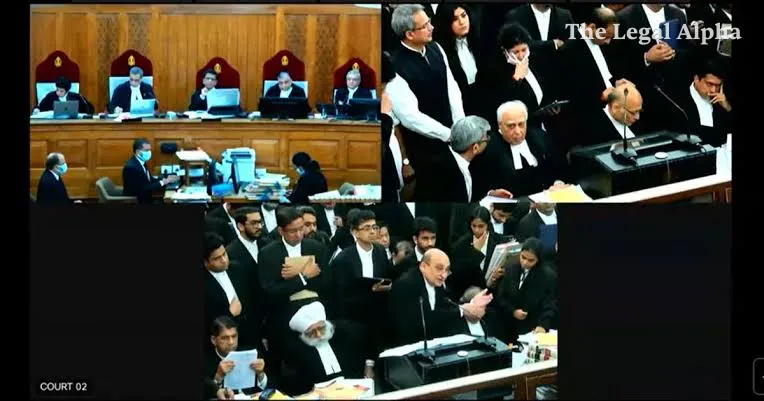
Supreme Court Refuses to Club Cyber Fraud FIRs, Likens ‘Digital Arrest’ Schemes to Organised Dacoity

The Supreme Court of India declined to entertain a writ petition seeking to consolidate multiple criminal cases registered across several states against individuals accused of operating corporate "mule" bank accounts for cyber extortion and digital arrest operations.
A bench comprising the Chief Justice of India and Justice Joymalya Bagchi described digital arrest schemes and related transnational cybercrimes as digital dacoity, remarking that perpetrators of such extortion networks must be handled with utmost firmness. The petitioners, Gourab Kumar Saha and Nidhi Bhandari, faced at least 35 First Information Reports across Delhi, Maharashtra, Kerala, Telangana, and Gujarat for allegedly allowing their corporate entity’s accounts to channel siphoned money.
During the hearing, the bench pointed out that an 81-year-old resident from Ernakulam, Kerala, was defrauded of ₹1.90 crore, which was routed directly through the petitioners' account network before being siphoned abroad to destinations including Hong Kong and Bangkok. When the court indicated its unwillingness to grant relief that would burden victims and disrupt state-level investigations, the petitioners withdrew their plea.
Legal Topic
Area of Law: Criminal Law / Cyber Law
Sub-topic: Transfer and Consolidation of FIRs / Cyber Extortion and Money Mule Liability
Core Legal Issue
The petition raised the question of whether individuals facing multiple cross-jurisdictional FIRs for allegedly facilitating cyber extortion through mule bank accounts can invoke the Supreme Court's writ jurisdiction under Article 32 of the Constitution to consolidate and transfer all state investigations to a single forum for procedural convenience.
Specifically, the court examined whether an accused's request for procedural consolidation can supersede the jurisdictional rights of victims and the operational autonomy of independent state police agencies investigating widespread financial fraud.
What Did the Court / Authority Decide?
The Supreme Court refused to grant an order consolidating or transferring the multi-state investigations to Delhi, compelling the petitioners to withdraw the writ petition.
The bench ruled that the convenience of an accused seeking a single investigative venue cannot override the interests of victims and individual law enforcement agencies. The judges highlighted that forcing victims from across India—such as elderly citizens defrauded in Kerala—to travel to Delhi to pursue prosecution or seek restitution would undermine justice. The court noted that while centralisation might be considered if requested by an agency like the Delhi Police for genuine investigative cohesion, an accused cannot deploy Article 32 to weaken or derail coordinated probes across multiple states.
Key Legal Points
-
Equating Cyber Fraud with Dacoity: The bench observed that modern cyber extortion rings and "digital arrest" scams operate on an organized scale comparable to dacoity, necessitating strict judicial scrutiny rather than procedural indulgence.
-
Primacy of Victim and Investigative Rights: An accused's claim of personal inconvenience cannot take precedence over the statutory territorial jurisdiction of state police forces or the ability of dispersed victims to access local justice.
-
Mule Account Liability: Providing corporate accounts to receive, layer, or transfer illicit proceeds from fraudulent schemes directly implicates account holders in the broader criminal conspiracy.
-
Limits of Article 32 for Consolidation: While the Supreme Court possesses extraordinary powers to club FIRs arising out of the identical cause of action, it will not exercise this discretion where distinct offences victimise separate citizens across multiple jurisdictions.
Relevant Law
-
Constitution of India, Article 32: Extraordinary writ jurisdiction invoked by the petitioners seeking consolidation of multiple criminal proceedings across India.
-
Code of Criminal Procedure, 1973 (CrPC), Sections 177 and 178 / Bharatiya Nagarik Suraksha Sanhita, 2023 (BNSS): Governs the territorial jurisdiction of criminal courts and inquiries where offences occur across multiple local jurisdictions.
-
Indian Penal Code, 1860 (IPC) / Bharatiya Nyaya Sanhita, 2023 (BNS): Provisions addressing extortion, cheating (Section 420 IPC), and criminal conspiracy (Section 120B IPC).
-
Information Technology Act, 2000, Section 66D: Penalises cheating by personation through computer resources or communication devices.
Arguments of the Parties
Petitioners (Gourab Kumar Saha and Nidhi Bhandari)
The petitioners argued that managing 35 parallel investigations across multiple distant states caused immense harassment, severe procedural hardship, and conflicting proceedings. They submitted that because the allegations pertained to interconnected cyber transactions, all FIRs ought to be consolidated and investigated by a single nodal agency, such as the Delhi Police.
The Court's Observations on Behalf of Victims and the State
The bench countered that the petitioners knowingly permitted their company's bank accounts to function as conduits for extensive cyber fraud. The court emphasised that scattered victims—frequently senior citizens stripped of life savings—cannot be expected to travel across the country to pursue remedies simply to suit the accused's geographic preference.
Why Does It Matter?
This development clarifies that the Supreme Court is unwilling to provide procedural shields to intermediaries operating within cybercrime ecosystems. By categorising "digital arrest" and coordinated online fraud as modern dacoity, the apex court has signalled a strict approach toward bail, quashing, and transfer applications in cyber-fraud litigation.
For corporate entities and bank account holders, the decision highlights the severe personal and criminal exposure of operating "mule" accounts. Facilitating the routing of unauthorized transactions precludes an accused from claiming ignorance to secure consolidation of cases, reinforcing that every defrauded victim retains the statutory right to have local law enforcement investigate the crime in their home jurisdiction.
Legal Takeaway
Accused persons facing multiple cyber fraud FIRs across different states cannot claim case consolidation as a matter of right when doing so inconveniences victims or impedes independent police investigations. Opening or operating company accounts that receive proceeds from digital arrest extortion treats the account holder as an integral participant in the crime, subjecting them to separate proceedings across every affected jurisdiction.
Sources
Primary Source:
Supreme Court of India, Gourab Kumar Saha and Anr. v. State and Ors., Writ Petition (Criminal) No. 439/2026, orders and oral observations dated October 28, 2026 (Bench comprising the Chief Justice of India and Joymalya Bagchi, J.).
Additional Sources:
Supreme Court Cause List (Part-A, Item 18, October 28, 2026); High Court and Supreme Court cyber jurisprudence on Section 66D of the Information Technology Act, 2000 and Section 420 of the Indian Penal Code.