Supreme Court Refuses Deemed Practice Benefit to 2026 Law Graduates Seeking Civil Judge Posts
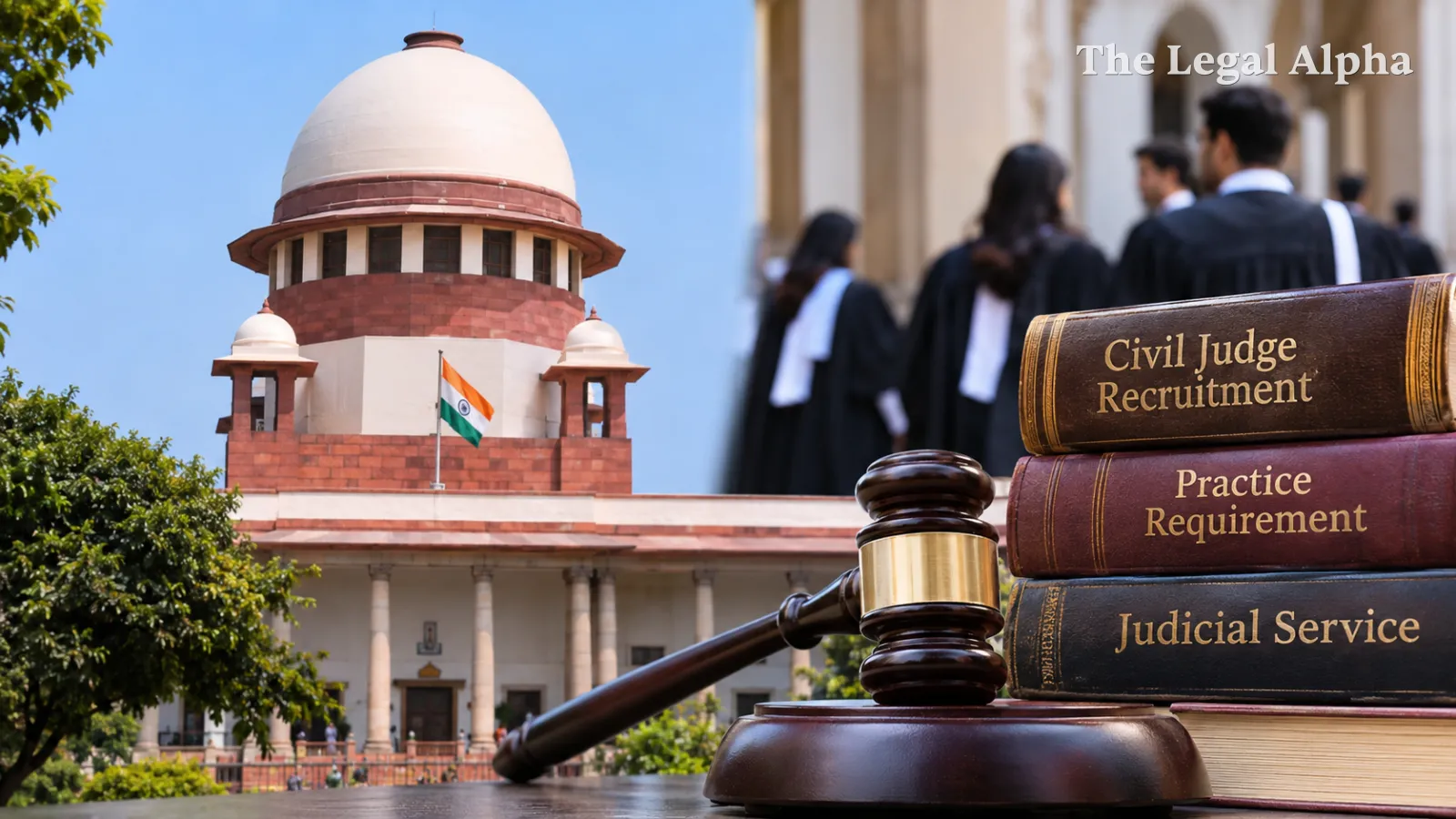
The Supreme Court of India has declined to extend the one-year deemed practice benefit granted under its judgment in Bhumika Trust v. Union of India to law graduates who completed their degrees in 2026 and are seeking appointment as Civil Judges (Junior Division).
A three-judge Bench comprising Chief Justice of India Surya Kant, Justice Joymalya Bagchi and Justice V. Mohana was hearing a petition challenging an Andhra Pradesh High Court decision that rejected requests by recently graduated law students seeking eligibility for the Civil Judge recruitment process.
The dispute arose from an Andhra Pradesh recruitment notification dated September 25, 2026. Candidates who had graduated within the preceding year argued that they should also receive the benefit of the deemed practice arrangement introduced by the Supreme Court.
Senior Advocate Pinky Anand, appearing for the petitioner, sought an extension of the exemption. However, the Bench declined to extend the benefit, observing that newly enrolled 2026 graduates should gain practical experience before seeking entry into the judicial service.
Legal Topic
Area of Law: Constitutional Law and Judicial Service Law
Sub-topic: Eligibility for Judicial Recruitment – Mandatory Practice Requirement – Deemed Practice Exemption
Core Legal Issue
The central legal question was whether law graduates who obtained their degrees in 2026 could claim the benefit of one year of deemed legal practice under the transitional arrangement formulated in Bhumika Trust v. Union of India, even though they had not completed one year from their graduation or provisional enrolment.
The Court was required to consider whether the transitional exemption was intended to cover all candidates applying before March 31, 2027, or whether the deemed practice benefit was limited to graduates who had already spent the relevant period acquiring practical exposure after the earlier judgment.
What Did the Supreme Court Decide?
The Supreme Court declined to extend the deemed practice benefit to candidates who graduated in 2026.
During the hearing, Chief Justice Surya Kant explained that the earlier exemption was intended to address the position of law graduates who had completed approximately one year after the May 2025 judgment restoring the practice requirement, by the time the Supreme Court delivered its revised decision in August 2026.
The Chief Justice observed that those graduates were presumed to have spent the intervening period working in law offices, assisting senior advocates, visiting courts and gaining practical legal exposure. The Court therefore considered it appropriate to treat that period as one year of practice.
The Bench indicated that extending the same benefit to newly graduated candidates would go beyond the purpose of the transitional arrangement. It observed that 2026 graduates should be allowed to spend a year gaining practical experience before entering the judicial recruitment process.
The Court's refusal means that the deemed practice concession cannot automatically be claimed by 2026 graduates merely because the recruitment notification falls within the transitional period.
Key Legal Points
-
The Supreme Court has maintained the distinction between the transitional exemption and the actual practice requirement applicable to newly graduated candidates.
-
The deemed one-year practice benefit was introduced to address the difficulties faced by law graduates following the restoration of the three-year practice requirement in May 2025.
-
The exemption was based on the Court's assessment that eligible graduates had spent the intervening period gaining practical exposure to legal work.
-
Candidates graduating in 2026 cannot automatically claim one year of deemed practice under the transitional arrangement.
-
The ruling reinforces the importance of practical courtroom experience before entering the judicial service.
Relevant Law
Bhumika Trust v. Union of India (2026 LiveLaw (SC) 841)
The Supreme Court's August 21, 2026 judgment modified its earlier decision dated May 20, 2025, concerning the mandatory practice requirement for direct recruitment to the post of Civil Judge (Junior Division).
The revised framework provides:
-
Transitional period: Recruitment notifications issued between May 20, 2025 and March 31, 2027 are governed by the transitional arrangement.
-
Deemed practice: Eligible candidates covered by the transitional arrangement receive the benefit of one year of deemed practice.
-
Recruitments from April 1, 2027: Candidates must complete at least one year of actual practice before appearing for the examination.
-
Post-selection requirements: Selected candidates must undergo one year of judicial academy training and one year of structured law clerkship.
The earlier three-year practice requirement was restored through the Supreme Court's judgment in All India Judges Association v. Union of India, dated May 20, 2025.
Arguments of the Parties
Petitioner / Applicant
Senior Advocate Pinky Anand, appearing for the petitioner, sought the extension of the deemed practice benefit to 2026 law graduates. She argued that candidates falling within the same recruitment category should also receive the benefit of the transitional arrangement.
She highlighted that several candidates were similarly situated and sought relief from the eligibility restriction.
Respondents
The arguments of the respondents are not detailed in the available report. The Supreme Court's observations, however, focused on the distinction between graduates who had spent the intervening period gaining practical exposure and those who had only recently completed their law degrees.
Why Does It Matter?
The development is significant for law graduates preparing for Civil Judge (Junior Division) examinations across India.
The Supreme Court's decision indicates that the transitional exemption introduced in Bhumika Trust cannot be treated as a blanket relaxation for every law graduate whose recruitment notification falls before March 31, 2027.
For candidates graduating in 2026, the decision highlights the importance of gaining actual professional exposure before seeking entry into judicial service.
It also clarifies the practical limits of the transitional arrangement. The exemption was designed to address the hardship caused by the sudden restoration of the practice requirement, rather than permanently remove the expectation of prior legal experience.
For judicial aspirants, the distinction between deemed practice and actual practice is therefore particularly important when assessing eligibility for upcoming recruitment examinations.
Legal Takeaway
The Supreme Court has declined to extend the deemed one-year practice benefit under Bhumika Trust to law graduates who completed their degrees in 2026. The transitional concession cannot automatically be interpreted as a general exemption from the requirement of gaining practical legal experience.
Sources
Primary Source:
- Bhumika Trust v. Union of India, 2026 LiveLaw (SC) 841, Supreme Court judgment dated August 21, 2026.
Additional Sources:
Editorial note: The account of the November 19, 2026 hearing is based on the available news report. A separate written Supreme Court order in the present matter was not independently verified.