Supreme Court Questions Accountability Over Yamuna Pollution Despite Heavy Expenditure on Cleanup
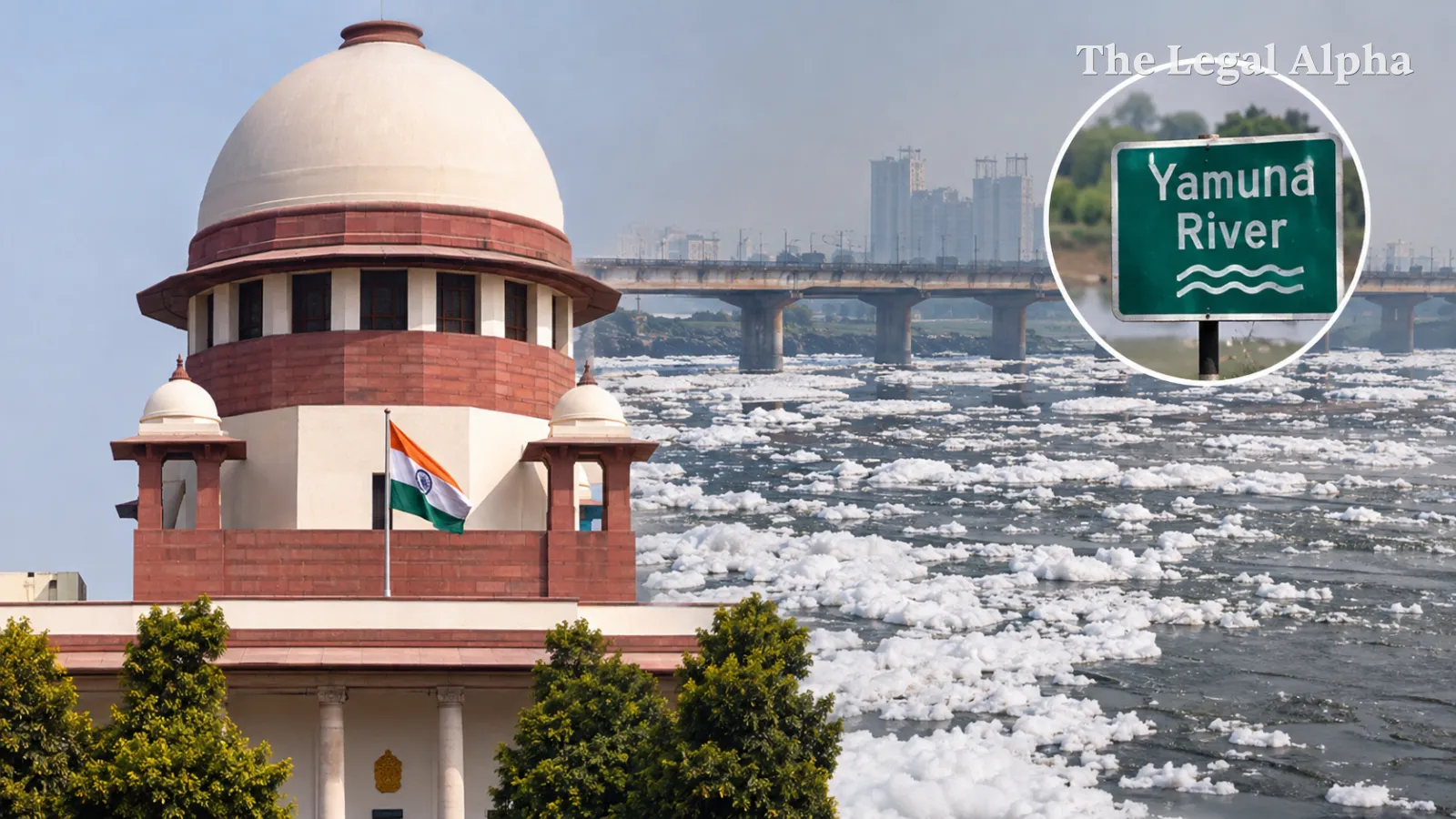
The Supreme Court's concerns over the continuing deterioration of the Yamuna raise important questions about environmental governance, public expenditure and the responsibility of authorities to prevent untreated sewage and industrial waste from entering the river.
What Happened?
On November 4, 2026, the Supreme Court of India examined the implementation of the Yamuna Action Plan while hearing matters concerning pollution in the river. A Bench comprising Justice Manoj Misra and Justice Manmohan expressed concern that substantial public expenditure on cleaning the Yamuna had not translated into improved water quality.
The Court identified untreated sewage, industrial discharge, encroachments and shortcomings in civic administration as major contributors to the pollution. It also questioned inconsistencies in the Delhi government's action plan, particularly regarding encroachments on water bodies and the performance of sewage treatment plants.
The proceedings arise in New Okhla Industrial Development Authority v. State of Uttar Pradesh & Ors., Civil Appeal Nos. 8547–8548 of 2022, along with connected matters.
Legal Topic
Area of Law: Environmental Law
Sub-topic: River Pollution, Environmental Governance and Accountability of Public Authorities
Core Legal Issue
The central legal issue concerns the responsibility of States, Union Territories and civic authorities to prevent and control pollution in a river that passes through multiple jurisdictions.
The Supreme Court is examining whether authorities can be held financially accountable when pollution levels deteriorate within their respective jurisdictions despite public expenditure and existing environmental protection measures.
Another important question is whether constructing sewage treatment plants alone is sufficient to restore the river without addressing industrial waste, unauthorised settlements, encroachments and inadequate sewage infrastructure.
What Did the Supreme Court Decide?
In its November 4 order, the Supreme Court issued directions aimed at strengthening monitoring, transparency and accountability in the Yamuna's pollution-control framework.
The Court directed the Central Pollution Control Board (CPCB) to monitor water quality at the entry and exit points of States, Union Territories and districts, using parameters including Biochemical Oxygen Demand, Chemical Oxygen Demand, Fecal Coliform and Total Suspended Solids.
It further provided that States, Union Territories and districts could face financial penalties if water quality deteriorates within their respective jurisdictions. The CPCB was directed to suggest a formula for calculating such compensation.
The Court also directed:
-
Installation of tamper-proof energy meters and continuous monitoring sensors at sewage treatment plants and common effluent treatment plants.
-
Live publication of plant-wise operational and discharge data on pollution control board websites.
-
Surprise inspections and quarterly sampling of sewage treatment plants with a capacity of at least 5 MLD and common effluent treatment plants.
-
Environmental compensation from treatment plant operators for each day of non-compliance.
-
GPS tracking and registration of septage tankers to monitor sewage collection and disposal.
-
Appointment of senior nodal officers by the concerned States, Union Territories and Central Ministries within two weeks.
The Court directed that the matter be listed on January 13, 2027, at 2 PM.
Key Legal Points
- Shared environmental responsibility: The Court applied the principle of Common but Differentiated Responsibilities, requiring States to protect the river collectively while accounting for their respective contributions to pollution and capacity to address it.
- Polluter accountability: Authorities may recover environmental penalties from polluters and officials found responsible for negligence after appropriate inquiry.
- Scientific monitoring: Water quality must be assessed through measurable parameters and independently verifiable testing.
- Transparency in public infrastructure: Treatment plants must provide real-time information about their operations, treatment capacity and discharge quality.
- Protection of river ecosystems: The Court emphasised that restoring the Yamuna requires addressing encroachments, sewage networks, industrial pollution and waste management rather than relying exclusively on additional treatment plants.
Relevant Law
Constitution of India
-
Article 21 – Right to Life, which has been judicially interpreted to include the right to a clean and healthy environment.
-
Article 48A – Directive Principle requiring the State to protect and improve the environment.
-
Article 51A(g) – Fundamental duty of citizens to protect and improve the natural environment.
Environmental Legislation
-
Environment (Protection) Act, 1986.
-
Water (Prevention and Control of Pollution) Act, 1974.
Relevant Environmental Principle
- Common but Differentiated Responsibilities, recognised under Principle 7 of the Rio Declaration on Environment and Development, 1992.
- River Ganga (Rejuvenation, Protection and Management) Authorities Order, 2016, which provides guidance for treating a river and its tributaries as an integrated system.
Arguments of the Parties
The November 4 order primarily records the Court's examination of the Yamuna Action Plan and the directions issued to the concerned authorities. It does not provide a complete account of separate arguments advanced by every party.
Court-Appointed Amicus Curiae
The amicus curiae proposed a coordinated planning and implementation mechanism involving the Centre and the States concerned. The recommendations included identifying polluting industries, mapping treatment infrastructure, monitoring drains and publishing river water quality data.
Union Government and Concerned Authorities
The proceedings considered the Yamuna Action Plan prepared under the coordination of the Union Ministry of Home Affairs. The plan proposed new sewage treatment plants, common effluent treatment plants, solid waste facilities and restoration of water bodies.
The Court identified inconsistencies in the plan and sought stronger measures to address existing pollution sources.
Why Does It Matter?
The Supreme Court's intervention places greater emphasis on measurable environmental outcomes rather than merely assessing the amount of money spent on river-cleaning projects.
The proposed accountability framework could have significant consequences for State governments, municipal corporations, pollution control boards and private operators responsible for sewage and industrial waste treatment.
The Court's approach also highlights the importance of inter-State cooperation in environmental protection. Pollution cannot be addressed effectively if individual States consider only their own stretches of a shared river.
Importantly, the directions concerning monitoring and financial penalties could strengthen enforcement by connecting deterioration in water quality with identifiable administrative responsibilities.
Legal Takeaway
The Supreme Court has emphasised that spending public money on environmental projects is not enough unless authorities can demonstrate measurable improvements in environmental conditions. Its November 4 order establishes a stronger framework for monitoring pollution, identifying responsibility and imposing financial consequences for non-compliance.
The proceedings will continue on January 13, 2027, when the Court is expected to consider further developments in implementing its directions.
Sources
Primary Source:
- Supreme Court of India – Order dated November 4, 2026 (Official Order PDF).
Additional Sources:
- NDTV – Supreme Court Questions Yamuna Cleanup: Crores Spent, Pollution Still Rising.