Supreme Court Initiates Criminal Contempt Proceedings Against Advocate Over Courtroom Outburst and Social Media Remarks Targeting CJI Surya Kant
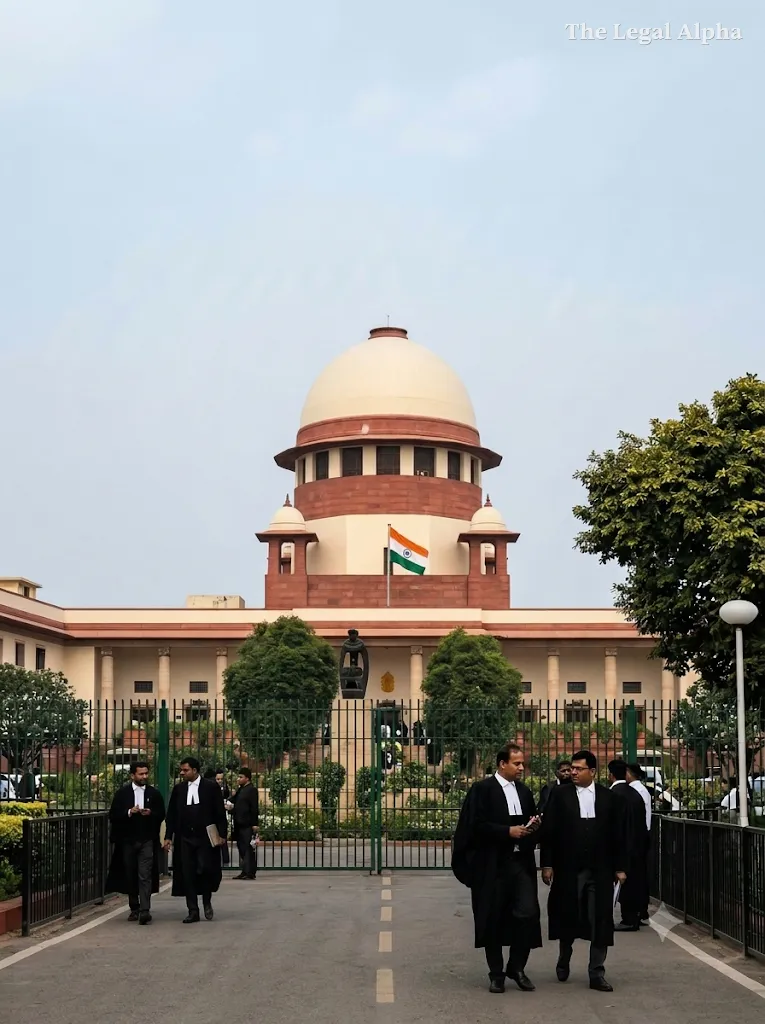
The Supreme Court of India issued a formal show-cause notice on November 18, 2026, in a criminal contempt petition filed against Advocate Pravin Singhal. The action stems from two related incidents: an open-court confrontation with Chief Justice of India (CJI) Surya Kant on November 16, 2026, and an earlier social media video published by the lawyer.
During afternoon proceedings in Courtroom No. 1 on November 16, Singhal approached a bench led by CJI Surya Kant—alongside Justices Joymalya Bagchi and V. Mohana—demanding an immediate hearing on a submission he had sent to the Chief Justice’s office two weeks earlier. When Justice Mohana objected to the irregular mentioning and the Chief Justice asked him to wait, Singhal refused, threw papers toward the bench, and declared in open court that the Chief Justice lacked the integrity to hold the office. Court staff muted the live audio-video feed, and security personnel escorted him out of the courtroom, though he allegedly continued shouting abusive remarks on the court premises.
Following the incident, the Supreme Court Bar Association (SCBA) obtained written consent from Attorney General R. Venkataramani and moved a criminal contempt petition (Supreme Court Bar Association v. Pravin Singhal, Contempt Petition (Crl.) No. 3 of 2026). The petition also flagged an Instagram reel posted on October 13, 2026, in which Singhal allegedly called the Chief Justice a "thief," "fake," and a political "agent".
Legal Topic
Area of Law: Constitutional and Procedural Law
Sub-topic: Criminal Contempt of Court / Professional Misconduct
Core Legal Issue
The central legal question before the Supreme Court is whether personal attacks made against the Chief Justice of India during live judicial proceedings—combined with abusive allegations circulated on social media—cross the boundary of permissible criticism and constitute "criminal contempt" by scandalizing the court and lowering its institutional authority.
Additionally, the matter raises an important procedural and regulatory question regarding how courts and bar associations should address individuals claiming to be practicing advocates who use courtroom disruptions and social media monetization to undermine judicial dignity.
What Did the Court / Authority Decide?
A three-judge bench comprising Justices Dipankar Datta, Joymalya Bagchi, and V. Mohana took up the SCBA's motion on November 18, 2026. Notably, CJI Surya Kant did not sit on the bench hearing the contempt petition.
-
Prima Facie Satisfaction: After reviewing the SCBA's petition and the Attorney General's statutory consent, the bench recorded that it was prima facie satisfied that the motion warranted further proceedings.
-
Notice and Personal Appearance: The Court issued a formal notice to Advocate Pravin Singhal to show cause why criminal contempt proceedings should not be pursued against him. It directed him to remain physically present in court on the next date of hearing.
-
Timeline: The respondent has been permitted to file a reply to the notice, with the SCBA granted liberty to file a rejoinder thereafter. The matter is scheduled to be taken up next in January 2027.
-
Pending Requests: The SCBA has also sought interim directions ordering Meta Platforms (Instagram), Facebook, and YouTube to preserve account logs and remove the offending videos, alongside an injunction restraining Singhal from making further imputations. No final finding of guilt or punishment has been made yet; the substantive hearing will occur after pleadings are completed.
Key Legal Points
-
Institutional Dignity Over Individual Ego: The Supreme Court reiterated that criminal contempt jurisdiction exists to protect the authority of the judicial institution and public confidence in the justice system, rather than to shield individual judges from personal offense.
-
Statutory Consent Requirement: Because the contempt motion was initiated by a third party (the SCBA) rather than by the Court on its own motion (suo motu), obtaining the prior written consent of the Attorney General under Section 15(1)(b) of the Contempt of Courts Act, 1971, was a mandatory procedural prerequisite.
-
Cumulative Assessment of Conduct: In finding a prima facie case, the Court looked at the open-court disruption alongside pre-existing social media broadcasts, treating online defamation of the judiciary as an extension of contemptuous interference.
-
Accountability of Bar Members: While advocates enjoy wide latitude to argue fearlessly, throwing papers at the bench and refusing to follow mentioning protocols violates basic courtroom decorum and professional ethics.
Relevant Law
-
Article 129 of the Constitution of India: Declares the Supreme Court to be a "court of record" endowed with inherent constitutional power to punish for contempt of itself.
-
Section 2(c) of the Contempt of Courts Act, 1971: Defines "criminal contempt" to include the publication of any matter or the doing of any act that scandalizes or tends to scandalize, or lowers or tends to lower, the authority of any court, or interferes with the due course of any judicial proceeding.
-
Section 15(1)(b) of the Contempt of Courts Act, 1971: Governs cognizance of criminal contempt in cases other than those committed directly in the face of the court, requiring a motion made by any other person with the written consent of the Attorney General or the Solicitor General.
-
Section 12 of the Contempt of Courts Act, 1971: Prescribes the punishment for contempt of court, which may extend to simple imprisonment for up to six months, a fine of up to two thousand rupees, or both.
Arguments of the Parties
Petitioner (Supreme Court Bar Association)
Represented by Senior Advocate Pradeep Rai, the SCBA submitted that Singhal’s courtroom outburst and social media videos were deeply disrespectful and went far beyond fair or temperate criticism of judicial administration. The association clarified that Singhal is not an SCBA member and highlighted a growing trend of individuals claiming to be Supreme Court advocates who record provocative content on court premises to generate social media income. The SCBA argued that viral digital platforms multiply the damage to public trust and urged the Court to intervene to protect the institution.
Union of India / Law Officers
Attorney General R. Venkataramani, in his written consent letter, characterized the advocate's conduct as "extremely scandalous and unpardonable". Appearing during the hearing, Solicitor General Tushar Mehta fully supported the SCBA's petition, submitting that the majesty of the Court cannot be compromised.
Respondent (Advocate Pravin Singhal)
Singhal has not yet filed a formal legal reply to the contempt notice. During the November 16 incident, he contended on the floor of the court that he was compelled to mention the matter urgently because his November 2 representation regarding alleged judicial corruption had gone unanswered for fifteen days.
Why Does It Matter?
This case sits at the intersection of courtroom discipline, free speech, and the rise of social media-driven legal commentary. Over the past year, the Supreme Court has increasingly confronted viral video clips and online campaigns targeting sitting judges. By entertaining a petition that explicitly seeks data preservation and takedown orders against major technology platforms alongside traditional contempt sanctions, the Court is signaling that digital broadcasts attacking judicial integrity carry real legal consequences.
Furthermore, the SCBA's submissions point to an emerging regulatory concern within the legal profession: self-styled court commentators and practitioners using the Supreme Court premises as a backdrop for monetized outrage. How the bench handles the Solicitor General's assistance on the next hearing date could establish clearer boundaries for both advocate conduct on court grounds and intermediary accountability when contemptuous material circulates online.
Legal Takeaway
While citizens and lawyers have the constitutional right to criticize judicial decisions and administration fairly, launching abusive personal attacks against judges—whether inside a courtroom or on social media—invites prosecution for criminal contempt. Under Indian law, disrupting live proceedings and questioning a judge's integrity without basis is treated not as protected speech, but as a direct attack on the public's trust in the justice system.
Sources
Primary Source:
Order of the Supreme Court of India dated November 18, 2026, in Supreme Court Bar Association v. Pravin Singhal, Contempt Petition (Criminal) No. 3 of 2026 (Bench of Justices Dipankar Datta, Joymalya Bagchi, and V. Mohana).
Additional Sources:
Consent Letter of the Attorney General for India under Section 15(1)(b) of the Contempt of Courts Act, 1971; Courtroom reporting and filings verified via LiveLaw, Bar & Bench, and Verdictum.