Supreme Court Orders Inquiry Into Three-Year Delay in Listing ED's Challenge to Anticipatory Bail
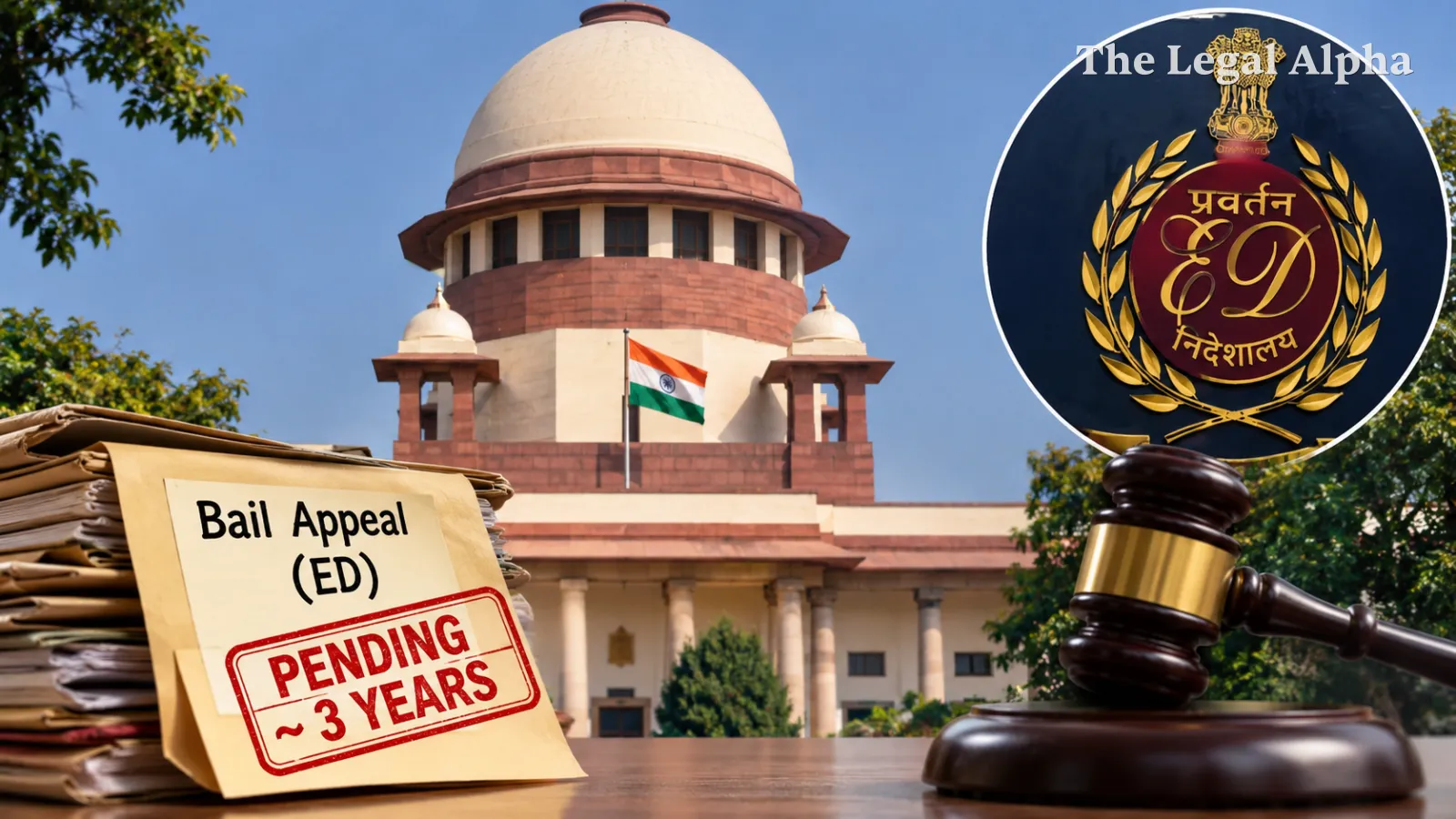
The Supreme Court of India has ordered a fact-finding inquiry into the failure to list an Enforcement Directorate (ED) challenge to an anticipatory bail order for nearly three years, despite earlier judicial directions for the matter to be taken up.
The development raises important questions about the functioning of the Supreme Court Registry, compliance with judicial directions and the timely administration of justice.
The matter concerns an appeal filed by the Enforcement Directorate in 2023 against an anticipatory bail order granted to businessman Raman Singhal, also known as Raman Singla, by the Punjab and Haryana High Court on January 30, 2023.
The ED had challenged the High Court's decision in connection with a money laundering investigation involving an alleged bank fraud of approximately ₹155.21 crore linked to Mahesh Timbers Private Limited.
Although the Supreme Court issued notice in September 2023 and subsequently directed the matter to be relisted, the appeal did not receive an effective hearing for nearly three years.
During the hearing on November 20, 2026, the Supreme Court questioned how the matter had remained unlisted despite earlier judicial directions. The Bench expressed concern over the Registry's functioning and ordered an investigation into the delay.
Legal Topic
Area of Law: Criminal Law
Sub-topic: Money Laundering, Anticipatory Bail and Supreme Court Registry Procedures
Core Legal Issue
The principal issue before the Supreme Court was why the Enforcement Directorate's challenge to an anticipatory bail order had not been listed for hearing despite specific directions issued by the Court.
The matter also raised concerns about institutional accountability, compliance with judicial orders and the responsibility of the Supreme Court Registry to ensure that pending proceedings are placed before the appropriate Bench within a reasonable time.
What Did the Supreme Court Decide?
A Bench comprising Chief Justice of India Surya Kant and Justices Joymalya Bagchi and V. Mohana expressed serious concern over the unexplained delay.
The Chief Justice questioned why the matter had not been listed in September 2023, September 2024, September 2025 and September 2026. When the possibility of non-availability of Benches was suggested, the CJI responded that all Benches were available.
Justice Joymalya Bagchi described the situation as institutional lethargy.
The Supreme Court subsequently directed its Secretary General to conduct a fact-finding inquiry into why the matter was not listed in accordance with the earlier judicial directions, including the orders passed in July 2023 and January 2024. The findings are to be submitted to the Court.
However, the Bench also disposed of the ED's challenge to the anticipatory bail order without interfering with the relief granted to Singhal.
The Court took note of the fact that the trial had already progressed substantially, with eight witnesses examined.
The Bench further clarified that the High Court's anticipatory bail order would neither be treated as a precedent nor have any impact on the outcome of the ongoing trial.
The inquiry into the Registry's failure remains a separate issue.
Key Legal Points
-
Judicial Directions and Registry Compliance: The Supreme Court examined why its earlier directions to list the matter had not been implemented.
-
Institutional Accountability: The Secretary General has been directed to investigate the circumstances behind the prolonged delay.
-
Anticipatory Bail Proceedings: The ED's challenge arose from the Punjab and Haryana High Court's decision granting anticipatory bail to the businessman.
-
Progress of Criminal Trial: The Supreme Court considered the substantial progress of the trial, including the examination of eight witnesses, while disposing of the ED's challenge.
-
Precedential Effect: The Bench clarified that the High Court's bail order would not be treated as a precedent and would not influence the outcome of the ongoing trial.
Relevant Law
Prevention of Money Laundering Act, 2002 (PMLA)
The proceedings originated from a money laundering investigation under the PMLA. The legislation provides the statutory framework governing offences of money laundering, investigation and related proceedings.
Law Relating to Anticipatory Bail
The original proceedings concerned anticipatory bail granted by the Punjab and Haryana High Court. The legal framework governing anticipatory bail is relevant to understanding the underlying challenge.
Supreme Court Procedural Framework
The Supreme Court Rules and the Court's administrative procedures govern the processing, listing and hearing of matters before the Supreme Court.
The present development particularly concerns compliance with judicial directions relating to the listing of pending proceedings.
Arguments of the Parties
Enforcement Directorate
The ED challenged the anticipatory bail granted to Raman Singhal in connection with the money laundering investigation.
During the Supreme Court proceedings, the agency's counsel informed the Bench that the trial had commenced and eight witnesses had already been examined.
The ED also requested that the High Court's bail order should not be treated as a precedent.
Respondent's Side
Senior Advocate Siddharth Dave, appearing for the respondent, expressed concern over the prolonged failure to list the matter.
He indicated that such an extended delay was unusual and suggested that changes in the composition or availability of Benches could have contributed to the situation.
The exchange prompted the Bench to seek an explanation from the Registry.
Why Does This Development Matter?
The Supreme Court's order highlights an important aspect of judicial administration: court proceedings depend not only on judicial decisions but also on the effective functioning of the institutional machinery responsible for implementing them.
A matter that remains unlisted despite repeated judicial directions raises concerns about access to timely justice and the accountability of administrative authorities within the judicial system.
The inquiry is significant because it seeks to establish the reasons behind the delay rather than treating the lapse as an ordinary administrative issue.
The development also carries implications for litigants whose cases depend on timely listing and hearing. Prolonged procedural delays can affect the ability of parties to obtain meaningful judicial consideration, particularly in criminal proceedings involving personal liberty.
At the same time, the Supreme Court's decision not to interfere with the anticipatory bail order demonstrates that the administrative inquiry and the substantive question of bail were treated as separate matters.
Legal Takeaway
The Supreme Court has emphasised the importance of accountability in the administration of judicial proceedings by ordering an inquiry into the failure to list the ED's appeal despite earlier directions.
The development reinforces that judicial directions must be implemented effectively and that unexplained administrative delays require appropriate examination. The inquiry will determine the circumstances responsible for the lapse.
Sources
Primary Source:
Supreme Court of India — Order in Directorate of Enforcement v. Raman Singhal @ Raman Singla, SLP (Criminal) No. 8719/2023, dated November 20, 2026. The full official order was not independently available for verification.
Additional Sources: