Supreme Court Mandates Election Commission Scrutiny of Alleged Bulk Deletion Requests in Uttar Pradesh Electoral Rolls
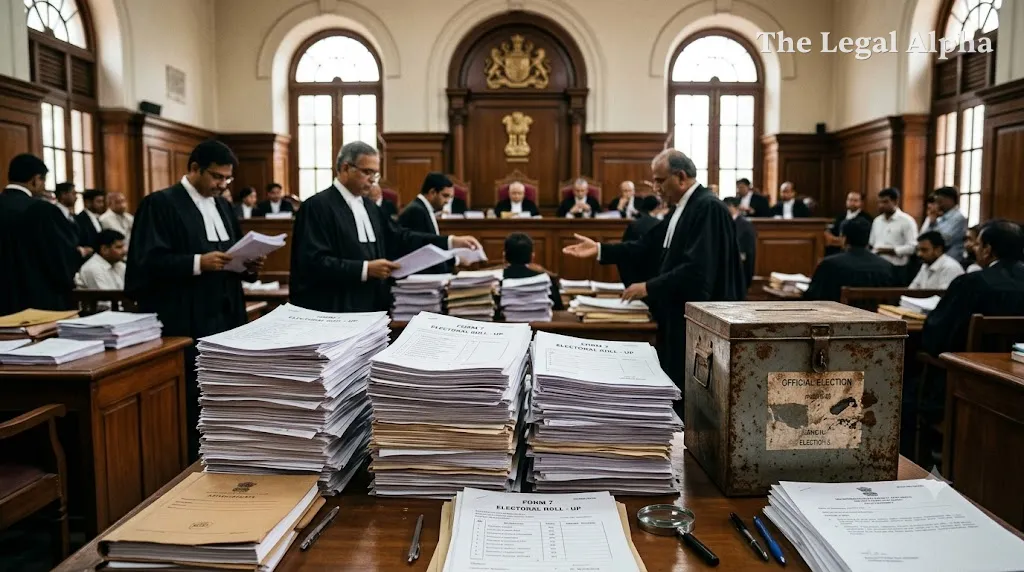
The Supreme Court of India intervened in controversies surrounding the Special Intensive Revision (SIR) of voter rolls in Uttar Pradesh following allegations that bulk applications were submitted to expunge legitimate voters. During hearings on petitions filed by Member of Parliament Tanuj Punia and others, the bench addressed claims that targeted Form-7 submissions—the statutory application used to seek deletion or object to entries in electoral registers—were being misused against specific communities. The court formally instructed the Election Commission of India to verify these complaints, initiate remedial action where discrepancies exist, and place a compliance report on record.
Legal Topic
-
Area of Law: Constitutional & Election Law
-
Sub-topic: Electoral Roll Revisions / Right of Franchise & Administrative Accountability
Core Legal Issue
The controversy centres on whether the statutory mechanism governing the deletion of voters' names under the electoral roll framework has been exposed to systematic, fraudulent abuse via bulk objection filings, thereby jeopardising the fundamental integrity of universal adult franchise.
The primary legal question is whether election authorities maintained adequate administrative and procedural safeguards under election rules before receiving, processing, and acting upon deletion requests, and whether the Commission must establish institutional mechanisms to penalise fraudulent objectors targeting specific electoral demographics.
What Did the Court Decide?
A three-judge bench headed by the Chief Justice directed the petitioners to compile and forward all unresolved complaints concerning voter deletion attempts in Uttar Pradesh directly to the Election Commission.
The Court ordered the poll panel to:
-
Ascertain the factual validity of each alleged irregularity concerning Form-7 submissions.
-
Undertake corrective administrative steps to reinstate or protect any wrongfully challenged voters.
-
Submit a formal compliance report detailing the actions taken and findings recorded.
The bench, however, did not grant blanket deadline extensions for ongoing revision processes in other states such as Kerala, clarifying that individual voters seeking inclusions or corrections retain the right to approach electoral officers under existing procedures.
Key Legal Points
-
Preservation of the Franchise: The statutory right to vote cannot be curtailed through unverified, orchestrative, or automated objections submitted by third parties.
-
Rebuttal and Duty of Verification: Electoral Registration Officers (EROs) must independently check and cross-examine objections under Form-7 rather than routinely processing mass deletion requests.
-
Administrative Redressal vs. Judicial Preemptiveness: The apex court refrained from passing immediate disqualifying directives against the revision exercise itself, opting instead to enforce supervisory compliance and demand accountability from the constitutional regulator.
-
Potential Criminality of Fraudulent Objections: The court's directions implicitly reflect concerns over false statutory declarations filed during roll revisions, highlighting the need for deterrence against malicious deletion drives.
Relevant Law
-
The Representation of the People Act, 1950: Sections 21 and 22 (Preparation, revision, and correction of entries in electoral rolls).
-
Registration of Electors Rules, 1960: Rule 13(2) and Rule 20 (Filing of Form-7 objections, notices, and procedural inquiries into claims and objections).
-
Constitution of India: Article 324 (Superintendence, direction, and control of elections vested in the Election Commission) and Article 326 (Elections to the House of the People and to the Legislative Assemblies to be on the basis of adult suffrage).
Arguments of the Parties
Petitioners: Counsel appearing for the petitioners argued that the Special Intensive Revision had been compromised by coordinated attempts to strike eligible voters off the rolls, highlighting instances where dozens of Form-7 applications were filed against members of a single community within individual assembly constituencies. They submitted that certain forms carried irregularities—including direct verification or signatures by local booth-level personnel—pointing to an orchestrated campaign that warranted formal investigation and police action analogous to steps taken previously in other jurisdictions.
Election Commission of India: Senior counsel representing the Commission acknowledged that multiple bulk Form-7 applications had indeed been submitted during revision exercises in Uttar Pradesh and other states. However, the regulator maintained that its verification mechanism functioned effectively: the vast majority of suspicious objections were scrutinized, found to be baseless, and rejected without unlawfully disenfranchising any legitimate elector. The poll body affirmed its readiness to investigate any specific pending grievances brought before it.
Why Does It Matter?
The integrity of the electoral register is the bedrock of democratic legitimacy. When third-party objection procedures can be weaponised through mass filings, entire communities face the risk of administrative disenfranchisement without timely personal notice.
This ruling reinforces that the constitutional mandate under Article 324 requires the Election Commission to act not merely as a passive recipient of standard forms, but as an active gatekeeper against systemic manipulation. By demanding a compliance report on record, the Supreme Court has set a clear benchmark: statutory roll revisions cannot sacrifice due process for procedural speed, and election machinery must establish verifiable audits whenever concentrated objection filings occur.
Legal Takeaway
Objections to an individual’s right to vote via Form-7 cannot be treated as ministerial routine; they require stringent factual verification before any deletion is processed. The Election Commission remains judicially accountable for safeguarding voter rolls against coordinated, fraudulent bulk challenges aimed at manipulating the electoral register.
Sources
-
Primary Source: Record of Proceedings & Oral Observations, Supreme Court of India (Special Intensive Revision Challenge in Uttar Pradesh, Bench headed by CJI Surya Kant, October 30, 2026).
-
Additional Sources: Filings and submissions by the Election Commission of India and legal reporting via Press Trust of India / LiveLaw.