Madras High Court Directs Police to Bar Protests Aimed at Personally Targeting or Intimidating Sitting Judges
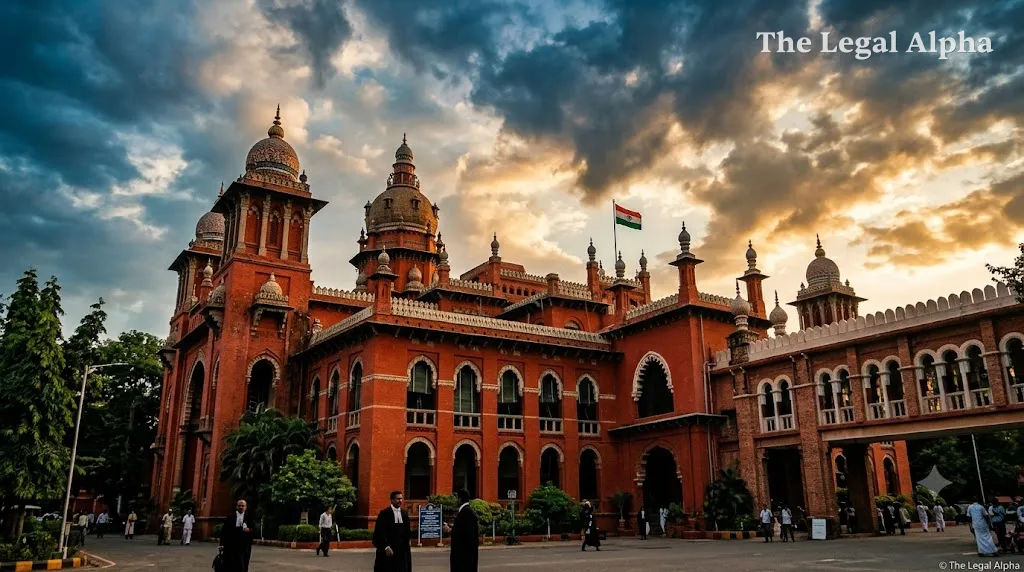
The Madras High Court has instructed the Tamil Nadu Police and local district authorities to deny permission for any public gatherings, marches, or demonstrations intended to personally target, defame, or intimidate sitting judges.
The ruling stems from a Public Interest Litigation (PIL) filed by advocate R. Karthikeyan. The petition highlighted a series of demonstrations and digital smear campaigns organized across Tamil Nadu following a June 2026 ruling by a Madurai Bench. In that earlier matter, the court had struck down a state government notification that extended Backward Class reservation benefits to individuals who converted to Islam. Karthikeyan pointed out that multiple organizations subsequently launched coordinated rallies, displayed inflammatory posters, and circulated abusive, caste-based remarks on social media specifically targeting one of the judges on the bench.
Addressing these concerns, a Division Bench comprising Chief Justice Sushrut Arvind Dharmadhikari and Justice G. Arul Murugan clarified that while legitimate criticism of judicial pronouncements is fully protected, personal abuse and intimidation of judges cross constitutional boundaries and threaten the administration of justice.
Legal Topic
-
Area of Law: Constitutional Law / Criminal Procedure
-
Sub-topic: Freedom of Speech and Assembly vs. Judicial Independence and Contempt of Court
Core Legal Issue
The fundamental legal question before the court was whether the constitutional rights to peaceful assembly and free speech under Article 19 extend to organizing public demonstrations and media campaigns that personally attack, defame, or intimidate judges over their rulings.
Specifically, the court had to define where legitimate, protected critique of a judicial ruling ends and impermissible contemptuous conduct—calculated to scandalize the court and erode institutional integrity—begins, alongside determining the regulatory powers of law enforcement authorities under policing statutes and procedural codes to preemptively disallow such gatherings.
What Did the Court Decide?
The Division Bench disposed of the writ petition with a comprehensive set of binding directives to state authorities while declining to issue a sweeping, blanket prohibition on all assemblies concerning judicial decisions:
-
Prohibition of Targeted Demonstrations: The Bench explicitly ruled that authorities must refuse permission for any proposed rally, protest, or public gathering whose objective is to insult, defame, or intimidate sitting judges.
-
Immediate Termination of Defiant Gatherings: If an initially authorized gathering deviates from its permitted scope to launch personalized vitriol, hate speech, or casteist attacks against members of the judiciary, local officials must revoke permissions immediately, disperse the gathering, and initiate criminal proceedings.
-
Social Media and Digital Surveillance: The Tamil Nadu Cyber Crime Division has been directed to maintain proactive surveillance across digital platforms and swiftly prosecute instances where online commentary escalates into criminal intimidation or coordinated harassment of judges.
-
Status of Pending Probes: The court ordered local police to conclude investigations expeditiously and impartially into existing First Information Reports (FIR Nos. 152 and 158 of 2026 registered at Madurai's B-5 Southgate Police Station) relating to past defamatory campaigns.
Key Legal Points
-
Criticism of Judgments vs. Attacks on Judges: Citizens hold a constitutional right to disagree with, scrutinize, and robustly critique legal reasoning and final judgments; however, this right cannot be weaponized into personalized slander, abuse, or caste-tinged vilification of the authoring judge.
-
Reasonable Restrictions on Assembly: The fundamental freedoms guaranteed under Article 19(1)(a) and 19(1)(b) remain subject to reasonable restrictions under Articles 19(2) and 19(3), including contempt of court, public order, and morality.
-
Institutional Protection: Public demonstrations calculated to coerce, threaten, or malign judicial officers undermine public trust in the rule of law and warrant proactive regulatory intervention by law enforcement.
-
Case-by-Case Administrative Review: District collectors and police chiefs must independently evaluate protest applications on their individual merits under procedural and local police laws rather than applying an arbitrary, blanket clampdown on peaceful civic discourse.
Relevant Law
-
Constitution of India:
-
Article 19(1)(a) (Freedom of speech and expression)
-
Article 19(1)(b) (Right to assemble peaceably and without arms)
-
Article 19(2) & 19(3) (Permissible grounds of reasonable restrictions, including contempt of court, defamation, and public order)
-
Article 215 (High Court as a Court of Record with powers to punish for contempt)
-
-
Bharatiya Nagarik Suraksha Sanhita, 2023 (BNSS) / Police Regulatory Powers: Statutory powers governing permissions, assembly regulations, and preventive public order measures.
-
Contempt of Courts Act, 1971: Statutory boundaries addressing actions that tend to scandalize or lower the authority of the court.
Arguments of the Parties
Petitioner
The petitioner, R. Karthikeyan, argued that the right to express discontent cannot serve as a protective shield for orchestrated intimidation. He contended that certain fringe and political groups crossed legal lines by holding venomous agitations, circulating videos, and raising posters directed at specific sitting judges following the June 25 reservation ruling. The petitioner submitted that failing to curb such targeted caste-based and defamatory campaigns leaves the judiciary vulnerable to systemic pressure and lowers the prestige of the high court in the eyes of the public.
State Authorities
The State machinery maintained that law enforcement assesses law-and-order situations objectively under existing statutory provisions. The administration affirmed that police stations are already acting against instances of clear incitement, highlighting ongoing inquiries and formal complaints registered against violators. The State recognized the constitutional imperative of maintaining public tranquility while safeguarding the dignity and security of the bench.
Why Does It Matter?
This ruling addresses the increasing vulnerability of judicial officers to coordinated online and offline intimidation campaigns following controversial or sensitive judgments. By outlining an actionable standard for law enforcement, the high court offers police clear legal grounding to intervene early before aggressive agitations turn hostile or physically coercive.
Importantly, the bench struck a careful balance by refusing a total ban on demonstrations about court decisions. By preserving room for constructive public dissent while drawing a hard line against personalized defamation and hate speech, the judgment provides procedural clarity on how police and district magistrates across jurisdictions should evaluate protest permits in high-profile legal controversies.
Legal Takeaway
Citizens possess a protected right to analyze, debate, and critically evaluate court judgments, but that freedom does not extend to personal abuse, defamation, or intimidation of sitting judges. Law enforcement authorities possess both the power and the statutory duty to deny permission for rallies that cross the line into character assassination and must end any demonstration that turns personally hostile.
Sources
Primary Source:
-
Division Bench Order of the Madras High Court in R. Karthikeyan v. Union of India and Others (Writ Petition / Public Interest Litigation disposed of on October 30, 2026; coram: Chief Justice Sushrut Arvind Dharmadhikari and Justice G. Arul Murugan).
Additional Sources:
-
High Court of Judicature at Madras case records and regulatory directives under the BNSS and Tamil Nadu Police regulations.
-
Underlying Judgment of the Madurai Bench of Madras High Court dated June 25, 2026 (G.R. Swaminathan & P.B. Balaji, JJ.) regarding reservation claims post-conversion.