Supreme Court Grants One-Time Approval for Karthigai Deepam at Thiruparankundram Pillar, Stays High Court Findings on Site Status
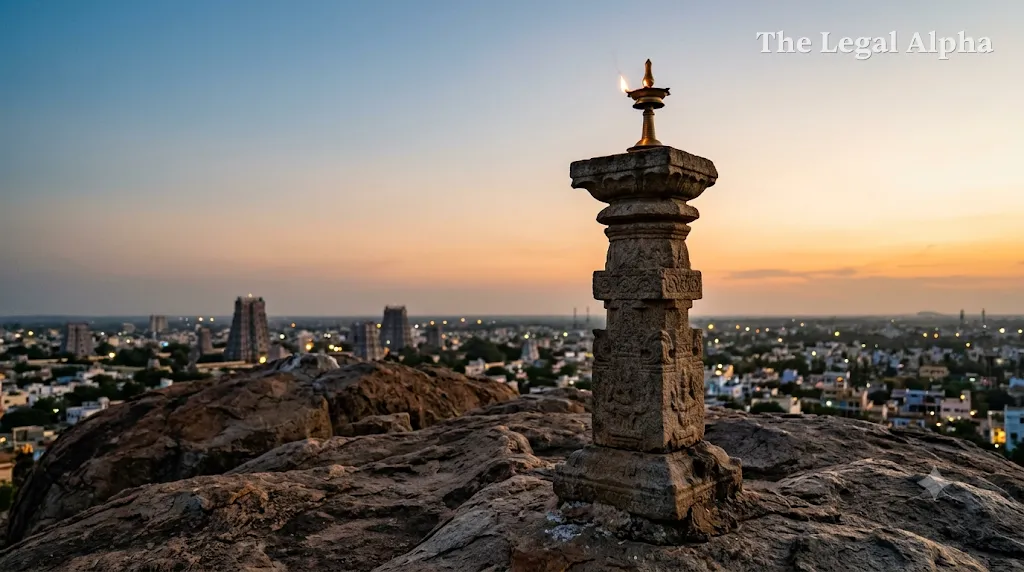
The Supreme Court of India issued an interim order on November 20, 2026, permitting a small group of temple officials to light the ceremonial Karthigai Deepam lamp at a disputed stone pillar atop the Thiruparankundram hillock in Madurai, Tamil Nadu. The ceremony is scheduled for November 24, 2026, to mark the Karthigai Deepam festival.
The dispute involves the State of Tamil Nadu, the Madurai District Collector, the Arulmigu Subramania Swamy Temple administration, the Sikandar Badusha Dargah Committee, and devotee Rama Ravikumar. A Supreme Court Bench comprising Justices Aravind Kumar and Vipul Pancholi heard the State’s appeal challenging a January 2026 Madras High Court Division Bench ruling. While allowing the lamp to be lit this year under strict administrative supervision, the Supreme Court stayed the High Court’s underlying findings regarding the ownership of the land and the religious classification of the stone structure.
Legal Topic
Area of Law: Constitutional Law and Property Disputes Sub-topic: Freedom of Religion / Religious Endowments and Customary Rights
Core Legal Issue
The central legal question before the Supreme Court is whether a stone pillar located near the Sikandar Badusha Dargah on Thiruparankundram hill constitutes a traditional Hindu Deepathoon (lamp pillar) where devotees hold a customary or constitutional right to perform worship, or whether it is a secular survey marker where introducing a new religious ritual alters the established historical status quo.
In deciding the interim relief, the Court had to balance competing claims over religious observance and public order without prematurely validating either side's substantive property and customary rights ahead of the final hearing.
What Did the Court Decide?
The Supreme Court passed a conditional interim order separating the immediate festival arrangements from the broader legal dispute:
-
What Was Allowed: Lighting the Karthigai Deepam at the stone pillar on November 24, 2026, strictly as a one-time arrangement.
-
What Was Stayed: The Madras High Court’s observations and findings declaring that the stone structure is a Deepathoon situated on temple land.
-
Important Directions and Conditions: Only a limited team from the Arulmigu Subramania Swamy Temple may approach the pillar to perform the ritual. The Madurai District Collector—in consultation with the temple’s Executive Officer, the Archaeological Survey of India (ASI), and the Police Commissioner—will determine the team's size, route, timing, and duration. The team must vacate the area immediately afterward without leaving any materials behind.
-
Restrictions on Access and Alterations: Public gatherings, processions, demonstrations, and slogan-raising are completely prohibited at the site. No excavation, construction, or structural alteration is permitted. Furthermore, the Bench mandated that regular worship at customary sites and lawful access to the nearby dargah and mosque must continue without disruption.
-
What Remains Pending: The substantive determination of whether lighting the lamp at this specific pillar is an essential religious practice, whether a historical custom exists, and how a 1923 civil decree governs the hillock's boundaries. The Supreme Court clarified that this year's ceremony cannot be cited as precedent or proof of custom in future years. Final arguments are scheduled for January 2027.
Key Legal Points
-
No Precedential Value for Interim Relief: Permission granted purely as an interim, one-time measure does not establish a customary right, right of access, or legal precedent for subsequent years.
-
Preservation of Religious Status Quo: Courts must ensure that temporary accommodations for one community’s festival do not obstruct or interfere with the existing, lawful worship and access rights of another community sharing the same geographic precinct.
-
Primacy of Administrative Regulation: Even when permitting a religious ritual at a sensitive site, constitutional courts rely on district and archaeological authorities to regulate crowd size, timing, and security to prevent law-and-order disturbances.
-
Deferral of Essential Religious Practice Inquiry: Whether a specific ritual at a contested location qualifies as an essential religious practice requires full evidentiary scrutiny and cannot be conclusively settled through summary or interim observations.
Relevant Law
-
Constitution of India, Articles 25 and 26: Guarantee the freedom of conscience, the right to freely profess, practice, and propagate religion, and the right of religious denominations to manage their own affairs in matters of religion, subject to public order, morality, and health.
-
Ancient Monuments and Archaeological Sites and Remains Act, 1958: Governs the preservation, access, and prohibition of structural alterations at protected heritage sites, relevant due to the involvement of the Archaeological Survey of India on Thiruparankundram hill.
-
1923 Civil Court Decree: A historical judicial decree demarcating property ownership and usage rights between Hindu and Muslim parties across different peaks and portions of the Thiruparankundram hillock.
Arguments of the Parties
-
Petitioner (State of Tamil Nadu, District Collector, and Dargah Committee): The State and District Collector contended that no historical custom exists to light the lamp at the upper stone pillar, arguing that official survey records identify the structure as a British-era survey marker rather than a temple lamp post. The Dargah Committee submitted that the High Court misconstrued the 1923 decree and noted that the single judge had conducted a site inspection without prior notice to the dargah management, thereby creating a new religious practice without proper adjudication.
-
Respondent (Devotee Rama Ravikumar): The respondent argued that the physical design of the pillar—specifically a hollow depression at its crown—matches traditional Deepathoons found across Tamil Nadu temples. Counsel submitted that the 1923 decree recognized temple ownership over the specific peak housing the pillar, and that the High Court had merely permitted an established festival ritual under strict administrative supervision without infringing upon the dargah's space.
Why Does It Matter?
Disputes involving shared sacred spaces or adjacent religious structures frequently carry high potential for communal friction and administrative deadlock. By separating the immediate ceremonial allowance from the underlying title and customary claims, the Supreme Court demonstrated a cautious judicial approach to managing sensitive religious litigation.
For state administrations, district collectors, and temple boards, the order reinforces the authority—and obligation—of local officials to tightly control access, security, and heritage conservation at multi-faith monuments. For litigants in religious endowment disputes, the ruling signals that appellate courts will scrutinize lower court findings on historical customs and property decrees closely before allowing permanent changes to established religious practices.
Legal Takeaway
An interim court order allowing a religious ceremony at a disputed site does not validate historical ownership or establish a permanent customary right. When sensitive religious and heritage precincts are involved, courts prioritize strict administrative control and the protection of existing worship rights for all communities until the underlying legal claims are fully resolved.
Sources
Primary Source:
Order of the Supreme Court of India in State of Tamil Nadu v. Rama Ravikumar & Ors. (Bench of Justices Aravind Kumar and Vipul M. Pancholi, November 20, 2026).
Additional Sources:
-
Judgment of the Division Bench of the Madras High Court (January 6, 2026) and Order of Justice G.R. Swaminathan (December 1, 2025).
-
Supreme Court Observer and LiveLaw case filings and hearing reports (November 17–20, 2026).