Supreme Court Explains How Close Family Relationships Can Disqualify an Authority on Grounds of Bias
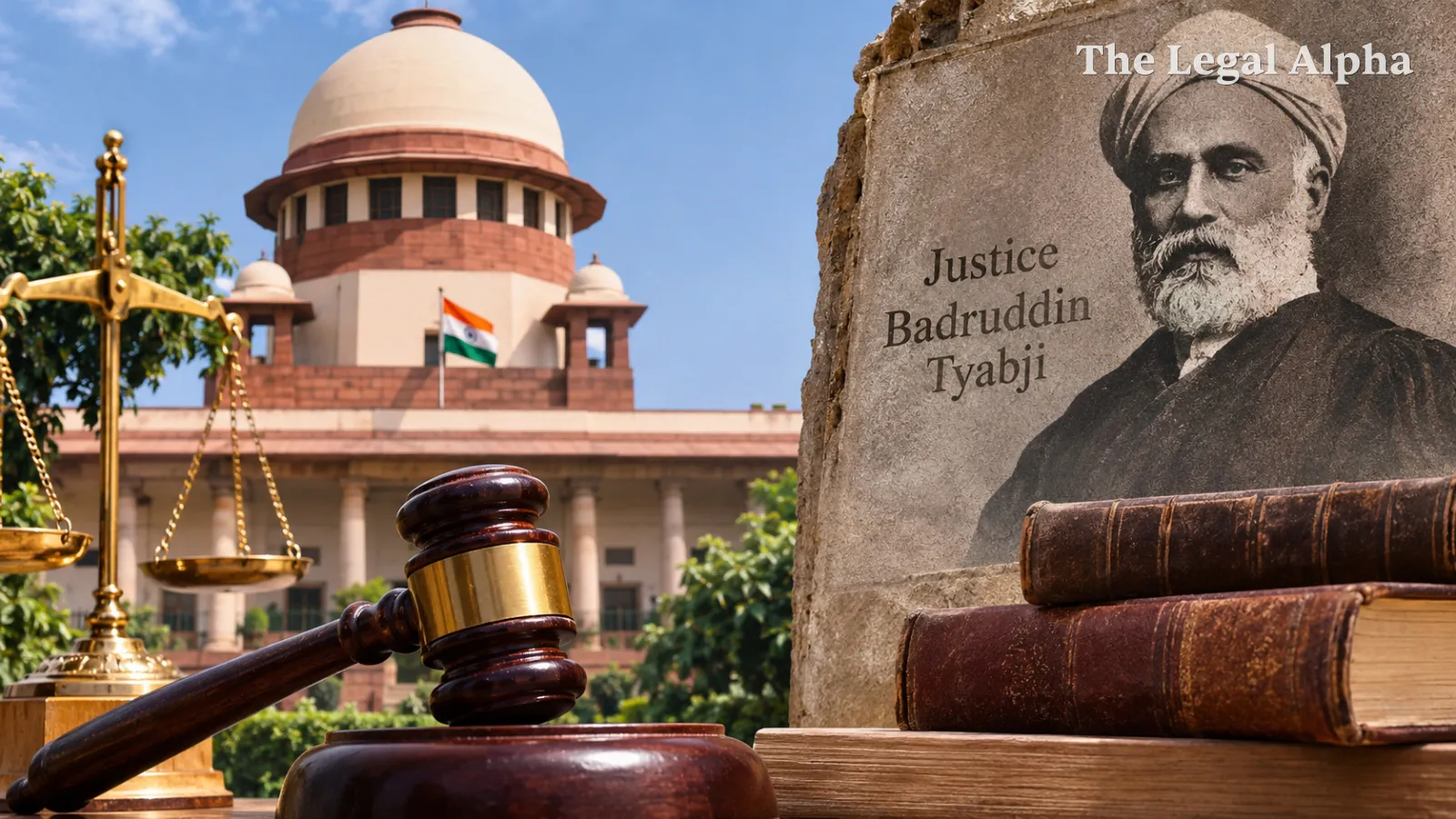
The Supreme Court of India has highlighted the changing standards governing judicial and administrative impartiality, recalling an unusual episode from colonial-era Bombay involving Justice Badruddin Tyabji and his two lawyer sons.
The observation came while the Court was examining a disciplinary inquiry against an assistant teacher. The central question was whether an inquiry could remain legally valid when the person conducting it was closely related to the individual who initiated the disciplinary proceedings and acted as the principal witness.
The ruling reinforces an important principle of natural justice: a person deciding a matter must not be placed in circumstances that create a reasonable likelihood of bias.
What Happened?
A Bench comprising Justice Manoj Misra and Justice Manmohan considered an appeal arising from the termination of an assistant teacher following disciplinary proceedings.
The dispute involved the composition of the Inquiry Committee. Its Convenor was the real brother of the School Secretary, who had initiated the complaint, participated in the proceedings as prosecutor and appeared as a principal witness against the teacher.
The Supreme Court examined whether this close family relationship compromised the fairness and independence of the inquiry.
During its discussion, the Bench recalled the historical example of Justice Badruddin Tyabji, a former Bombay High Court judge, whose two sons practised as advocates before him. The anecdote illustrated how perceptions and legal standards concerning impartiality have evolved over time.
Legal Topic
Area of Law: Constitutional Law and Administrative Law
Sub-topic: Principles of Natural Justice – Rule Against Bias – Nemo Judex in Causa Sua
Core Legal Issue
The principal legal issue was whether disciplinary proceedings are sustainable when the person conducting the inquiry is closely related to the complainant and principal witness.
The Court also considered whether actual bias must be established through direct evidence or whether a reasonable likelihood of bias is sufficient to invalidate the proceedings.
What Did the Supreme Court Decide?
The Supreme Court held that the disciplinary inquiry was legally unsustainable because the relationship between the Inquiry Committee's Convenor and the School Secretary created a reasonable likelihood of bias.
The Court noted that the School Secretary was not merely the complainant but also acted as the prosecutor and a principal witness. His evidence was recorded before his own brother, who was responsible for conducting the inquiry.
The Bench concluded that such circumstances would create a reasonable apprehension of partiality in the mind of a fair-minded person.
Allowing the appeal, the Supreme Court set aside the Bombay High Court judgment dated April 29, 2025, and restored the Nagpur School Tribunal's judgment dated March 21, 2024.
The Court further directed the Education Officer to consider the feasibility of absorbing the teacher in another 100% grant-in-aid school within the jurisdiction, in accordance with Rule 26(2)(iii) of the Maharashtra Employees of Private Schools Rules.
Key Legal Points
- Actual bias need not be proved: It is sufficient to establish a reasonable likelihood or real possibility of bias from the perspective of a fair-minded person.
- Close family relationships matter: A sufficiently close relationship between an adjudicator and a person directly interested in the proceedings can disqualify the adjudicator.
- Impartiality is essential: The principle of nemo judex in causa sua requires that nobody should act as a judge in their own cause.
- Administrative inquiries must be fair: The requirement of impartiality applies to administrative and disciplinary authorities, not merely judicial proceedings.
- Article 14 safeguards fairness: The rule against bias forms part of the constitutional guarantee of fairness and non-arbitrariness under Article 14.
Relevant Law
Constitution of India
-
Article 14 – Equality before law and protection against arbitrary state action.
-
Article 21 – Protection of life and personal liberty.
Maharashtra Employees of Private Schools (Conditions of Service) Rules, 1981
-
Rule 36 – Procedure relating to disciplinary inquiries.
-
Rule 26(2)(iii) – Relevant provision concerning absorption of employees in another school.
Important Judicial Precedent
- A.K. Kraipak v. Union of India – Established that a reasonable likelihood of bias can invalidate an administrative decision even without proof of actual bias.
- Dr. G. Sarana v. University of Lucknow – Explained the principles governing the assessment of bias and reasonable apprehension of partiality.
Arguments of the Parties
Appellant – Assistant Teacher
The appellant challenged the fairness of the disciplinary proceedings, arguing that the Inquiry Committee's Convenor was the real brother of the School Secretary, who was directly involved in the proceedings as complainant and witness.
She maintained that the relationship compromised the independence of the inquiry and violated the principles of natural justice.
Respondents – School Management
The respondents opposed the challenge to the inquiry proceedings. Their position included the contention that actual bias had not been established and that the inquiry should not be invalidated merely because of a family relationship.
The Supreme Court ultimately rejected the requirement of proving actual bias in the circumstances of the case.
Why Does It Matter?
The judgment carries significance for disciplinary proceedings conducted by educational institutions, employers and administrative authorities.
It makes clear that procedural fairness involves more than providing an employee with an opportunity to respond to allegations. The person conducting the inquiry must also be sufficiently independent and impartial.
For school managements, the ruling highlights the importance of carefully selecting inquiry committee members, particularly where personal or family relationships exist between committee members and individuals directly involved in the allegations.
The decision also reinforces public confidence in administrative justice. An inquiry may follow formal procedures, but if its circumstances create a reasonable likelihood of bias, the resulting proceedings can still be invalidated.
The historical reference to Justice Badruddin Tyabji illustrates how legal standards of impartiality have developed. What may once have been socially accepted is not necessarily consistent with contemporary principles of natural justice.
Legal Takeaway
The Supreme Court has reaffirmed that justice must not only be done but must also appear to be done. A disciplinary inquiry can be invalidated where a close family relationship creates a reasonable likelihood of bias, even without proof of actual prejudice. Independence and impartiality are essential requirements of a legally sustainable decision-making process.
Sources
Primary Source:
- Supreme Court of India, Ku. Kiran D/o Purushottam Bhujade v. Sudhir Shikshan Sanstha & Ors., 2026 INSC 1229, judgment dated November 17, 2026.
Read the Supreme Court judgment (PDF).
Additional Sources: