Supreme Court Directs Fresh Environmental Review of Proposed Industrial Cluster Near Taj Mahal
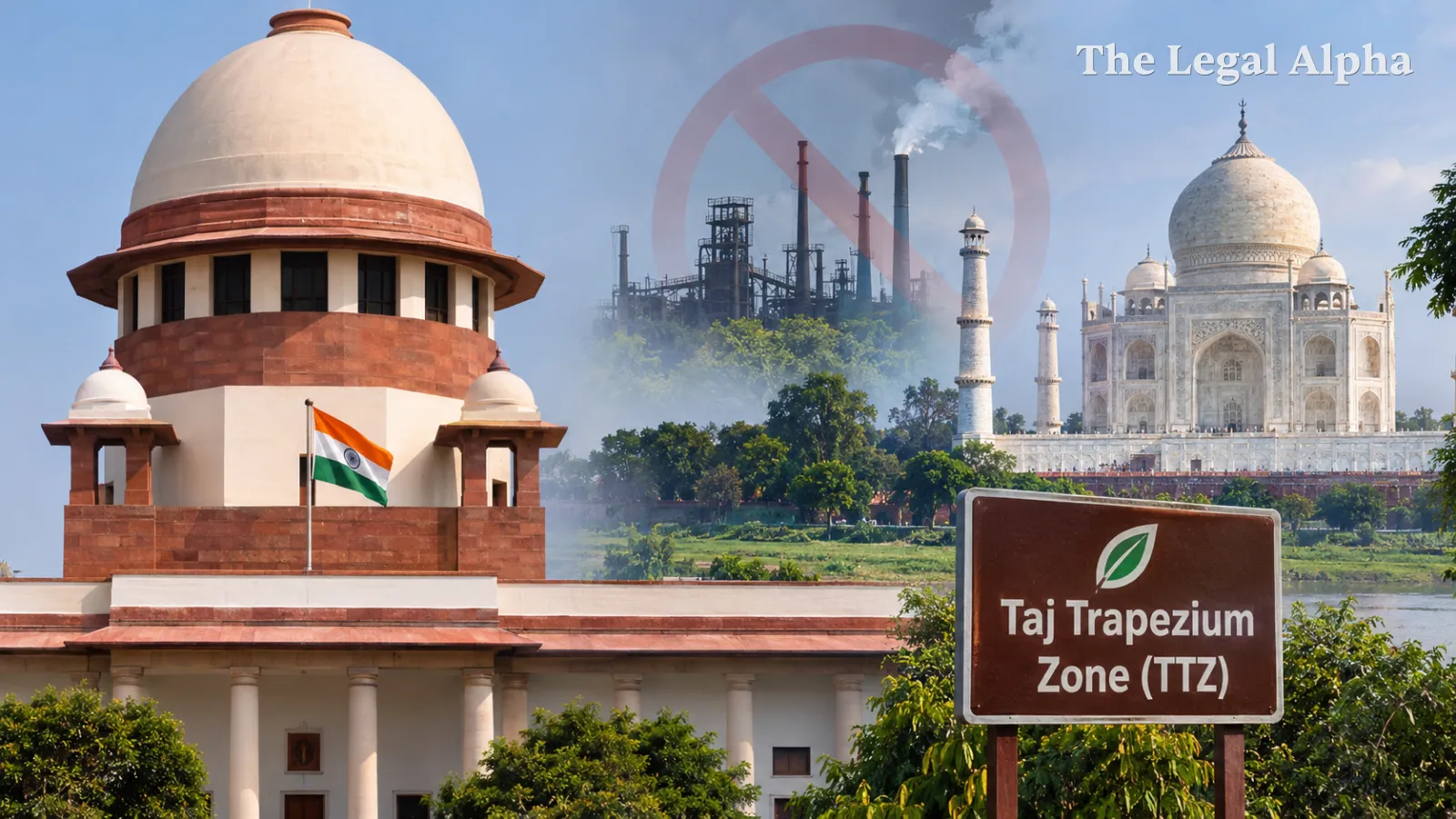
The Supreme Court has directed the Central Empowered Committee (CEC) and the Taj Trapezium Zone (TTZ) Authority to hold a fresh joint meeting over the proposed Integrated Manufacturing Cluster in Agra, following disagreements between the two bodies over the project's earlier conditional clearance.
The Court has asked the authorities to resolve their differences, reconsider the conditions attached to the project and submit a comprehensive joint report within two weeks. The direction comes amid concerns about the decision-making process for industrial development within the environmentally sensitive Taj Trapezium Zone.
What Happened?
The dispute concerns a proposed Integrated Manufacturing Cluster near the Taj Mahal, within the Taj Trapezium Zone, an approximately 10,400-square-kilometre environmentally sensitive area surrounding the Taj Mahal and other heritage monuments.
Representatives of the CEC and the TTZ Authority had met on September 22, 2026, and reportedly agreed to grant conditional permission for the project. However, the arrangement came under scrutiny after CEC member A.K. Mohanty sent an email on November 6, 2026, raising objections to the decision.
The Supreme Court took note of the disagreement and considered another joint consultation necessary before the matter could proceed further.
Legal Topic
Area of Law: Environmental Law
Sub-topic: Environmental Regulation, Industrial Development and Protection of Heritage Zones
Core Legal Issue
The central legal question concerns whether a proposed industrial development within the Taj Trapezium Zone can proceed on the basis of conditional clearance when the authorities responsible for environmental oversight have expressed disagreement over the decision.
The matter also raises questions about the need for proper consultation, transparent decision-making and consensus among the designated environmental authorities before permissions affecting a protected zone are acted upon.
What Did the Supreme Court Decide?
The Bench comprising Chief Justice of India Surya Kant and Justices Joymalya Bagchi and V. Mohana directed the CEC and the TTZ Authority to convene a fresh meeting.
The Court specifically directed the authorities to:
-
Reconsider the conditions attached to the proposed manufacturing cluster.
-
Resolve the differences arising from their earlier meeting.
-
Hold a fresh joint consultation.
-
Submit a comprehensive joint report to the Supreme Court within two weeks.
The Attorney General, R. Venkataramani, informed the Court that although the CEC had recommended conditional permission for tree-felling, the minutes of the September meeting had not been properly circulated.
The Court has therefore sought a fresh institutional assessment rather than treating the earlier disagreement as resolved.
No final approval of the proposed manufacturing cluster was granted through this direction. The matter remains subject to further consideration by the Supreme Court.
Key Legal Points
-
Judicial supervision: Industrial activities and tree-felling permissions within the Taj Trapezium Zone remain subject to Supreme Court oversight.
-
Institutional coordination: The CEC and TTZ Authority must resolve their differences before submitting a common assessment to the Court.
-
Procedural transparency: The issue concerning circulation of the September meeting minutes highlights the importance of properly documented regulatory decisions.
-
Environmental safeguards: Conditional permission for tree-felling must be considered alongside the environmental requirements governing the protected zone.
-
Expert assessment: The Court's earlier directions require participation of nominated experts from the CEC and the National Environmental Engineering Research Institute (NEERI) in relevant industrial applications.
Relevant Law
Supreme Court's Environmental Protection Directions
The regulatory framework governing the Taj Trapezium Zone originates from the Supreme Court's interventions to protect the Taj Mahal and surrounding heritage monuments from environmental pollution.
Environment (Protection) Act, 1986
The Act provides the statutory framework for environmental protection and regulation of activities that may adversely affect the environment.
Supreme Court Orders Governing the Taj Trapezium Zone
The Court's earlier directions regulate industrial activities, tree-felling and the processing of applications within the zone.
In its July 23, 2026 order, the Supreme Court permitted the TTZ Authority to process pending industrial applications subject to safeguards, including the participation of CEC and NEERI experts and the requirement of unanimity for certain decisions.
Arguments of the Parties
Attorney General R. Venkataramani
The Attorney General submitted that the CEC had recommended conditional permission for tree-felling in connection with the proposed project. However, he pointed out that the minutes of the September 22 meeting had not been properly circulated.
He suggested that the CEC and TTZ Authority hold another meeting to resolve their differences and submit a joint report to the Supreme Court.
CEC Member A.K. Mohanty
A.K. Mohanty raised reservations through an email dated November 6, 2026, concerning the decision reportedly reached during the September meeting. The specific reasons for his reservations were brought to the Court's attention.
Position of the TTZ Authority
The available reporting does not provide a separate detailed submission from the TTZ Authority on the merits of the disagreement.
Why Does It Matter?
The proposed manufacturing cluster highlights the challenge of balancing industrial development with environmental protection in areas surrounding nationally and internationally significant heritage monuments.
The Taj Trapezium Zone is subject to a specialised regulatory framework because industrial emissions, construction activities and tree-felling can affect the environmental conditions surrounding the Taj Mahal.
The Supreme Court's direction also highlights the importance of coordination between expert institutions. Conditional permission cannot be treated as the end of the regulatory process when disagreements emerge over the decision itself.
For businesses proposing industrial projects within the zone, the development underlines the importance of complying with environmental conditions and ensuring that regulatory approvals follow the prescribed consultation process.
The next significant development will be the joint report expected from the CEC and TTZ Authority within two weeks.
Legal Takeaway
The Supreme Court has reinforced the importance of coordinated environmental decision-making within the Taj Trapezium Zone. Its latest direction requires the concerned authorities to resolve their differences and submit a joint assessment before the Court considers the matter further. The direction does not amount to final approval of the proposed manufacturing cluster.
Sources
Primary Sources:
-
Supreme Court of India – Orders concerning regulation of industries and environmental protection in the Taj Trapezium Zone.
-
Supreme Court order dated July 23, 2026, concerning processing of pending industrial applications. Read the earlier Supreme Court order.
Additional Sources:
Editorial note: The November 19, 2026 direction is reported from the hearing. A separate signed order containing that day's directions was not independently located for verification.