Supreme Court Directs Bengal SIR Tribunals to Prioritise Deleted Voters’ Appeals Ahead of Kolkata Civic Polls
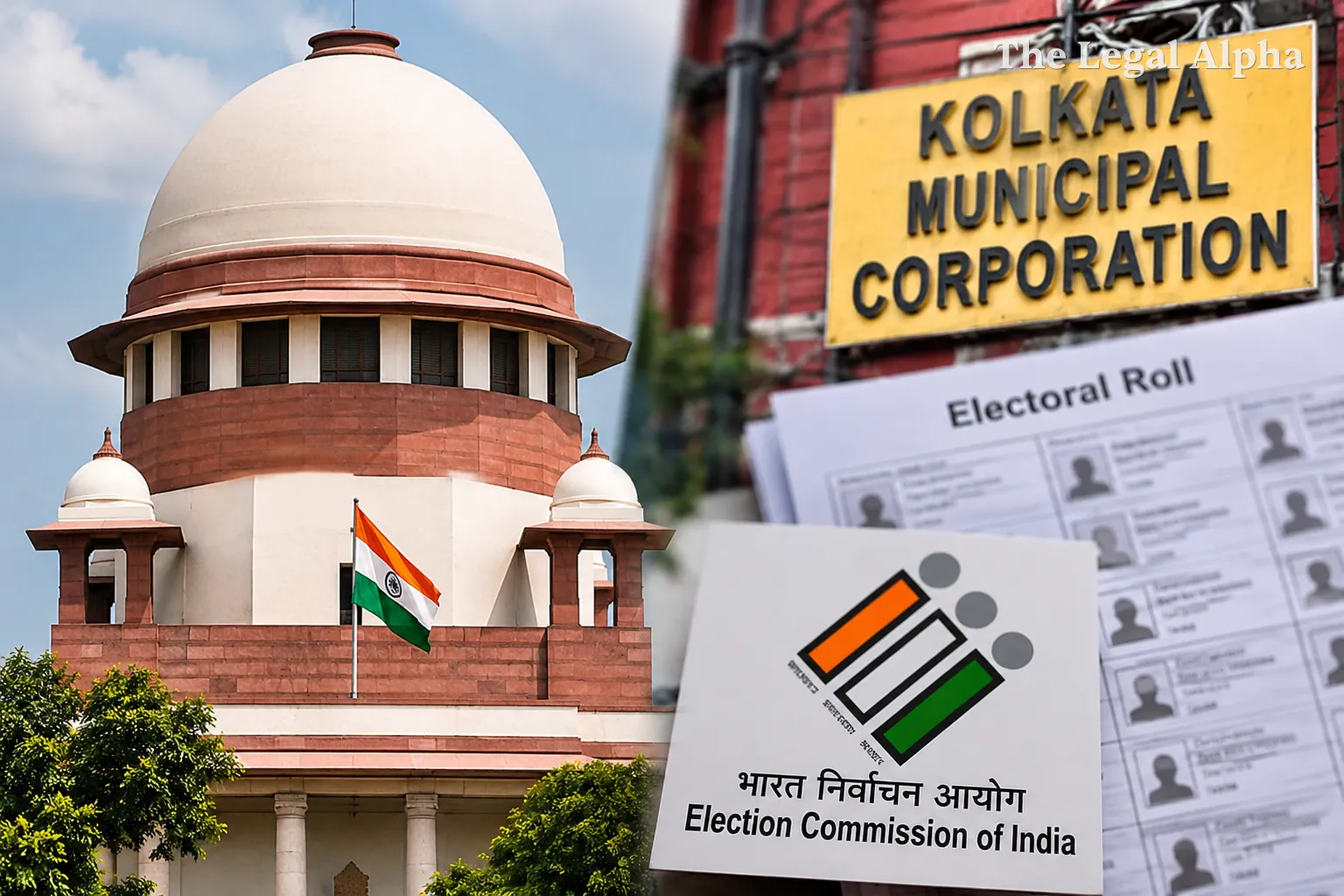
The Supreme Court of India has directed appellate tribunals handling disputes arising from the Special Intensive Revision (SIR) of electoral rolls in West Bengal to prioritise appeals filed by voters whose names have been deleted from the voter lists.
The directions were issued on November 23, 2026, by a three-judge Bench comprising Chief Justice of India Surya Kant and Justices Joymalya Bagchi and V. Mohana.
The Court instructed the tribunals to separate pending appeals into two categories: cases challenging the deletion of voters' names and cases challenging the inclusion of certain individuals in the electoral rolls. It held that appeals seeking restoration of deleted names should receive priority, while challenges to voter inclusions could be deferred for the time being.
The Court also specifically emphasised the need to expedite appeals involving voters within the Kolkata Municipal Corporation (KMC) area, considering the upcoming municipal elections.
Legal Topic
Area of Law: Constitutional Law and Election Law
Sub-topic: Electoral Rights, Revision of Electoral Rolls and Appellate Tribunal Proceedings
Core Legal Issue
The central legal issue concerns the timely adjudication of appeals filed by individuals whose names were removed from electoral rolls during the SIR exercise in West Bengal.
The matter raises questions about the fairness of electoral procedures and the practical protection of voting rights when large numbers of affected individuals are awaiting appellate decisions, particularly when elections are approaching.
The Court was also concerned with how the appellate mechanism could efficiently deal with different categories of voter-list disputes without allowing challenges to existing inclusions to delay the restoration claims of excluded voters.
What Did the Supreme Court Decide?
The Supreme Court issued interim directions to improve the functioning and efficiency of the appellate tribunals dealing with West Bengal's SIR-related disputes.
The Court directed the tribunals to divide pending appeals into two groups:
-
Appeals filed by voters whose names have been deleted from the electoral rolls.
-
Appeals challenging the inclusion of certain individuals in the electoral rolls.
The Bench observed that appeals challenging voter inclusions did not involve the same degree of urgency and could therefore be deferred temporarily. Appeals filed by excluded voters must receive preference in final disposal.
The Court further directed that appeals involving voters within the jurisdiction of the Kolkata Municipal Corporation should receive particular priority because of the forthcoming civic elections.
Additionally, the Election Commission of India (ECI) was asked to increase the strength of the appellate tribunals in consultation with the Chief Justice of the Calcutta High Court.
The Commission was also directed to identify alternative suitable premises at different locations across Kolkata to improve accessibility and facilitate faster disposal of pending appeals.
These directions address the prioritisation and administrative capacity of the tribunals. The Court did not declare that every voter with a pending appeal would automatically be entitled to vote in the municipal elections.
Key Legal Points
-
Priority for excluded voters: Appeals filed by individuals whose names were deleted from electoral rolls must be heard before challenges concerning the inclusion of other voters.
-
Deferral of inclusion-related appeals: Tribunals may temporarily postpone appeals challenging the inclusion of names because the Court found them less urgent.
-
Special priority for Kolkata voters: Appeals involving deleted voters within the Kolkata Municipal Corporation limits must receive priority in view of the upcoming municipal elections.
-
Expansion of appellate tribunals: The ECI must increase the number of tribunals in consultation with the Chief Justice of the Calcutta High Court.
-
Improved accessibility: The Election Commission must identify alternative premises across Kolkata to make tribunal proceedings more accessible and support quicker disposal.
Relevant Law
Representation of the People Act, 1950
The Act provides the statutory framework for the preparation and revision of electoral rolls, including the registration of electors and the correction of electoral records.
Registration of Electors Rules, 1960
These Rules govern the procedures relating to electoral registration, inclusion, deletion and correction of names, as well as appeals against decisions of Electoral Registration Officers.
Article 326 of the Constitution of India
Article 326 establishes the principle of adult suffrage for elections to the Lok Sabha and State Legislative Assemblies, subject to the constitutional and statutory qualifications.
Article 142 of the Constitution of India
Article 142 empowers the Supreme Court to pass orders necessary to do complete justice in matters before it. Its relevance to the broader SIR proceedings should be distinguished from the specific interim directions issued on November 23.
Arguments of the Parties
Petitioners' Submissions
Advocate Prashant Bhushan, appearing for the petitioners, informed the Court that approximately 38 lakh appeals had been filed before the tribunals, while only slightly more than one lakh had been decided.
He submitted that around 93 per cent of the appeals decided so far had resulted in orders favouring the restoration of excluded voters' names.
Bhushan also highlighted that more than two lakh voters within the Kolkata Municipal Corporation area were affected by deletions and had pending appeals. He argued that leaving these appeals unresolved could deprive eligible voters of their democratic rights for a second time.
Senior Advocate Gopal Sankaranarayanan also questioned the legal basis for appeals filed by the Chief Electoral Officer challenging the inclusion of certain individuals in the electoral rolls.
He contended that the Election Commission could not use the appellate mechanism to effectively challenge inclusion decisions through an authority designated by the Commission itself.
Election Commission's Position
The Election Commission's figures placed before the Court indicated approximately 38.31 lakh appeals, comprising around 22.21 lakh appeals seeking restoration of deleted names and 16.10 lakh appeals challenging inclusions.
The Commission's position and the precise legal justification for the disputed appeals must be distinguished from the submissions made by the petitioners.
Why Does It Matter?
The Supreme Court's directions address an important concern about the relationship between electoral administration and the effective exercise of voting rights.
The large number of pending appeals means that voters whose names have been deleted may face prolonged uncertainty about their electoral status. When elections are approaching, delays in resolving these disputes can have consequences that extend beyond the administrative process.
The decision is particularly significant for Kolkata, where the Court has recognised the urgency of resolving exclusion-related appeals before the municipal elections.
The directions also place responsibility on the Election Commission to ensure that the appellate mechanism has sufficient capacity and accessible facilities. Increasing the number of tribunals and providing additional premises could help reduce procedural delays.
However, the order does not establish that every deletion was unlawful or that every pending appellant must automatically be restored to the electoral rolls. Individual appeals will still require adjudication.
Legal Takeaway
The Supreme Court has emphasised that electoral appeals involving the deletion of voters' names must receive timely attention, particularly when upcoming elections could make delays consequential. The directions reinforce the importance of an accessible and effective appellate mechanism in protecting the electoral rights of eligible citizens.
Sources
Primary Source:
- Supreme Court of India – Interim directions dated November 23, 2026, in the West Bengal SIR proceedings. The complete signed order was not independently available for verification at the time of preparation.
Additional Sources: