Supreme Court Cancels Bail in Narcotics Case, Reiterates Strict Standards for Release of Accused
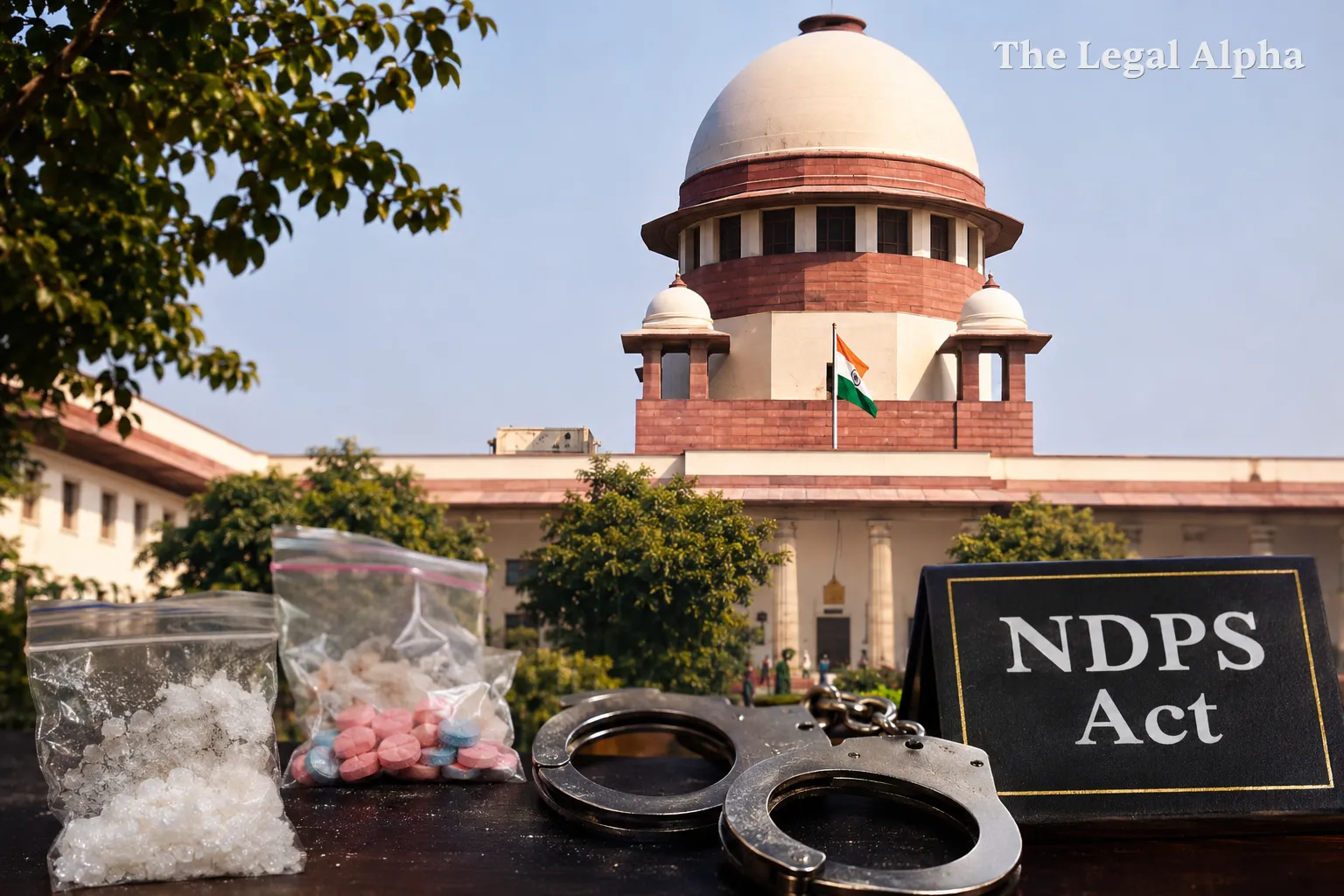
The Supreme Court of India has cancelled the bail granted to an accused in a narcotics-related case, reinforcing the need for courts to apply the statutory restrictions governing bail under the Narcotic Drugs and Psychotropic Substances (NDPS) Act.
The decision highlights the importance of examining the seriousness of narcotics offences and the statutory conditions before granting liberty to an accused. The ruling also underlines that bail orders must comply with the specific safeguards prescribed by law.
Legal Topic
Area of Law: Criminal Law
Sub-topic: Narcotic Drugs and Psychotropic Substances (NDPS) Act – Bail and Cancellation of Bail
Core Legal Issue
The central legal question was whether bail could be sustained when the High Court had relied on the Airbnb facility manager's access to the rented room to doubt the prosecution's recovery of narcotic substances.
The Supreme Court examined whether the manager's possession of duplicate keys was, by itself, sufficient to undermine the prosecution's case regarding the accused's possession and occupancy of the room.
What Did the Supreme Court Decide?
A Bench comprising Justice J.B. Pardiwala and Justice K. Vinod Chandran set aside the Bombay High Court's bail order in State of Goa v. Agniv Sengupta.
The case involved the alleged recovery of:
-
50.03 grams of cocaine.
-
15.04 grams of MDMA (Ecstasy).
The substances were allegedly recovered from Room No. 106 at Helen Oasis, an Airbnb facility in Vagator, Goa.
The Supreme Court disagreed with the High Court's reasoning that the facility manager's access to the room raised sufficient doubt about the recovery.
The Bench observed that accepting such reasoning would effectively mean that recovery of contraband from hotel rooms could not be attributed to their occupants simply because hotel management possessed duplicate keys.
The Court also considered the search proceedings, statements of witnesses, medical report concerning the accused's burn injury and the Leave and Licence Agreement.
It found no justification for continuing the bail granted by the High Court.
Consequently, the Supreme Court directed the accused to surrender within three weeks. In case of non-compliance, he could be apprehended and produced before the jurisdictional court for being taken into judicial custody.
Key Legal Points
-
Management's access to a rented room through duplicate keys does not automatically disassociate the occupant from contraband allegedly recovered there.
-
Recovery proceedings must be examined alongside the surrounding circumstances and supporting evidence.
-
Independent witnesses and video recording of a search can be relevant when examining the prosecution's account of recovery.
-
The accused's explanation regarding alleged police misconduct and planting of contraband must be assessed against the available record.
-
Bail orders can be set aside by the Supreme Court when the reasoning supporting their grant is found unsustainable.
Relevant Law
Narcotic Drugs and Psychotropic Substances Act, 1985
-
Section 21 – Punishment for contravention relating to manufactured drugs and preparations.
-
Section 22 – Punishment for contravention relating to psychotropic substances.
The case concerns alleged possession of cocaine and MDMA, attracting the relevant provisions governing narcotic drugs and psychotropic substances.
Arguments of the Parties
Prosecution / State of Goa
The prosecution argued that the High Court had incorrectly relied on the Airbnb manager's access to the room to grant bail.
It contended that hotel and rental accommodation managers routinely retain duplicate keys for administrative purposes, including cleaning and maintenance. Such access, by itself, could not invalidate a recovery made from an occupant's room.
Accused / Respondent
The accused maintained that he had been falsely implicated. He alleged that police had apprehended him two days earlier, subjected him to torture and subsequently planted narcotics in the room.
He also questioned whether he was actually occupying Room No. 106, arguing that the manager held the relevant lease arrangement and had access to the premises.
Why Does It Matter?
The Supreme Court's decision is significant for cases involving alleged recovery of contraband from hotels, guest houses, homestays and short-term rental properties.
It makes clear that the mere availability of duplicate keys with property management cannot automatically defeat the prosecution's case.
The decision also highlights the importance of evaluating the complete evidentiary record, including occupancy documents, witness statements, search procedures and medical evidence, rather than relying on one circumstance in isolation.
For courts dealing with narcotics-related bail applications, the ruling reinforces the need for careful judicial scrutiny of the material available on record.
Legal Takeaway
Access to rented accommodation by its manager does not, by itself, absolve an occupant of responsibility for contraband allegedly recovered from the premises. The Supreme Court has emphasised that bail decisions must be assessed against the complete factual record and the strength of the reasoning supporting the grant of bail.
Sources
Primary Source: Supreme Court judgment in State of Goa v. Agniv Sengupta, 2026 LiveLaw (SC) 1175. The linked judgment document could not be independently matched to this case.
Additional Sources: